What is the Best Music for Sleep?
The best music for sleep is instrumental, with a slow tempo of 60–80 BPM that helps your heart rate and breathing naturally slow down through a process called entrainment. Sleep researchers frequently recommend pieces like Chopin's Nocturnes, Debussy's Clair de Lune, Satie's Gymnopédies, and Bach's Goldberg Variations — which was originally composed to help a count with insomnia.
Sleep researchers frequently recommend pieces like Chopin's Nocturnes, Debussy's Clair de Lune, Satie's Gymnopédies, and Bach's Goldberg Variations — which was originally composed to help a count with insomnia.
Why Is Music Your Best Sleep Companion?
In the quiet of the night, when the world finally stills, does your mind decide to run a marathon? You are not alone. Approximately 30 to 40 percent of adults experience insomnia at some point each year, and about 8.4 percent of adults take sleep medications most nights, according to data from UC Davis Health. In our hyper-connected world, truly disconnecting has become a monumental task. This nightly struggle for rest is more than just frustrating; it impacts our mental, emotional, and physical health in profound ways.
As sleep scientist and author of Why We Sleep, Dr. Matthew Walker, PhD, Professor of Neuroscience and Psychology at UC Berkeley, famously stated, "Sleep is the single most effective thing we can do to reset our brain and body health each day." Yet for millions, achieving quality sleep remains elusive. The default solution has long been sleeping pills, but a growing number of people are seeking a more natural, sustainable, and enjoyable alternative. Enter music.
Music is not just for entertainment; it is a powerful, science-backed tool for improving your sleep. The right kind of music does not just mask environmental sounds the way white noise does; it actively calms your nervous system, slows your heart rate, reduces the stress hormone cortisol, and guides your brain toward the restorative depths of sleep. It is a gentle, accessible, and proven method to reclaim your nights — and the research behind it is remarkably strong.
This guide is your definitive resource for understanding and using the best music for sleep to transform your nightly routine. We will dive deep into the science of how music affects your brain, explore which specific genres and tempos are most effective, and provide a step-by-step guide to building your perfect, personalized sleep playlist. Whether you are new to using music as a sleep aid or looking to optimize your current routine, you will find evidence-based strategies to help you fall asleep faster, stay asleep longer, and wake up feeling truly refreshed. With tools like the BetterSleep app, which has a vast library of curated sleep music designed around these scientific principles, you have everything you need to get started tonight. Understanding the basics of sleep hygiene is a great first step, and adding music to your routine can take your sleep quality to the next level.
What Does Science Say About Music and Sleep?
Have you ever wondered why a gentle melody can lull you to sleep more effectively than silence? The answer lies in a fascinating interplay between sound, your brain, and your body's autonomic nervous system. Music is not just a passive distraction; it actively triggers a cascade of physiological changes that are conducive to sleep. The evidence supporting this is substantial and growing.
A landmark 2022 Cochrane meta-analysis, which reviewed 13 randomized controlled trials with over 1,000 participants, found that listening to music consistently improved sleep quality. The effect was significant, with participants scoring nearly three points better on the Pittsburgh Sleep Quality Index (PSQI), a standard measure of sleep health. This improvement was observed across different age groups, from college students to older adults, and across different settings, from homes to hospitals.
More recently, a comprehensive 2025 meta-narrative review analyzing 27 studies confirmed that music therapy significantly improves sleep quality across diverse populations. The consistency of these findings across decades of research is what makes music such a compelling sleep intervention.
According to Dr. Michael Breus, PhD, a board-certified sleep specialist known as "The Sleep Doctor," "Music can be a powerful tool for sleep because it engages the parasympathetic nervous system, helping your body transition from a state of alertness to one of rest." This is the core mechanism: music helps shift your body out of the "fight-or-flight" mode (sympathetic nervous system) and into the "rest-and-digest" mode (parasympathetic nervous system), creating the ideal physiological conditions for sleep.
How Does Music Affect Your Brain and Body?
When you listen to calming music, a remarkable cascade of positive changes occurs throughout your body. Understanding these mechanisms helps explain why music is such an effective sleep aid.
Your heart rate and breathing slow down in response to the tempo of the music. Slow, steady music encourages your heart rate and respiratory rate to decelerate, mimicking the body's natural state during the initial stages of sleep. This is not a subtle effect; research has shown that music at 60 BPM can measurably reduce heart rate within minutes of listening. Your blood pressure decreases as well. As your cardiovascular system relaxes, your blood pressure naturally drops, further promoting a state of deep physical relaxation that is conducive to sleep onset.
Perhaps most importantly, calming music has been shown to reduce cortisol levels. Cortisol, the body's primary stress hormone, is a major enemy of sleep. When cortisol levels are elevated — as they often are after a stressful day — falling asleep becomes significantly more difficult. Listening to relaxing music helps to quiet the physiological stress response that keeps you awake, creating a hormonal environment that supports sleep. At the same time, pleasant music can trigger the release of dopamine and serotonin, feel-good neurotransmitters that counteract feelings of anxiety and improve your mood, making it easier to drift off peacefully.
A 2023 study published in Frontiers in Psychology demonstrated these effects in practice, finding that ambient music improved both subjective sleep quality and objective sleep onset latency in college students, while simultaneously reducing symptoms of anxiety and depression. This dual benefit — improving sleep while also addressing the mental health factors that often cause poor sleep — makes music a uniquely holistic intervention.
What Is the Entrainment Effect?
The most powerful mechanism behind sleep music is a phenomenon called auditory-motor entrainment. Think of it as your body's internal metronome syncing up with an external rhythm. When you walk with a friend, you naturally fall into step with their pace. Similarly, your brainwaves and heart rate can synchronize with the tempo of the music you are listening to.
A groundbreaking 2025 review in Frontiers in Sleep identified that slow-tempo music between 60 and 80 beats per minute (BPM) is the sweet spot for sleep. Why this specific range? A healthy resting heart rate is typically within this zone. By listening to music at this tempo, you are essentially providing your body with an auditory guide, encouraging it to slow down and align with the peaceful rhythm. The review analyzed 21 studies and concluded that instrumental music with simple structures, soft dynamics, and predictable patterns was consistently the most effective at promoting sleep.
This process of entrainment is a key reason why a carefully chosen playlist can be more effective than random background sounds for initiating sleep. Your body is not just hearing the music; it is responding to it on a physiological level, synchronizing its internal rhythms with the external tempo. Furthermore, some advanced forms of music, like binaural beats and isochronic tones, take this a step further by using specific frequencies to directly entrain neural oscillations, encouraging your brain to produce the delta and theta waves associated with deep, restorative sleep. We will explore this in more detail later. The BetterSleep app is designed around these scientific principles, offering music specifically engineered to leverage the power of entrainment for better sleep.
🎶 What Are the Best Types of Music for Sleep?
While personal preference plays a role, scientific research consistently points to certain genres and musical styles as being particularly effective for promoting sleep. These types of music share common characteristics: they are typically instrumental, have a slow tempo, a predictable rhythm, and a smooth, flowing melody. Here is a comprehensive breakdown of the best music genres for sleep, backed by science.
Classical Music for Sleep
Classical music is one of the most studied genres for sleep, and for good reason. The compositions of masters like Chopin, Debussy, Satie, and Mozart often feature the slow tempos, soft dynamics, and complex harmonies that are ideal for calming the mind. The key is to choose pieces that are more serene and less dramatic. Adagios, nocturnes, and solo piano pieces are excellent choices, while bombastic symphonies or dramatic concertos should be avoided.
Specific pieces that are frequently recommended by sleep researchers include Chopin's Nocturnes, Debussy's Clair de Lune, Satie's Gymnopédies, and Bach's Goldberg Variations (originally composed to help a count with insomnia). The slow, predictable nature of these compositions makes them ideal candidates for the entrainment effect, gently guiding your heart rate and breathing toward a state of rest. BetterSleep offers a deep dive into whether classical music is good for sleeping, and the evidence is overwhelmingly positive.
BetterSleep Recommendation: The BetterSleep app features curated classical music playlists, including works by Chopin and Satie, so you do not have to sift through entire catalogs to find the perfect sleep-inducing pieces. These playlists are specifically designed with tempo and instrumentation in mind.
Ambient and Relaxing Music for Sleep
Ambient music is designed to create an atmosphere without demanding your full attention. Pioneered by artists like Brian Eno in the 1970s, it often lacks a distinct melody or driving rhythm, focusing instead on texture, tone, and soundscapes. This makes it exceptionally good at fading into the background, helping to quiet mental chatter without introducing new cognitive distractions.
The 2023 study in Frontiers in Psychology mentioned earlier found that ambient music improved subjective sleep quality and even shortened the objective time it took for participants to fall asleep. Modern ambient artists create atmospheric, beatless soundscapes that are perfectly suited for the bedroom. This category also includes genres like spa music for sleep, which is specifically designed for relaxation and often incorporates gentle water sounds, soft chimes, and sustained pads. The ambient music trio Marconi Union even created a piece called Weightless that starts at 60 BPM and gradually slows to 50 BPM over eight minutes, specifically designed to induce relaxation.
Piano and Instrumental Music for Sleep
Music without lyrics is crucial for sleep, and this is one of the most important principles to understand. When you listen to songs with words, your brain's language centers are activated as you subconsciously process the lyrics. This cognitive activation is the opposite of what you want when trying to fall asleep. Your mind will naturally try to follow the narrative, decode the meaning, or even sing along internally — all of which keep your brain in an alert, active state.
Instrumental music, particularly solo piano music, provides the melodic and harmonic benefits of music without engaging the analytical parts of your brain. The simple, predictable nature of a solo instrument can be incredibly soothing. Think of gentle piano pieces, soft guitar fingerpicking, or the warm tones of a solo cello. The absence of lyrics allows your mind to wander freely toward sleep rather than being tethered to words and meaning.
Meditation Music for Sleep
Designed specifically to facilitate a state of calm, meditation music often incorporates elements from ambient and classical music but may also include drones, sustained tones, singing bowls, Solfeggio frequencies, and gentle, repetitive patterns. It is crafted to help you disengage from your thoughts and focus on the present moment, making it an excellent bridge between wakefulness and sleep. Many find this type of music helps them transition from a state of active thinking to a more relaxed, pre-sleep state.
For an even more powerful effect, you can combine meditation music with a guided sleep meditation, where a soothing voice guides you through progressive relaxation exercises, body scans, or visualization techniques. The combination of calming music and gentle verbal guidance can be remarkably effective for people who struggle with racing thoughts at bedtime. The BetterSleep app offers a vast library of both guided and unguided mindfulness music for sleep to help you find what works best for you.
Binaural Beats for Sleep
Binaural beats are a form of sound wave therapy that has gained significant attention for its sleep-promoting effects. Here is how it works: you listen to two slightly different frequencies, one in each ear, through headphones. Your brain perceives the difference between these two frequencies as a third, single tone — the binaural beat. For example, if you hear 200 Hz in your left ear and 204 Hz in your right, your brain will perceive a 4 Hz beat, which falls in the delta brainwave range associated with deep sleep.
This is where the science gets particularly interesting. Your brainwaves can entrain to this perceived beat. For sleep, the goal is to encourage delta (0.5-4 Hz) and theta (4-8 Hz) brainwaves, which are associated with deep sleep and relaxation respectively. The research supporting this is compelling. A 2024 study published in Sleep found that dynamic binaural beats significantly improved sleep quality in participants. Another 2024 study in Scientific Reports showed that binaural beats at just 0.25 Hz could entrain neural oscillations and shorten the time it took to reach deep, slow-wave sleep. And a 2024 study in Geriatrics and Gerontology International confirmed that binaural beat music improved sleep quality in older adults while also positively affecting heart rate variability and depression symptoms.
To be effective, binaural beats must be listened to with headphones, as each ear needs to receive a different frequency. For a deeper understanding of the science, BetterSleep has comprehensive guides on binaural beats for sleep, how binaural beats affect your brain, and the benefits of binaural beats.
BetterSleep Recommendation: The BetterSleep app has a dedicated binaural beats library with adjustable frequencies, allowing you to target the specific brainwave states associated with deep, restorative sleep. You can even layer binaural beats with other sounds using the app's mixer for a customized experience.
Deep Sleep Music and Delta Waves
Some music is specifically composed to encourage the production of delta waves, the brainwaves dominant during the deepest, most restorative stages of sleep (NREM stages 3 and 4). This deep sleep music often uses very slow tempos (below 60 BPM), sustained low-frequency tones, Solfeggio frequencies like the healing 174 Hz tone, and a minimalist structure to guide your brain into this state. While it can fall under the umbrella of ambient or meditation music, its specific focus is on leveraging the principles of brainwave entrainment to maximize deep sleep duration and quality.
Deep sleep is when your body does its most important repair work — tissue growth and repair, immune system strengthening, and memory consolidation all occur primarily during this stage. By using music designed to promote delta wave activity, you may be able to spend more time in this critical sleep phase. The BetterSleep app offers tracks like Deep Sleep Delta Waves and immersive soundscapes that are engineered for this exact purpose.
Lo-Fi and Chill-Out Music for Sleep
For those who find traditional sleep music a bit too sterile or unfamiliar, lo-fi (low-fidelity) and chill-out music can be a great modern alternative. Characterized by slower tempos (typically 70-90 BPM), simple hip-hop-inspired beats, and often incorporating elements of jazz, soul, and vinyl crackle, lo-fi music has a warm, nostalgic feel that many find incredibly relaxing. The genre has exploded in popularity on platforms like YouTube, where "lo-fi beats to sleep to" streams attract millions of listeners.
While there is less formal research specifically on lo-fi music for sleep, its core characteristics — slow tempo, instrumental focus, repetitive structure, and soft dynamics — align perfectly with the known principles of effective sleep music. The gentle, unobtrusive nature of lo-fi makes it an excellent choice for people who want something that feels more contemporary and less clinical than traditional sleep music.
🤔 What Makes Sleep Music Effective?
Not all music is created equal when it comes to sleep. The difference between a song that energizes you and one that lulls you to sleep comes down to a few key musical elements. Understanding these components can help you make more effective choices for your nightly routine. The most comprehensive slow-tempo music research from 2025 highlights three critical factors: tempo, lyrical content, and volume.
What Is the Ideal Tempo and Rhythm?
Tempo is arguably the most important factor in determining whether music will help or hinder your sleep. The ideal tempo for sleep music is between 60 and 80 beats per minute (BPM). This range closely mirrors a relaxed resting heart rate, making it easier for your body to sync up through the process of entrainment. To put this in perspective, most pop songs are between 100-130 BPM, which is why they feel energizing rather than relaxing.
The rhythm should be simple, consistent, and predictable. Complex rhythms, syncopation, sudden changes in tempo, or heavy percussion can be jarring and may stimulate the brain rather than calming it. The 2025 Frontiers in Sleep review specifically noted that accented beats and percussive elements should be avoided, as they can trigger alertness responses in the brain. Think of a gentle, flowing river rather than ocean waves crashing on rocks — the rhythm should carry you smoothly toward sleep.
Why Do Lyrics Hurt Your Sleep?
Have you ever had a song stuck in your head, replaying the chorus over and over? This is known as an "earworm," and it is exactly what you want to avoid when trying to sleep. Music with lyrics, especially in a language you understand, engages the language-processing centers of your brain. Your mind will naturally try to follow the story, decode the meaning, or sing along internally, which is a form of cognitive arousal. This is why even a "relaxing" song with lyrics can keep you awake — your brain is working to process the words rather than winding down.
To promote sleep, you want to quiet these analytical parts of the brain. This is why instrumental music is almost always the superior choice for a sleep playlist. If you absolutely must listen to music with vocals, choose songs in a language you do not understand, or opt for choral music where individual words are less distinct.
How Do Volume and Duration Affect Sleep?
How loud and how long you listen to music also matters significantly. The volume should be just loud enough to be heard comfortably, but not so loud that it becomes a distraction or risks damaging your hearing over time. Think of it as background music at a quiet restaurant — present and pleasant, but not demanding your attention. It should blend seamlessly into your sleep environment.
As for duration, most studies suggest listening for 30 to 45 minutes as you are winding down and trying to fall asleep. This is typically enough time for the music to work its magic on your nervous system. Many people find it helpful to use a sleep timer, so the music does not play all night and potentially disrupt your natural sleep cycles during the lighter stages of sleep in the second half of the night. The BetterSleep app includes a built-in sleep timer that can be set to gently fade the music out after a set period, ensuring you get the benefits of music for sleep onset without it interfering with your deeper sleep cycles.
🎧 How Can You Build the Perfect Sleep Playlist?
Creating a personalized sleep playlist is one of the best ways to ensure your music is effective. While curated playlists are a great starting point, building your own allows you to tailor the experience to your unique preferences. As Jesse Koskey, MD, a psychiatrist in the UC Davis Department of Psychiatry and Behavioral Sciences, notes, "A lot of studies include relaxing classical or ambient songs. But one study showed that the music participants picked out themselves — including video game and pop music — helped just as much as an album called 'The Most Relaxing Classical Music.'" The key takeaway is that the music should be familiar and personally relaxing to you. Here is a step-by-step guide to building your perfect sleep playlist.
Step 1: Start with Familiar Favorites (Instrumental Versions). Begin with instrumental pieces you already know and love. Familiarity can be comforting and reduces the chance of your brain being overly stimulated by something new. Think about movie scores, instrumental covers of your favorite pop songs, or classical pieces you recognize. The emotional associations you have with familiar music can enhance its relaxing effects.
Step 2: Focus on the 60-80 BPM Range. Use a tool like a BPM counter app or website to check the tempo of potential tracks. Prioritize songs that fall within the 60-80 BPM sweet spot. This will be the foundation of your playlist's effectiveness. If a song feels right but is slightly outside this range, trust your instincts — personal resonance matters too.
Step 3: Choose Simple, Repetitive Melodies. Look for music that has a simple, flowing structure. Avoid tracks with dramatic shifts in volume, sudden instrumental entries, or unexpected tempo changes. The goal is predictability and smoothness. For a more detailed guide on selecting the right tracks, BetterSleep offers helpful advice on choosing relaxation music.
Step 4: Layer Sounds with a Mixer. For a truly personalized experience, use a tool like the BetterSleep app's sound mixer. You can layer a gentle piano melody over the sound of soft rain, or combine an ambient drone with the sound of a crackling fireplace. For inspiration on combining sleep music with other sounds, BetterSleep has a helpful guide. This allows you to create a unique soundscape that you find maximally relaxing — something no pre-made playlist can offer.
Step 5: Set a Duration of 45-60 Minutes. Make your playlist long enough to guide you into sleep without looping too quickly. A duration of 45 to 60 minutes is a great target. This gives your body and mind ample time to wind down through the full relaxation response.
Step 6: Use a Sleep Timer. Do not let your music become a disruption later in the night. Use a sleep timer to have the music gently fade out after you have fallen asleep. This ensures you get the benefits of the music for sleep onset without it interfering with your deep sleep cycles.
Step 7: Incorporate Complementary Techniques. Consider pairing your sleep music with other relaxation methods, such as breathing exercises for sleep. The combination of controlled breathing and calming music can be an incredibly powerful tool for quieting an anxious mind. Progressive muscle relaxation, where you systematically tense and release muscle groups while listening to soothing music, is another excellent pairing.
Step 8: Experiment and Iterate. Your first playlist might not be perfect, and that is completely fine. Pay attention to how you feel as you listen. Do certain tracks make you more alert? Remove them. Do others seem to melt away your tension? Add more like them. Over time, you will refine your playlist into a powerful, personalized sleep tool.
💊 Is Music for Sleep Better Than Medication?
For decades, the go-to solution for insomnia has been prescription medication. While sleeping pills can be effective in the short term, they often come with a host of side effects, including morning grogginess, dependency, cognitive impairment, and a risk of tolerance. This has led many people — and many doctors — to search for safer, more sustainable solutions for managing sleep difficulties.
Music emerges as a powerful contender. In a review of research published in The Carlat Report, Jesse Koskey, MD, found that music's effect on improving sleep quality was comparable to that of common prescription sleep medications like Z-drugs (such as zolpidem) and benzodiazepines. He concludes, "Music is a low-cost, accessible, and effective treatment for insomnia. The only side effect I came across was the 'earworm effect,' where a song gets stuck in your head." That is a remarkably favorable side-effect profile compared to pharmaceutical alternatives.
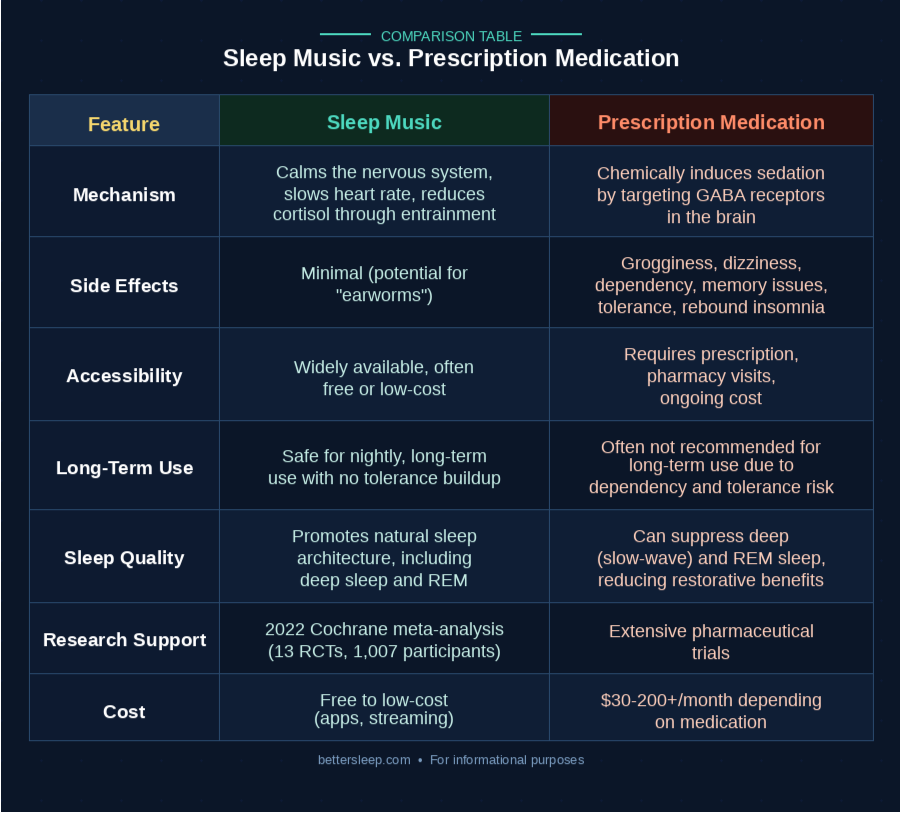
A 2023 randomized controlled trial, the MUSTAFI study, specifically examined music for people with depression-related insomnia and found that music was a safe and moderately effective intervention, with sustained benefits even after the music intervention was discontinued. This suggests that music may help retrain your brain's sleep patterns rather than simply masking the problem.
While music can be a powerful tool, it is important to have realistic expectations, especially if you are dealing with chronic insomnia or anxiety. Music is excellent for mild to moderate sleep issues and for quieting a mind struggling with everyday stress. However, if you are dealing with severe anxiety, it is also worth exploring resources on how to sleep when anxious. For chronic or severe insomnia, it is always best to consult with a healthcare provider. Music can be a fantastic part of a comprehensive treatment plan, but it is not a replacement for medical care in those cases.
What Are the Most Common Mistakes When Using Music for Sleep?
While using music for sleep is straightforward, a few common pitfalls can undermine its effectiveness. Avoiding these mistakes will help you get the most out of your nightly listening routine.
Choosing Music with Lyrics. This is the single most common mistake. As discussed earlier, lyrics activate your brain's language centers, which is counterproductive to falling asleep. Even if the song feels "relaxing," your brain is still working to process the words. Stick to instrumental music for the best results.
Playing Music Too Loudly. The goal is to create a calming soundscape, not a concert. Loud music can be stimulating and may even damage your hearing over time, especially if you are using headphones. Keep the volume low and comfortable — it should be audible but not attention-grabbing.
Using a Playlist with Ads. Nothing shatters a peaceful pre-sleep state like a loud, jarring advertisement for car insurance. If you are using a free streaming service, the interruptions can completely negate the benefits of the music. Use a premium streaming service or an ad-free app like BetterSleep to ensure an uninterrupted listening experience.
Watching Music Videos or Using a Bright Screen. The blue light emitted from your phone or TV screen suppresses the production of melatonin, the hormone that signals to your body that it is time to sleep. Start your playlist and then put your phone face-down or use a screen-free listening method. Avoid video platforms unless you can listen with the screen off.
Not Using a Sleep Timer. Letting music play all night can disrupt your sleep during the lighter stages in the second half of the night. Set a timer for 30-60 minutes so the music fades out after you have fallen asleep. The BetterSleep app makes this easy with its built-in timer.
Giving Up Too Quickly. Like any new habit, it may take a few nights for your brain and body to adapt. If one type of music does not work, try another. Experiment with different genres, tempos, and playlists until you find what is most relaxing for you. Some people also find success with alternative techniques like the military sleep method in combination with music.
Choosing Unfamiliar, Complex Music. While exploring new music is great during the day, bedtime is not the time for discovery. New, complex, or surprising music can stimulate your brain as it tries to process unfamiliar patterns. Save the musical exploration for daytime and stick to familiar, predictable tracks at night.
Who Should Consider Special Approaches to Sleep Music?
While the general principles of sleep music apply to most people, there are a few special considerations for different age groups and situations that are worth understanding.
Older Adults. Research has shown that music is particularly effective for improving sleep in older adults, who often experience age-related changes in sleep architecture. A 2025 meta-analysis published in PLoS ONE confirmed that music therapy improves sleep quality in the elderly, with significant effects observed across multiple studies. Additionally, a 2024 study found that binaural beat music improved sleep quality in older adults while also positively affecting heart rate variability and reducing symptoms of depression. For older adults who may be taking multiple medications, music offers a particularly attractive option because it has no drug interactions and no risk of polypharmacy complications.
Hospitalized Patients. The unfamiliar and often noisy environment of a hospital can make sleep incredibly difficult, which in turn can slow recovery. A 2023 systematic review and meta-analysis found that for hospitalized patients, music benefited them by significantly improving sleep quality compared to standard care, with a large effect size (SMD 1.55). This suggests that hospitals should consider incorporating music into their patient care protocols.
Depression-Related Insomnia. For individuals whose sleep problems are linked to depression, music can be a safe and effective complementary aid. The 2023 MUSTAFI randomized controlled trial on depression-related insomnia found that a music intervention was moderately effective for improving sleep, with the added benefit that improvements were sustained even after the music intervention was discontinued. This is particularly encouraging because it suggests music may help break the cycle of depression and insomnia rather than just providing temporary relief.
Sleep Music for Adults vs. Children. While this guide focuses primarily on adults, it is worth noting that the principles of sleep music apply across age groups. For adults specifically, the key difference is that you have more control over your sleep environment and can make deliberate choices about tempo, genre, and duration. The BetterSleep app offers content specifically designed for sleep music for adults, taking into account the unique stressors and sleep challenges that adults face.
Frequently Asked Questions About Music for Sleep
1. What type of music is best for sleep? Instrumental music with a slow tempo of 60-80 BPM is best for sleep. Genres like classical, ambient, meditation, and piano music are scientifically shown to be effective. The key is to avoid lyrics and sudden changes in volume or rhythm. Some people also find that specific Solfeggio frequencies, such as the 528 Hz tone, enhance relaxation. A 2025 review of 21 studies confirmed that these characteristics consistently promote better sleep quality.
2. Is it OK to listen to music while sleeping all night? While it is generally safe, most experts recommend using a sleep timer to turn the music off after 30-60 minutes. This prevents it from potentially disrupting your natural sleep cycles during the lighter stages of sleep in the second half of the night. The BetterSleep app has a feature that allows the music to fade out gently at a time you set.
3. What BPM is best for sleep music? The ideal BPM for sleep music is between 60 and 80 beats per minute. This range mimics a relaxed heart rate and helps your body's internal rhythms slow down in preparation for sleep through a process called entrainment. Music at 60 BPM is particularly effective because it matches the lower end of a healthy resting heart rate.
4. Do binaural beats actually help you sleep? Yes, multiple studies from 2024 confirm they can be very effective. Binaural beats work by encouraging your brain to produce the brainwaves associated with deep sleep and relaxation (delta and theta waves). One study found they significantly improved sleep quality, while another showed they shortened the time to reach slow-wave sleep. Remember to use headphones for them to work.
5. Is classical music or ambient music better for sleep? Both are excellent choices, and the "better" one often comes down to personal preference. Classical music offers beautiful melodies and harmonies with a rich emotional quality, while ambient music provides a less structured, atmospheric soundscape that fades into the background. Try both to see which one you find more relaxing. You can even alternate between them on different nights.
6. Can music replace sleeping pills? For mild to moderate insomnia, research suggests music can be as effective as some prescription medications without the side effects. A UC Davis review found comparable effectiveness between music and Z-drugs. However, for chronic or severe insomnia, music should be considered a complementary therapy, not a replacement for medical advice. Always consult a doctor for persistent sleep problems.
7. Should I use headphones or speakers for sleep music? Both can be effective for most types of sleep music. Headphones are necessary for binaural beats (each ear needs a different frequency) and can help block out external noise. Speakers are a good option if you find headphones uncomfortable to sleep with. Sleep-specific headphones, such as thin headband-style models, offer a comfortable middle ground.
8. How long should I listen to music before falling asleep? Most studies suggest a listening duration of 30 to 45 minutes. This gives your body enough time to respond to the music and transition into a state of relaxation conducive to sleep. Some people prefer to listen for up to 60 minutes. The key is consistency — making music a regular part of your bedtime routine amplifies its effectiveness over time.
🌟 What Is Your Path to Better Sleep Through Music?
In the quest for a good night's sleep, music stands out as a uniquely powerful, pleasant, and science-backed solution. It is more than just a distraction; it is a tool that actively works with your body's natural rhythms to lower stress, calm your mind, and guide you gently into slumber. From the timeless compositions of classical masters to the modern soundscapes of ambient music and the targeted frequencies of binaural beats, there is a world of auditory experiences waiting to transform your nights.
The evidence is clear and compelling. A 2022 Cochrane meta-analysis of 13 trials, a 2025 narrative review of 21 studies, and numerous individual studies all point to the same conclusion: music is a safe, effective, and accessible tool for improving sleep quality. It works by engaging your parasympathetic nervous system, lowering cortisol, slowing your heart rate, and synchronizing your brainwaves with calming rhythms through the process of entrainment.
As Jesse Koskey, MD, puts it, "The gist is that there's no wrong way to try music as a sleep aid. And it's likely to help with mild sleep problems." The journey is one of experimentation — finding the tempos, genres, and sounds that resonate most deeply with you. By understanding the science of what makes sleep music effective and following the steps to build your own personalized playlist, you are empowering yourself to take control of your sleep health in a natural and sustainable way.
Ready to start your journey to better sleep tonight? Download the BetterSleep app for free and explore hundreds of hours of curated sleep music, binaural beats, guided meditations, and our powerful sound mixer. With a 4.7-star rating and over 388,000 reviews, millions of users have already discovered the profound impact of sound on their sleep. Your path to waking up refreshed and revitalized is just a playlist away.
📚 References
[1] Pan, Y., & Wang, Y. (2025). Elements of music that work to improve sleep, a narrative review. Frontiers in Sleep, 4, 1707162. https://pmc.ncbi.nlm.nih.gov/articles/PMC12713922/
[2] Jespersen, K. V., Koenig, J., Jennum, P., & Vuust, P. (2022). Listening to music for insomnia in adults. Cochrane Database of Systematic Reviews, (8). https://www.cochranelibrary.com/cdsr/doi/10.1002/14651858.CD010459.pub3/full
[3] Li, Y., et al. (2023). Effect of sleep ambient music on sleep quality and mental health in college students. Frontiers in Psychology, 14, 1171939. https://www.frontiersin.org/journals/psychology/articles/10.3389/fpsyg.2023.1171939/full
[4] Lee, S., et al. (2024). Effect of dynamic binaural beats on sleep quality: a proof-of-concept study. Sleep, 47(10), zsae097. https://pubmed.ncbi.nlm.nih.gov/38629490/
[5] Weiland, H., et al. (2024). Binaural beats at 0.25 Hz shorten the latency to slow-wave sleep. Scientific Reports, 14(1), 25489. https://www.nature.com/articles/s41598-024-76059-9
[6] Li, X., et al. (2025). Effect of music therapy on sleep quality in elderly: A systematic review and meta-analysis. PLoS ONE, 20(1), e0316955. https://pmc.ncbi.nlm.nih.gov/articles/PMC12585030/
[7] Jespersen, K. V., et al. (2023). The effect of music on sleep in hospitalized patients: systematic review and meta-analysis. Sleep Health, 9(4), 425-436. https://www.sciencedirect.com/science/article/pii/S2352721823000645
[8] Lund, H. N., et al. (2023). Music to improve sleep quality in adults with depression-related insomnia (MUSTAFI): randomized controlled trial. Nordic Journal of Psychiatry, 77(2), 188-197. https://pubmed.ncbi.nlm.nih.gov/35697087/
[9] Zhang, Y., et al. (2025). Meta-narrative review: the impact of music therapy on sleep and mental health. Frontiers in Psychiatry, 15, 1497553. https://pmc.ncbi.nlm.nih.gov/articles/PMC11746032/
[10] Lin, Y. C., et al. (2024). Examining the effects of binaural beat music on sleep quality, heart rate variability, and depression in older people. Geriatrics & Gerontology International, 24(5), 456-463. https://onlinelibrary.wiley.com/doi/abs/10.1111/ggi.14827
This article is for informational purposes only and does not constitute medical advice. If you are experiencing persistent sleep problems, please consult a qualified healthcare provider or sleep specialist. The BetterSleep app is not a medical device and is not intended to diagnose, treat, cure, or prevent any medical condition.