Sleep meditation: Beginner's Guide for Deep Sleep
To meditate for sleep, lie in bed and try a technique like mindful breathing (following each inhale and exhale), a body scan (releasing tension from head to toe), 4-7-8 breathing, or a guided sleep meditation to anchor your focus. Even 5–10 minutes of consistent practice calms your nervous system, quiets racing thoughts, and helps you fall asleep faster.
To meditate for sleep, lie in bed and try a technique like mindful breathing (following each inhale and exhale), a body scan (releasing tension from head to toe), 4-7-8 breathing, or a guided sleep meditation to anchor your focus. Even 5–10 minutes of consistent practice calms your nervous system, quiets racing thoughts, and helps you fall asleep faster.
It’s late, and you’ve done your best to set yourself up for sleep. You’re all snug in bed, the lights are off, your phone is (mostly) out of reach… yet somehow your mind refuses to settle down.
You keep replaying some troublesome conversation you had earlier in the day, rewrite tomorrow’s to-do list in your head, and keep finding yourself worrying about all sorts of things that are out of your control — all the while wishing your brain just had some kind of an “off” switch you could press that would finally let you get some real sleep.
Meanwhile, of course, your body is crying out for rest. 😴
If you’ve been living this experience for several days, weeks, or months in a row, you’re exhausted all the time. And the longer this genuinely worrisome condition continues, you only get that much more exhausted — and freaked out about what this lack of sleep is doing to you. You know you simply can’t let it go on much longer.
If this sounds familiar, rest assured you’re not alone. Racing thoughts, stress, and that wired-but-tired feeling are classic signs your nervous system is still running in daytime mode, even though everything around you says it should be winding down. In moments like these, most people start searching the internet for answers — “why can’t I sleep,” “how to fall asleep fast,” “how to quiet my mind.”
That’s often when they first stumble across the idea of sleep meditation, even if they’re not totally sure what it means or how to begin. For many, this is the moment they start wondering whether meditation for sleep could actually help them fall asleep faster — and what it looks like to meditate specifically for better sleep.
If you’re seeing those terms pop up in your own late-night searches, you might start wondering whether meditation to fall asleep is actually effective — and whether learning a simple sleep meditation could help calm your mind enough to finally drift off. The truth is, sleep meditation isn’t a quick fix, but it is a learnable skill that helps your mind and body shift into a calmer state so sleep can finally happen. In other words, it’s a scientifically proven sleep strategy that’s well worth looking into. You’re on the right track.
Many people are surprised to learn that even beginners benefit quickly once they understand how to meditate to fall asleep fast and use it consistently.
You see, instead of fighting with your thoughts when you’re trying to get to sleep, a consistent sleep meditation practice teaches your brain and body how to wind down at night. By slowing your breathing, softening your focus, and giving your mind a simple anchor — like the sensation of your breath or the steady sound of a meditation guide’s voice — you signal to your nervous system that it’s safe to shift out of “fight or flight” and into the rest-and-digest mode that lets you fall asleep faster and stay asleep longer.
This isn’t just feel-good “wellness” mumbo jumbo. In a randomized clinical trial of older adults who had moderate sleep disturbances, a mindfulness meditation program led to significant improvements in their sleep quality and daytime functioning compared with a standard sleep-education group. Other clinical studies have confirmed these findings. In other words, learning to meditate for sleep can genuinely change how you sleep—and how well you feel the next day.
As sleep scientist Dr. Matthew Walker, PhD, puts it:
“The best bridge between despair and hope is a good night’s sleep.”
This guide is designed to help you build that bridge. 🌉
Over the next sections, you’ll learn:
- The science of how meditation changes your brain and nervous system to improve sleep quality
- Exactly how to meditate for sleep, step-by-step, even if you’ve never meditated before
- Different types of sleep meditation—from body scan meditation and guided sleep meditations to Yoga Nidra and loving-kindness
- The real, measurable benefits of sleep meditation — from falling asleep faster to getting deeper, more restorative rest
Paired with the guided sleep meditations in the BetterSleep app, this article will show you how to turn meditation into a realistic, nightly habit, so you can stop dreading bedtime and start looking forward to consistent, truly restful sleep. 🌙
🧠 The Science Behind Meditation and Better Sleep
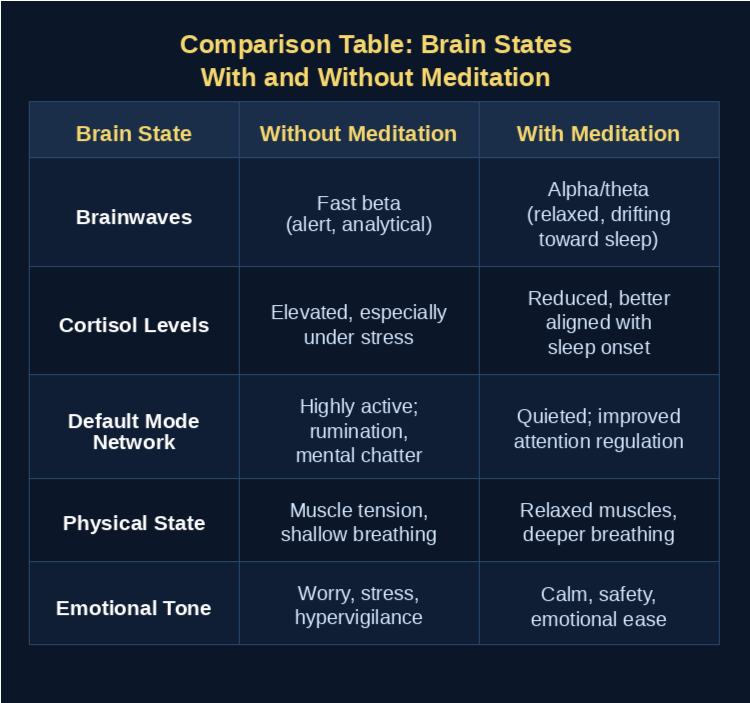
If you’ve ever wondered why meditation for sleep actually works, the answer comes down to this: your brain and body are wired to respond to certain cues. When those cues shift — from stress and stimulation toward calm and safety — your whole system starts shifting toward sleep. Meditation works with the body’s natural systems rather than working against them.
All of these physiological shifts explain why mindfulness meditation for sleep is one of the most reliable nighttime practices for calming both the mind and body.
Calming the Nervous System
On those nights when you’re lying in bed with racing thoughts or that all-too-familiar restless, jittery feeling in your chest, it’s because your sympathetic nervous system (SNS) — the part of your physiology responsible for vigilance, problem-solving, and reacting to stress — is still switched on. Sure, it’s great when you need to stay alert, but it’s definitely not the setting you want for bedtime.
Meditation helps shift control back to your parasympathetic nervous system (PNS) — the “rest and digest” branch that signals to your body that it’s safe to unwind. This is the same physiological shift that makes breathing meditation for sleep so effective, especially for people who struggle with nighttime stress or racing thoughts. Slow breathing, gentle focus, and mindful awareness all nudge your parasympathetic nervous system to take the lead; lowering your heart rate, easing muscle tension, and helping your body ease into sleep.
Many people find that even simple sleep meditation techniques — like slow breathing or a brief body scan — trigger this parasympathetic response within minutes.
A growing body of research shows that mindfulness practices improve overall sleep quality, partly by reducing physiological arousal and restoring a more stable sleep–wake rhythm.
Lowering Cortisol and Quieting Stress Cycles
Stress is one of the most common reasons people struggle with deep, restorative sleep. High cortisol levels, especially at night, delay sleep onset and reduce the time you spend in deep sleep. Meditation has been shown to lower cortisol, helping regulate the hormonal cycles that support healthy sleep–wake patterns.
This doesn’t happen because you “empty your mind.” What meditation really does is interrupt the stress loop: when your attention shifts away from worry, your body registers a lower sense of threat and your cortisol begins to settle. As that stress response quiets down, it gets easier for your system to move toward the kind of calm that supports sleep — even on nights when your mind feels way too busy.
This makes meditation one of the most accessible sleep relaxation techniques for people whose insomnia is closely tied to stress or emotional overload.
Shifting Brainwaves Toward Relaxation
During meditation, the brain naturally transitions from fast, analytical beta waves into slower alpha and theta waves, the very same frequencies that appear as you drift toward sleep. That shift is one reason why meditation works so well as a bridge between wakefulness and sleep.
- Alpha waves: relaxed wakefulness
- Theta waves: deep relaxation, light sleep, and the early stages of dreaming
This shift in brain activity helps you break out of that “stuck on alert” feeling that keeps so many people awake at night. It’s the reason many people turn to meditation for sleep, especially when their minds feel overstimulated or restless. It also explains why guided sleep meditation can be so effective — the gentle pacing and voice direction help your brain ease into the same relaxed rhythms that appear in the early stages of sleep.
Quieting the Default Mode Network (DMN)
The Default Mode Network is the part of your brain responsible for mental replay, memory loops, and imagining future scenarios. It’s basically the home of your “mind wandering.” When the DMN is running in overdrive, it keeps your mind circling the same thoughts. Mindfulness meditation has been shown to decrease DMN activity and increase the connectivity of brain regions that help you regulate attention and settle mental chatter.
And once your DMN quiets down, your internal noise level drops. It leaves you less caught up in your thoughts, so sleep becomes a more natural outcome. For many, this is the moment when meditation finally starts to feel like a practical tool for sleep rather than a concept — the mind quiets just enough to allow the body to settle.
Long-Term Brain Changes That Support Sleep
Regular meditation doesn’t just help you feel more at ease, it gradually changes how certain parts of your brain function and communicate with each other. Research has found increases in gray matter density in regions associated with emotional regulation, self-awareness, and stress control. These structural changes help you stay more balanced during the day, which, in turn, makes it easier for you to settle down at night.
This is one reason why meditation for sleep becomes more effective with consistency: the more you practice, the more responsive your mind becomes to calming cues.
Expert Insight
“Non-sleep deep rest is a powerful tool that allows you to control the relaxation state of your nervous system and your overall state of mind.”Dr. Andrew Huberman
This is precisely why practices like guided sleep meditation, breathing meditations, or body scans help you to fall asleep more easily; they shift your internal physiology into a state that welcomes rest.
BetterSleep Integration
You don’t have to track these changes manually. The BetterSleep app enables you to monitor your sleep patterns, sleep stages, and sleep score, so you can see how your meditation practice influences your sleep quality over time. Many users tell us they notice significant improvements after just a few weeks.
🌙How to Meditate for Sleep: A Beginner’s Guide
Meditation for sleep doesn’t require silence, perfection, or years of practice. It isn’t about “stopping your thoughts” or forcing your mind to behave. Instead, it’s simply a way of gently guiding your attention away from the noise of the day and into the calmer rhythms your body associates with rest. If you’ve been wondering how to meditate to fall asleep fast, these beginner-friendly steps will show you exactly how to shift your mind and body toward rest.
If you’ve ever wondered how to meditate to fall asleep fast, this next section breaks the process down step-by-step. Don’t be intimidated for even one minute; these techniques are approachable whether you’re brand new to meditation or you’ve tried before and felt like you “weren’t doing it right.”
The truth is, there is no single “right” way. There’s just showing up, again and again, until the practice feels more natural and sleep starts to follow—often sooner than you might expect. Think of this as a beginner sleep meditation approach you can return to every night, even if you’ve struggled with other meditation techniques for sleep in the past.
Step 1: Set Up Your Space 🛏️
You don’t need a dedicated meditation room or expensive equipment to start practicing this. A good sleep meditation practice starts with creating an environment that gently signals your system that the day is winding down.
For sleep meditation, your bedroom itself becomes your practice space.
To set yourself up to start meditating, these simple adjustments will make your environment more conducive to rest:
- Dim the lights or switch to a warm bedside lamp
- Put your devices on airplane mode or Do Not Disturb
- Reduce visual clutter wherever possible
- Adjust your blankets and pillows so your body feels supported
- Lower the room temperature a little bit; cooler rooms promote deeper sleep
A lot of people wonder whether practicing meditation for sleep should happen lying down in bed or sitting upright. For daytime meditation, sitting works well because the goal is usually alertness. But when it comes to nighttime meditation, sitting upright or lying down is your call to make, it’s optional. When your goal is to fall asleep, it’s perfectly fine — arguably even ideal — to meditate while lying in bed.
Many people find that learning how to meditate for sleep works best when their meditation posture matches their normal sleep routine.
BetterSleep Tip: Before starting your meditation, open the Breathing Exercises or Body Scan tracks in the BetterSleep app to help your mind settle into the space more easily.
Step 2: Find a Comfortable Position 😴
Traditional meditation often emphasizes posture, but sleep meditation is a different animal. The goal isn’t alert focus; it’s easing into a softer, more drowsy state.
These positions work well:
- Lying on your back (savasana) with your arms at your sides
- Lying on your side if that feels more natural
- Supported recline against a headboard if you prefer some elevation
Whichever position you choose, comfort matters more than form. Your body should feel relaxed enough that you could easily drift off without adjusting anything.
That said, if you tend to fall asleep too quickly during meditation and want to stay awake long enough to experience the full practice, a slightly upright position can help. But don’t overthink it. Again, there is no “wrong” posture here.
Step 3: Set a Gentle Intention 🌙
Intention-setting is a subtle step, but it’s a surprisingly effective one. It cues your mind that you’re transitioning from the activity of the day to the rest of the night.
A few soft examples:
- “I’m giving myself permission to rest now.”
- “I’m letting go of today.”
- “My body knows how to sleep.”
- “I’m shifting toward calm.”
This isn’t about convincing your mind of something. It’s more about offering it a direction. Your nervous system responds to simple, clear cues, even when they’re delivered softly.
Step 4: Focus on Your Breath 🌬️
Breath-focused meditation is at the heart of almost every effective sleep meditation practice out there. It anchors your attention and helps shift your body into the parasympathetic (rest and digest) state that makes falling asleep easier. This simple breathing-focused meditation to help you sleep fast is one of the most reliable ways to settle nighttime tension.
Here’s a simple, beginner-friendly way to practice:
- Close your eyes.
- Bring attention to your natural breathing — no need to deepen it yet.
- Notice where the breath feels most prominent: your chest, belly, nostrils, even the sound of your inhales and exhales.
- Gently follow your breath as it moves in and out of your body.
- If your mind wanders (and it probably will), gently guide your attention back to your breath without evaluating or criticizing yourself. It’s all just part of the process.
I often tell people to imagine meditation like training a puppy: the mind wanders, and you just keep guiding it back with patience. That gentle cycle of noticing and returning is the essence of mindfulness. It’s how you train your brain to let go instead of chasing every thought — one of the key skills that makes meditation so effective for sleep.
If you enjoy a bit more structure, try a simple 4–6 breathing pattern: inhale gently for a count of four, then exhale for a count of six. That slightly longer exhale nudges your heart rate downward and signals your body to relax.
BetterSleep Tip: In the BetterSleep app, the Evening Wind-Down and Deep Breathing sessions pair beautifully with this type of breathwork, especially when you’re trying to fall asleep fast.
Step 5: Let Go of Effort ✨
This is where sleep meditation diverges most from traditional mindfulness practices. Because:
You’re not trying to stay alert.You’re not trying to reach enlightenment.You’re not trying to achieve anything at all.
Instead, you're practicing allowing the mind and body to settle rather than forcing yourself to fall asleep or stay in perfect focus.
As you’ve probably experienced yourself, the paradox of sleep is that the harder you try to fall asleep, the more alert you typically become. Sleep is a biological process, not a performance, and meditation helps you step out of the way so your body can do what it’s wired to do.
As Jon Kabat-Zinn, PhD, puts it:
“Letting go is not such a foreign experience. We do it every night when we go to sleep. If you can’t let go, you can’t go to sleep.”
That’s the mechanism behind why sleep meditation helps so many people fall asleep more easily. With time, this becomes the foundation of a calming sleep meditation routine you can rely on night after night.
How Long Should You Meditate for Sleep? ⏱️
You don’t need long sessions to see real benefits. Short guided meditation for sleep sessions are especially helpful if your mind tends to stay active at night.
Research on mindfulness meditation for chronic insomnia shows that even short sessions can lead to meaningful improvements in sleep quality.
- Beginners: Start with 5–10 minutes
- Intermediate: 15–20 minutes
- If you enjoy longer practices: 30–45 minutes (especially for guided sleep meditation or Yoga Nidra)
Just keep in mind that consistency matters far more than duration. Meditating for 7 minutes every night will support your sleep much more effectively than doing 40 minutes once a week.
Creating a Bedtime Meditation Routine 🌟
Meditation becomes significantly more effective when paired with a consistent nighttime rhythm. Following a consistent, predictable routine helps regulate your circadian system and primes your mind for deeper rest.
Here’s a simple, realistic sequence:
- Lower the lights
- Put your phone on airplane mode or Do Not Disturb
- Do 1 minute of slow breathing
- Choose your meditation for sleep (guided meditation, body scan meditation, or mindful breathing)
- Practice without worrying about the outcome
- Let sleep come naturally
With repetition, this routine becomes a cue: “It’s bedtime.” Your nervous system then responds by relaxing more quickly, helping you fall asleep faster.
BetterSleep Tip: Inside the BetterSleep app, you can build a custom nighttime playlist. For example, Breathing → Body Scan → Gentle Ambient Sounds — so your whole wind-down unfolds without interruption.
Why This Approach Works
This step-by-step method aligns with what we know about sleep science:
- Breathing reduces physiological arousal
- Mindfulness reduces racing thoughts
- Body awareness quiets the Default Mode Network
- Consistency trains the brain to shift into relaxation more easily
- A calm nervous system increases the likelihood of deep sleep
It’s why many people who incorporate sleep meditation into their bedtime routine report not just falling asleep faster, but also waking up with more energy and experiencing fewer nighttime awakenings.
BetterSleep Integration 🌙
If you’re unsure where to begin, the BetterSleep app offers beginner-friendly guided meditations, body scans designed for deep rest, visualization practices, breathing exercises that help lower heart rate, and full Yoga Nidra sessions for profound relaxation.
Each of these practices removes the guesswork; you simply press play, follow the voice, and let the experience unfold while your body naturally settles.
🧘♀️ Types of Meditation for Sleep
There’s no single “best” meditation for sleep. Different practices work in different ways; some calm the body, some settle the mind, some help untangle stress, and others gently guide you into the drifting, spacious state that naturally leads to sleep. Think of these techniques as different ways to approach the same goal: easing your mind and body into a state where sleep comes naturally. These meditation techniques for sleep all work in slightly different ways, and experimenting with them is often the best way to discover which meditation helps you fall asleep fast and stay asleep longer.
Below, you’ll find a comprehensive guide to the most effective forms of sleep meditation. Each one includes a clear description, how to practice it, and the type of sleeper it tends to help the most.
Mindful Breathing Meditation
Mindful breathing is the foundation of nearly every form of meditation for sleep. It’s simple, quiet, and accessible, even on nights when your thoughts feel chaotic or your body won’t settle.
At its core, mindful breathing is all about paying attention, noticing the sensation of your breath moving in and out of your lungs without trying to change it. When you anchor your attention this way, your nervous system begins to shift: your heart rate slows, your muscles release, and your body naturally starts preparing for rest.
Mindful breathing is also considered one of the best meditation techniques for deep sleep because it settles both the body and the mind without effort.
How to practice:
- Lie down comfortably on your bed. Try to keep your spine straight, but if you need a pillow to help cushion your neck, use one, as it’s important for you to be as comfortable as possible.
- Close your eyes and bring awareness to the natural rise and fall of your chest and/or belly.
- Notice the temperature of the air as you inhale and exhale.
- When your mind wanders (as it’s naturally inclined to do), gently guide your attention back to your breath.
- Continue for 5–10 minutes or until you start to feel sleepy
I like to tell people to think of meditation like training a puppy: the mind wanders, and you repeatedly, but kindly, redirect it. This gentle returning to your “anchor” is the heart of mindfulness meditation and one of the reasons why it works so well for sleep.
People often underestimate how much something this simple can help them. But remember, breathing is a direct line to your parasympathetic nervous system (PNS) — the system that tells your body, “Okay, you’re safe. You can rest now.”
Best for: Beginners, people dealing with stress or racing thoughts, anyone who needs a straightforward introduction to sleep meditation.
BetterSleep Tip: Try the Deep Breathing or Evening Wind-Down sessions in the BetterSleep app for a guided version of this practice.
Body Scan Meditation
Many people first hear about this practice while searching “what is a body scan meditation for sleep?”—and the answer is beautifully simple: it’s a way of gently moving your awareness through the body to release tension and prepare for deep rest.
Body scan meditation is one of the most effective techniques for releasing the physical tension that’s messing with your ability to sleep. If you tend to carry stress in your shoulders, clench your jaw at night, or wake up feeling physically tight, this method should make a real difference in how your body feels come bedtime.
A body scan gently moves your attention through the body, one area at a time, noticing any sensations you feel without judgment. Paying attention in this way quiets the brain regions associated with worry and activates those involved in sensory awareness and calm.
How to practice:
- Start at the top of your head or the tips of your toes.
- Slowly shift attention through each region of the body: forehead, eyes, jaw, neck, shoulders, arms, hands, chest, belly, hips, legs, ankle joints, all the way down to your feet and toes.
- Simply notice sensations — warmth, heaviness, tingling, even discomfort — without trying to change anything.
- If you find tension, breathe into that area and soften your attention.
- Move through the scan at whatever pace feels most natural to you — there’s no need to rush.
As Dr. Judson Brewer, MD, PhD, describes it:
“Body scan meditation is like giving your nervous system permission to power down, one muscle group at a time.”
That’s why many people fall asleep before finishing the entire scan. This makes body scan meditation one of the most reliable sleep meditation practices for people who carry physical or emotional stress into bedtime.
Research on mindfulness-based stress reduction has consistently shown meaningful improvements in sleep disturbance, which helps explain why body-focused practices are so effective at bedtime.
Best for: People with high physical tension, restless leg sensations, or those who wake up feeling muscular tightness.
BetterSleep Tip: If you’re new to body scanning, try a shorter track first (5 or 10 minutes) so you can ease into the rhythm of the practice. Many BetterSleep users tell us the gentle pacing of these tracks helps them drift off naturally before the scan even ends.
Guided Sleep Meditation
A guided sleep meditation is one of the easiest ways to begin meditating for sleep because you don’t have to think about “what to do.” A soothing voice walks you through the process — helping you slow your breath, release tension, visualize calming scenes, or simply unwind from the day.
A guided sleep meditation can last anywhere from 5 minutes to an hour. A lot of people find that having a voice to follow keeps their attention steady and prevents them from getting pulled back into looping or repetitive thoughts. Among all meditation techniques for sleep, guided sleep meditation is often the most approachable because it removes the pressure to stay focused on your own.
How to practice:
- Put your device on airplane mode.
- Select a guided sleep meditation (BetterSleep’s library has dozens of them).
- Press play, lie down, and let the guide take you through each step.
- If you fall asleep before the meditation ends… then congrats, that’s the intended outcome.
Best for: Beginners, anyone who struggles to meditate on their own, or people whose minds tend to wander without structure.
BetterSleep Tip: Inside the BetterSleep app, look for “Guided Meditation for Deep Sleep” or the “10-Minute Wind-Down.” You’ll find both under the Meditation tab, and they’re two of the most popular options for falling asleep quickly.
Loving-Kindness (Metta) Meditation
Loving-kindness meditation (Metta) might not sound like a sleep practice at first, but it’s actually super effective for quieting emotional tension; something that often keeps people awake. The Metta meditation focuses on cultivating warmth, compassion, and gentleness toward yourself and others. All good things, in anyone’s book.
As you might know from experience, at night, unresolved frustration, worry, or self-criticism keeps your nervous system activated and wired. Metta helps to soften those edges.
Loving-kindness may not immediately sound like a sleep meditation, but it’s remarkably effective at easing emotional tension—the kind that keeps people awake long past bedtime.
How to practice:
- Lie down and take a few slow breaths.
- Silently repeat a few simple phrases, either toward yourself or others:
- “May I be safe.”
- “May I be peaceful.”
- “May I sleep easily.”
- “May I let go of today.”
- If you’re directing the phrases toward others, still leave it simple: “May you be peaceful,” “May you rest well, etc..”
Sharon Salzberg, the renowned meditation teacher and co-founder of the Insight Meditation Society, notes:
“Loving-kindness meditation shifts us out of the stress response and into a state of warmth and connection.”
This kind of emotional softening makes it much easier to drift toward sleep, especially on nights when your mind is all stirred up. For many people, Metta becomes a nightly meditation for sleep because it softens the emotional residue of the day.
Best for: People suffering anxiety, emotional rumination, or tension rooted in the events of the day.
BetterSleep Tip: Search “Loving-Kindness for Sleep” in the BetterSleep app for a guided version of this practice, voiced gently to help ease any disruptive nighttime tension.
Progressive Muscle Relaxation (PMR)
PMR is a classic relaxation technique regularly used in sleep therapy. It involves systematically tensing and releasing different muscle groups, creating a wave of relaxation throughout your body. It’s not only a pleasant feeling, but the physical contrast helps you notice where tension is hiding inside you and teaches your muscles to “let go” of it more deeply.
How to practice PMR:
- Start with your hands by gently clenching your fists for 5 seconds, then release.
- Move to your arms, shoulders, face, chest, abdomen, legs, and feet.
- With every release, you’ll feel the heaviness and warmth of relaxation.
PMR helps lower the background tension that keeps your body feeling restless or on-edge at night. As a relaxation technique for sleep, progressive muscle relaxation helps create the physical heaviness and warmth that naturally leads the body toward deeper rest.
Best for: People who feel mentally overloaded, those with high muscle tension, or anyone who feels physically wound-up at bedtime.
BetterSleep Tip: Try BetterSleep’s Progressive Muscle Relaxation track in the app for a structured guide you can follow without counting or needing to think much.
Yoga Nidra (NSDR – Non-Sleep Deep Rest)
Yoga Nidra (frequently called “yogic sleep”) is a powerful meditation technique that guides you into a state between wakefulness and deep rest. It’s similar to NSDR (non-sleep deep rest), a term popularized in neuroscience to describe states of profound relaxation that restore the mind and body.
During Yoga Nidra, you typically lie down while a guide takes you through a sequence of awareness and imagery exercises. Some people describe feeling unusually heavy, deeply relaxed, or as if they’re gently drifting — all signs the nervous system is settling toward sleep.
Because Yoga Nidra guides you into a state close to early sleep stages, many people consider it the best meditation for deep sleep, especially when their mind feels too active for traditional methods. Some even compare the experience to a gentle form of sleep hypnosis because it softens mental resistance while keeping you relaxed and aware.
How to practice:
- Lie comfortably on your back.
- Listen to a Yoga Nidra or NSDR recording.
- Your only job is to follow along as the guide leads you through body awareness, gentle breathing, and simple visualization.
- Simply let your mind drift without trying to monitor or control the experience..
Dr. Andrew Huberman, PhD, notes:
“NSDR and yoga nidra allow you to reach a state of deep relaxation while remaining awake and can be used to compensate for lost sleep.”
Yoga Nidra is especially useful when your sleep has been thrown off for several days because it brings your body into a state very close to early sleep stages, even if you stay half-awake. This helps reset your system and reduces that all-too-familiar “wired but tired” feeling.
Best for: People who are seeking deep restoration, those who respond well to guided practices, or anyone who struggles with relentless chronic stress or nighttime alertness.
BetterSleep Tip: In the app, look for the “Yoga Nidra Journey” sessions under the Meditation tab. These longer tracks (20–45 minutes) are particularly helpful on nights when your body is tired but your mind refuses to settle.
Visualization / Guided Imagery
Visualization uses mental imagery to create a calming, immersive scene that gently distracts your mind from intrusive thoughts. A lot of people find visualization more intuitive than breathwork because the human mind naturally gravitates toward imagery and storytelling.
Common imagery people employ for this practice include secluded beaches, lush green forests, soft rain, warm candlelight, or floating like a leaf on a calm lake or river on a beautiful summer day. The key here is vividness. Imagine the sounds, colors, textures, and emotional tone of the place you’re visiting in your mind. Visualization works as a natural sleep meditation because it gives the mind something soft and pleasant to rest on, reducing the mental noise that delays sleep.
How to practice:
- Close your eyes and pick a setting that feels peaceful to you
- Imagine this place with as much sensory detail as possible: the temperature, the smell of the air, the way the light moves, the sounds.
- If your mind wanders, don’t be self-critical. It’s common and perfectly natural. Just gently return to the scene.
Best for: Visual thinkers, people who enjoy storytelling, or anyone whose mind needs something engaging yet calming to focus on before bed.
BetterSleep Tip: Pair your visualization with a Sleep Story inside the BetterSleep app. The gentle narration and ambient sounds create a vivid mental environment that helps your mind drift without effort.
Sleep Stories
So, what is a ‘sleep story’, you ask? Sleep stories blend the charm of bedtime storytelling with the calming cadence of guided meditation. They’re designed to be engaging enough to hold your attention, but gentle enough to allow your mind to drift.
Unlike audiobooks, sleep stories avoid strong emotional arcs or cliffhangers. Instead, the pacing is slow, the imagery soft, and the narrator’s tone of voice helps your nervous system settle. Lots of people fall asleep long before the story ends.
How to practice:
- Choose a sleep story with a tone you enjoy — nature, travel, cozy nighttime scenes.
- Play it softly as you lie down.
- Let your mind follow the imagery without trying to stay awake.
Best for:People with racing thoughts, nighttime anxiety, or difficulty transitioning from thinking mode to resting mode.
BetterSleep Tip:Try The Distant Lighthouse or Moonlit Forest Walk — two of the app’s most popular sleep stories. Many people enjoy pairing sleep stories with calming sleep meditation music or a short guided meditation for sleep, creating a layered experience that helps the mind unwind more quickly.
🌟 Benefits of Sleep Meditation
Most people try sleep meditation because they want to fall asleep faster. And sure, that’s usually one of the first improvements people notice, but it’s far from the only one. A consistent meditation for sleep practice creates a cascade of benefits that touch nearly every part of your physical, mental, and emotional well-being.
Think of meditation as a structured way of relaxing that trains your brain and body to shift into calmer states more easily. The more often you practice, the more familiar that pathway becomes, and the more naturally your nights begin to change.
Sleep meditation works because it trains your nervous system to unwind more predictably, making it easier to fall asleep fast and stay asleep through the night. For people who’ve struggled with stress, anxiety, or racing thoughts at bedtime, meditation for sleep becomes a practical, repeatable technique that supports better sleep quality over time.
Here are a few of the benefits you can expect, both immediately and gradually over time.
You Fall Asleep Faster
Many people discover meditation at night precisely because they’re tired of tossing, turning, or replaying mental noise when all they want to do is get some much-needed rest.
Meditation shortens sleep onset latency (the time it takes to fall asleep) by calming the physiological and mental arousal that keeps you alert. Slow breathing reduces heart rate. Mindfulness reduces rumination. Body-based practices ease tension.
Together, these shifts send a clear signal to your nervous system: okay, it’s safe to let go now. This is one of the core reasons sleep meditation is so effective for those who want to fall asleep fast without relying on sleep medication.
People often report noticing this benefit within the first week, especially when they’re practicing guided sleep meditation or breathing techniques. Many ultimately land on guided meditation for sleep because it provides just enough structure to help quiet mental chatter without requiring effort or control.
Your Sleep Quality Improves
Of course, falling asleep is just one part of the equation. The type of sleep you get matters just as much.
Research on relaxation and mindfulness techniques shows improvements in:
- Deep sleep (NREM Stage 3) — the physically restorative stage
- REM sleep — which is critical for learning, mood regulation, and emotional processing
- Overall sleep continuity — fewer nighttime awakenings
Better sleep architecture leads to mornings that feel steadier and more energized, you no longer feel like you’re constantly dragging yourself through fog. This is why so many people searching for ways to improve sleep quality eventually turn to meditation for sleep — it supports both the depth and continuity of your rest.
A large, well-known meta-analysis by Goyal and colleagues on meditation programs found improvements in both psychological stress and overall well-being, including sleep-related outcomes. These gains only continue to build with a few weeks or months of consistent practice.
From a sleep science perspective, these improvements reflect the cumulative effect of relaxation therapy for sleep — which meditation embodies through mindfulness, breathwork, and guided awareness.
BetterSleep Tip: As you build a meditation routine, keep an eye on how your sleep stages shift over time. The BetterSleep sleep tracker will show you whether your deep sleep and REM periods are becoming longer or more stable. Many people are surprised to see real improvements within just a few weeks — a reassuring reminder that your practice is making a difference, even on days when it might not feel obvious.
Reduced Anxiety and Stress — Day and Night
Meditation is one of the most widely studied tools for reducing stress, anxiety, and physiological overactivation; all tightly linked to insomnia and restless nights.
Why does it work so well?
- It regulates the amygdala, the part of the brain responsible for processing threats.
- It lowers your cortisol levels, especially in the evening.
- It strengthens your prefrontal cortex, which helps you manage emotions and attention.
- It interrupts the “racing thoughts” cycle that keeps people awake at night.
This combination of emotional regulation and physiological calming is one reason mindfulness meditation is increasingly recommended as a natural way to improve sleep quality. In other words, meditation for sleep doesn’t just help you at bedtime, it helps your whole day feel more manageable, and by extension, makes your nights a lot more peaceful.
The meta-analysis by Goyal and colleagues referenced above also found that meditation programs produced moderate improvements in anxiety, making it a promising natural alternative or complement to traditional stress-management interventions.
BetterSleep Tip: Try pairing a short daytime mindfulness session with your nighttime routine. Many people find the combination dramatically improves both their overall stress levels and sleep quality.
Better Emotional Regulation
By practicing meditation regularly, you begin strengthening the brain circuits responsible for emotional balance. You’ll should soon notice that:
- You don’t get overwhelmed as quickly
- Your moods feel steadier
- Stressful situations feel less catastrophic
- Your recovery time after difficult moments is shorter
These changes occur partly because meditation activates networks involved in attention and executive function, helping you respond rather than react. Practiced over weeks and months, these skills translate into calmer evenings and smoother transitions into sleep.
This also reduces the likelihood of waking up in the middle of the night with a racing mind, one of the most common sleep complaints we hear at BetterSleep. These emotional benefits make sleep meditation especially helpful for people whose insomnia is tied to anxiety, stress, or nighttime overthinking.
Increased Self-Awareness and Insight
Meditation involves paying attention to the present moment without judgment. As you move along with your practice, this builds a kind of internal literacy. You start noticing your patterns more clearly, including the ones that disrupt your sleep.
For example:
- You may recognize which thoughts keep you mentally wired.
- You may identify emotional triggers that show up at night.
- You may notice physical tension you weren’t even aware of.
- You start to understand your stress–sleep cycle more clearly.
Greater self-awareness helps you make informed decisions about your sleep routine. It also supports long-term improvements in your mental health and sleep quality. It also makes your nightly meditation practice feel more intuitive, since you’ll begin choosing the type of sleep meditation — whether body scan meditation, mindful breathing, or guided meditation for sleep — that best matches your needs each night.
BetterSleep Tip: Try journaling for 1–2 minutes after your nightly meditation using the Sleep Notes feature in the app. Pretty soon you’ll start to see patterns that will help you refine your sleep meditation practice.
Reduced Reliance on Sleep Medication (for Some People)
Let’s be perfectly clear: meditation isn’t a replacement for medical guidance. But some people — with support from their healthcare provider — do find they can gradually reduce their sleep medication as meditation becomes part of their nightly routine.
Why?
Because meditation works on the root drivers of insomnia: hyperarousal, anxious thinking, rumination, and chronic stress. Instead of masking symptoms, it helps calm the systems that keep the brain wired at night.
If you’re using sleep medication, never make changes before speaking to your doctor. But know that meditation can be a supportive, non-pharmacological solution that complements your broader sleep plan. For some, meditation becomes a meaningful alternative to sleep medication because it improves sleep quality at the source rather than masking symptoms.
Long-Term Brain Health
Meditation is associated with several long-term cognitive benefits:
- Improved attention and focus
- Reduced age-related cognitive decline
- Stronger neural connections
- Increased gray matter density in areas tied to emotional regulation
Short bursts of meditation practice have been shown to improve attention and self-regulation — two skills that make it much easier to unwind at night and settle into deeper sleep.
Mindfulness practices have even been shown to calm inflammation in the body, something that often rises when people are stressed or sleep-deprived.
Fairly quickly, you should find your meditation practice becomes more than just a sleep tool, but a broad investment in your overall cognitive and emotional well-being. These long-term effects also make meditation for sleep appealing to people who want a sustainable, natural sleep meditation practice they can rely on as part of their nightly routine.
Benefits Timeline: What to Expect Over Time
While everyone progresses differently, most people who meditate for sleep notice a gradual shift not only in how quickly they fall asleep but in the overall quality of their sleep meditation routine.
Below is a simple, realistic timeline to show how meditation for sleep typically unfolds.
Timeframe
What You May Notice
1 Week
Falling asleep faster, reduced mental clutter, feeling more relaxed at bedtime
1 Month
Improved sleep quality, fewer nighttime awakenings, lower overall stress levels
3 Months
Better emotional balance, improved resilience to stress, more consistent sleep patterns
6 Months
Long-term cognitive benefits, deeper and more restorative sleep, a sense that meditation has become a natural part of your nightly routine
These patterns mirror what researchers see when studying meditation for sleep: improvements tend to build steadily as the nervous system becomes more familiar with calming cues. Everyone’s timeline differs, but these patterns are common across studies and personal reports.
BetterSleep Integration
Many BetterSleep users report significant improvements after combining nightly meditation with:
- Breathing exercises
- Body scan meditations
- Sleep stories
- Progressive muscle relaxation
- Yoga Nidra or NSDR sessions
Together, these practices help bridge the gap between day and night, making it easier to unwind, let go of stress, and experience truly restorative sleep.
Using the BetterSleep app also helps you experiment with different types of meditation for sleep — such as guided sleep meditation, sleep hypnosis–style tracks, or calming breathing exercises — so you can find the approach that helps you fall asleep fast and sleep more deeply.
❓ Frequently Asked Questions About Sleep Meditation
Even with a solid understanding of sleep meditation, people still have practical questions, especially when they’re just getting started. So let’s walk through a few of the most common questions we hear from people.
What’s the best position for sleep meditation?
The best position is whichever one that allows your body to fully relax. For most people, that means lying down in bed, the same position you normally sleep in. You can lie on your back with your arms at your sides, rest on your side in a curled position, or use pillows to support your knees or lower back.
If you find you tend to drift off before the meditation even begins, try propping yourself up slightly or meditating while sitting back against your headboard. But in general, sleep meditation works beautifully when done lying down. After all, the intention is to gently transition into sleep. Many beginners who want to fall asleep fast find that meditating in their natural sleep position helps the body associate meditation with sleep more quickly.
How long should I meditate for sleep?
There’s no ideal length of time that works for everyone. If you’re new to meditation, even 5–10 minutes should make a noticeable difference. As you get more comfortable, you might extend that to 15–20 minutes, or choose a guided meditation that lasts 30 minutes or more.
The real key here is consistency. A few minutes each night will help your mind and body develop a rhythm, one that tells your nervous system, “Okay, nervous system, we’re shifting toward rest now.” Some people fall asleep halfway through their meditation, and of course that’s perfectly fine. This is the objective, after all. If you’re using meditation for sleep as part of your nightly bedtime routine, choosing a consistent meditation duration — even a short one — can help improve sleep quality over time.
Is it okay to fall asleep during sleep meditation?
Yes, of course. It’s more than just okay, it’s expected. The whole idea of sleep meditation isn’t to keep you alert; but to guide you toward sleep. Lots of people never make it to the end of their chosen track, especially with guided meditations and body scans.
If you’re using meditation primarily as a tool to fall asleep faster, drifting off during the practice is actually the sign that it’s working. Well done!
Many guided meditations for sleep are intentionally designed so you drift off naturally, making them a great choice for people who struggle with racing thoughts at bedtime.
What if my mind keeps wandering?
Everyone’s mind wanders, even people who’ve been meditating for decades. It’s not a failure, it’s simply a part of the practice.
Whenever you notice your thoughts drifting, just gently bring your attention back to your breath or the sound of the guide’s voice. This soft redirection activates the parts of your brain involved in attention and emotional regulation. With regular practice, those wandering thoughts usually start to feel less gripping, and your mind learns to settle more easily. This is one of the reasons mindfulness meditation is so effective for sleep: it strengthens your ability to redirect attention gently, even on nights when your mind wanders more than usual.
BetterSleep Tip: The Quick Meditations in the BetterSleep app are great for people who get frustrated by wandering thoughts.They're short, structured, and easy to return to.
Can I listen to a sleep meditation all night?
You can, but most people don’t need to. Many guided sleep meditations taper off naturally or eventually fade into calming background sounds. This allows your brain to shift from structured guidance into the deeper, less conscious stages of sleep.
If you prefer having continuous sound — especially if you tend to wake easily — choose a meditation that transitions to gentle ambient noise or white noise. This gives you the comfort of sound without overstimulating your brain. Some people treat this as a form of sleep hypnosis or relaxation therapy for sleep, using sound to keep the mind from drifting into stressful thought patterns.
What’s the difference between sleep meditation and just relaxing?
Relaxation is obviously wonderful, but it’s not quite the same thing as meditation. Sleep meditation is a structured practice that trains your attention, regulates your breath, and calms your nervous system through intentional awareness. It teaches you how to shift your internal state, which leads to more consistent improvements in sleep quality.
Sure, relaxation should help you in the moment. Meditation helps you long-term.Think of meditation for sleep as a structured practice that trains your attention, while simple relaxation is more of a temporary easing of tension.
Think of it this way: Relaxation is like taking a short walk, whereas meditation is like gradually strengthening the muscles that help you to walk with ease.
How long does it take for sleep meditation to work?
It typically depends on your baseline stress levels, sleep habits, and how often you meditate. Some people notice benefits within the first few nights, they fall asleep faster and/or wake up in the middle of the night less often. For others, the changes happen more gradually.
Many studies suggest that consistent practice for 4–6 weeks leads to meaningful improvements in sleep quality. So, it’s probably best to think of your meditation practice as training your system to relax. The more often you practice, the easier it becomes for your body to shift into sleep mode. The effects compound with time. Most people who commit to a nightly meditation for sleep routine notice they fall asleep faster and experience better sleep quality by the end of the first month.
Can I do sleep meditation if I wake up in the middle of the night?
Absolutely. In fact, a short practice can be especially helpful when you wake at 2 or 3 AM and can’t get back to sleep. A brief body scan, a breathing meditation, or a 5-minute grounding exercise will help calm your nervous system and interrupt the mental loops that are contributing to keeping you awake.
This is also a moment when many people benefit from pain modulation and relaxation techniques. A short body scan meditation or guided meditation for sleep can help interrupt nighttime rumination and guide the nervous system back toward deeper rest. Research shows that mindfulness practices influence the brain regions involved in processing discomfort and tension — one reason why meditation makes it easier to settle back into sleep when you wake unexpectedly.
BetterSleep Tip: Keep your phone on airplane mode beside your bed with a short meditation queued up. Many users find that a quick guided meditation for sleep helps calm racing thoughts in the middle of the night without fully waking the mind.
When you’re ready to begin, simply open the BetterSleep track and let it ease you back toward rest.
🌙 Conclusion: Your Journey Toward Restful Sleep Starts Here
🌙 Conclusion: Your Journey Toward Restful Sleep Starts Here
By now, you’ve learned how meditation for sleep helps your mind and body shift into the calmer states they’re naturally designed for. You’ve explored the science behind these practices, how different techniques support different kinds of sleepers, and why a simple nightly routine can completely change your relationship with bedtime.
Most importantly, you’ve seen that meditation is a skill — one that becomes stronger with patience, gentle consistency, and a willingness to pause at the end of the day. With regular sleep meditation, these calming cues start to feel familiar, and your nights gradually become steadier and more restorative.
You don’t need perfect focus, special equipment, or years of experience. Even a few minutes of simple mindfulness and intentional relaxation can help calm your mind and guide your body toward rest. And over time, these small moments add up, making bedtime feel less like a struggle and more like a transition you actually look forward to.
As meditation teacher Sharon Salzberg reminds us: “You don’t have to be a monk or live in an ashram to benefit from meditation. Even a few minutes of practice can make a significant difference in how you feel and how you sleep.”
When you’re ready to put this into practice, the BetterSleep app offers everything you need to begin — guided sleep meditations, body scans, breathing exercises, Yoga Nidra sessions, and soothing sleep stories. Whether you have five minutes or fifty, there’s a practice waiting to help you unwind, calm your mind, and ease into the kind of sleep your body has been craving.
Your journey can begin tonight.Just open the app, press play, take a breath, and give yourself permission to rest.
Citations
- Rusch, H. L., Rosario, M., Levison, L. M., Livingston, W. S., Wu, M., Gill, J. M. (2019). The effect of mindfulness meditation on sleep quality: a systematic review and meta-analysis of randomized controlled trials. Annals of the New York Academy of Sciences. https://pubmed.ncbi.nlm.nih.gov/30575050/
- Black, D. S., O’Reilly, G. A., Olmstead, R., Breen, E. C., Irwin, M. R. (2015). Mindfulness meditation and improvement in sleep quality and daytime impairment among older adults with sleep disturbances: a randomized clinical trial. JAMA Internal Medicine, 175(4), 494–501. https://jamanetwork.com/journals/jamainternalmedicine/fullarticle/2110998
- Goyal, M., Singh, S., Sibinga, E. M., Gould, N. F., Rowland-Seymour, A., Sharma, R., … Haythornthwaite, J. A. (2014). Meditation programs for psychological stress and well-being: a systematic review and meta-analysis. JAMA Internal Medicine. https://jamanetwork.com/journals/jamainternalmedicine/fullarticle/1809754
- Winbush, N. Y., Gross, C. R., Kreitzer, M. J. (2007). The effects of mindfulness-based stress reduction on sleep disturbance: a systematic review. Journal of Psychosomatic Research, 64(4), 425–434. https://pmc.ncbi.nlm.nih.gov/articles/PMC4153063/
- Wang, Y., Zheng, L., Yu, H., Chen, W., Bai, Y. (2019). Mindfulness-based stress reduction for insomnia: a meta-analysis of randomized controlled trials. Annals of the New York Academy of Sciences. https://nyaspubs.onlinelibrary.wiley.com/doi/abs/10.1111/nyas.13996
- Brand, S., Holsboer-Trachsler, E., Naranjo, J. R., Schmidt, S. (2012). Influence of Mindfulness Practice on Cortisol and Sleep in Long-Term and Short-Term Meditators. Neuropsychobiology, 65(3), 109–118. https://karger.com/nps/article-abstract/65/3/109/233511
- Creswell, J. D., Irwin, M. R., Burklund, L. J., Lieberman, M. D., Arevalo, J. M., Ma, J., … Cole, S. W. (2012). Mindfulness-Based Stress Reduction training reduces loneliness and pro-inflammatory gene expression in older adults. Proceedings of the National Academy of Sciences (PNAS), 109(8), 129–133. https://www.pnas.org/doi/10.1073/pnas.1112029108
- Davidson, R. J., Kabat-Zinn, J., Schumacher, J., Rosenkranz, M., Muller, D., Santorelli, S. F., … Sheridan, J. F. (2003). Alterations in brain and immune function produced by mindfulness meditation. Psychosomatic Medicine, 65(4), 564–570. https://pmc.ncbi.nlm.nih.gov/articles/PMC3004979/
- Liu, Z., Li, X., Zhang, D., Xu, Y., Lin, S., Qiu, S. (2023). Effects of mindfulness-based interventions on sleep in adults: A systematic review and meta-analysis. Sleep Medicine Reviews. https://pubmed.ncbi.nlm.nih.gov/37474050/
- Ong, J. C., Shapiro, S. L., Manoach, D., Cole, D. C., Kothare, S. V., Wyatt, J. K. (2014). Mindfulness meditation and CBT-I: A randomized controlled trial of mindfulness-based therapy for insomnia. Sleep, 37(9), 1553–1563. https://academic.oup.com/sleep/article-abstract/37/9/1553/2416992
- Holzel, B. K., Carmody, J., Vangel, M., Congleton, C., Yerramsetti, S. M., Gard, T., Lazar, S. W. (2011). Mindfulness practice leads to increases in regional brain gray matter density. PNAS, 108(32), 13618–13623. https://www.pnas.org/doi/10.1073/pnas.0707678104
- Gallegos, A. M., Crean, H. F., Pigeon, W. R., Heffner, K. (2013). Meditation and exercise for depressive symptoms and sleep disturbances in adults: A randomized controlled trial. Brain, Behavior, and Immunity, 29, 174–184. https://www.sciencedirect.com/science/article/abs/pii/S0889159112001894
- Goyal, M., et al. (2014). Meditation programs for psychological stress and well-being: a systematic review and meta-analysis. JAMA Internal Medicine. https://pubmed.ncbi.nlm.nih.gov/24395196/ (Same study as #3, but you provided both links.)
- Gao, C., Zhang, L., Qi, S., Calhoun, V. D., Sui, J. (2011). Mindfulness meditation improves emotion regulation via changes in brain functional connectivity. Journal of Neuroscience, 31(14), 5540–5548. https://www.jneurosci.org/content/31/14/5540