Breathing Techniques for Anxiety and Sleep: A Guide
Breathing techniques are a powerful tool for managing anxiety and improving sleep because they directly influence the autonomic nervous system. By consciously slowing your breath and extending your exhales, you stimulate the vagus nerve, which activates the parasympathetic ("rest-and-digest") system. This sends a powerful signal to your brain to reduce your heart rate, lower cortisol levels, and shift out of the anxious "fight-or-flight" state. This physiological shift is essential for calming a racing mind and allowing the body to transition into deep, restorative sleep.
Introduction
You probably know the feeling. Sure, your body is exhausted, but your mind doesn’t get the memo and refuses to let you sleep. So you lie there, snug under your blankets, yet somehow everything in your chest feels loud. Too loud. There’s that tight, restless pressure, your heart won’t slow down, and you know something is just… off. Even if you can’t quite pin down what it is.
But you do know one thing: if you don’t get a decent sleep again tonight, tomorrow is going to be rough. You’ve got deadlines, expectations, people counting on you — and you already know how much harder all of that feels when you’re running on empty.
Of course, this only makes you worry more. And the harder you try to tell yourself to calm down, the more awake you feel. You’re wired, but you feel strangely helpless to do anything about it. It’s an awful experience, and far more common than most people realize.
For some of us, this is the nightly reality of anxiety-related sleep difficulties. Anxiety doesn’t just live in your head, it shows up in the body too: shallow breathing, tight muscles, a pounding heart, that awful sense of being on alert even though you’re safe in your own bed. And with time, that constant hyperarousal throws your whole sleep cycle off, making it harder to fall asleep and breaking up whatever rest you do manage to get.
If this scenario feels all too familiar, don’t despair. You can beat this. Understand that you already carry one of the simplest, most powerful tools for calming your nervous system: your breath. Unlike heart rate or digestion, your breath is both automatic and voluntary, making it a natural bridge between your body and your brain. You can control it.
A strong body of research shows that deliberate, slow, diaphragmatic breathing reduces stress, improves mood, and lowers physiological arousal by shifting the nervous system away from fight-or-flight mode and back toward a calmer rest-and-digest state. The one that supports real, restorative sleep.
As Dr. Andrew Huberman, PhD, puts it: "Your breath is the remote control for your nervous system. By consciously changing the rhythm and depth of your breath, you can send a powerful signal to your brain to move from a state of stress to a state of calm."
This guide will walk you through what’s happening in your body when anxiety rears its ugly head, and exactly how to use breathing techniques to interrupt that spiral. By the end of this article, you’ll understand:
- The science of how breathing affects your brain, heart, and stress response
- Five foundational breathing techniques you can use anytime you feel anxious or overwhelmed
- Specific breathing practices for sleep that help quiet a racing mind at night
- How to practice diaphragmatic breathing correctly, step by step
- When more advanced methods like the Wim Hof technique might (or might not) be helpful
- How to build a simple daily breathwork routine that becomes automatic over time
You’ll also see how tools like the guided breathing exercises in the BetterSleep app can help you practice consistently and feel the benefits sooner. This isn’t magic. Rather, it’s a practical, science-backed way to reclaim a sense of calm and safety, one breath at a time.
🧬 The Science of Breath: How Your Lungs Control Your Brain
When anxiety is taking up too much space in your mind, breathing is one of the few ways you can talk back to it with your body. To understand why breathing techniques for anxiety are so effective, it helps to look at the system that runs quietly in the background all day: your autonomic nervous system.
🧠 The Autonomic Nervous System: Fight-or-Flight vs Rest-and-Digest
The autonomic nervous system (ANS) has two main branches:
- Sympathetic nervous system (SNS) (your fight-or-flight system)
- Speeds up your heart rate
- Increases your breathing rate
- Releases stress hormones like adrenaline and cortisol
- Primes your body to react to a threat
- Parasympathetic nervous system (PNS) (your rest-and-digest system)
- Slows down your heart rate
- Deepens and slows your breathing
- Promotes digestion, repair, and recovery
- Supports relaxation and sleep
When you’re suffering chronic stress or anxiety, your sympathetic system tends to stay “on” even if you’re not in any real danger. Your breathing becomes faster and shallower, your heart rate stays elevated, and it becomes that much harder for you to wind down at night.
Slow, deep breathing is one of the most direct ways to nudge your body back toward the parasympathetic, calming side of your nervous system. And research on slow, controlled breathing shows meaningful drops in stress, low mood, and physiological arousal. All things that tend to feed anxiety-related sleep issues.
🌬️ How Does Breathing Affect Anxiety?
The way you breathe sends constant feedback to your brain about whether you’re safe or in danger. Those signals shape how anxious or calm you feel at any given time.
- Fast, shallow, chest-based breathing is interpreted by your brain as a sign of threat or emergency.
- Slow, deep, diaphragmatic breathing is interpreted as a sign of safety.
When you’re anxious, you might not notice that your breath rate increases, your exhales get shorter, and you can start to over-breathe (taking in more air than your body actually requires). This lowers carbon dioxide (CO₂) levels in your blood, leading to symptoms like dizziness, tingling, and a feeling of being “spaced out”, which only make genuine panic attacks feel all the more frightening.
But by consciously changing the rhythm, depth, and pattern of your breath, you can interrupt this loop. You’re no longer just along for the ride with your anxiety, you’re actively steering your physiology toward calm.
🧵 The Vagus Nerve: Your Built-In Calm Button
Running from your brainstem down through your chest and abdomen is the vagus nerve, sometimes called the body’s “superhighway” of relaxation. The vagus nerve helps control:
- Heart rate
- Breathing
- Digestive processes
- Inflammation
When you slow down your breath and lengthen your exhalations, you stimulate this vagus nerve. This activates the parasympathetic nervous system and sends a clear signal to your brain: Hey, we’re safe enough to relax now. Studies have clearly demonstrated how slow breathing practices increase vagal tone—a measure of how responsive and flexible this calming system is—and improve emotional regulation and your overall resilience to stress.
Dr. Elissa Epel, PhD, a leading researcher on stress and health, explains it this way:
"Slow, deep exhalations are the key. The exhale is the part of the breath cycle that is physiologically linked to the parasympathetic ‘rest-and-digest’ system. To calm down quickly, make your exhale longer than your inhale. This is a built-in safety valve for stress."
Many of the breathing techniques for anxiety and sleep you’ll be learning in this guide are built around this principle: longer, slower exhales to gently press your internal “calm button.”
❤️ Heart Rate Variability (HRV): A Window Into Your Stress Response
Another way breathing affects anxiety is through heart rate variability (HRV), the tiny, natural variations in time between your heartbeats.
- Higher HRV reflects a more flexible, resilient nervous system that’s more apt to shift smoothly between stress and relaxation.
- Whereas lower HRV is typically associated with chronic stress, anxiety, and worse health outcomes.
Slow, coherent breathing, ideally around 5–6 breaths per minute, has been well proven to increase HRV and promote a state of calm focus. That’s one reason why techniques like resonant breathing feel so stabilizing: they synchronize your heart, lungs, and nervous system into a calmer rhythm.
“Heart-rate variability is one of our best real-time windows into stress. Slow breathing is a simple, powerful way to nudge that system toward resilience.” — Dr. Andrew Huberman, PhD
You don’t need lab equipment to witness this in action. You can simply use BetterSleep’s sleep tracker or compatible wearable integrations to:
- Check your resting heart rate before a short breathing session
- Practice 5–10 minutes of slow, diaphragmatic breathing
- Check your heart rate again afterward
Most people practicing this kind of breathwork will see a noticeable drop in heart rate, a sign that their parasympathetic system is stepping into the picture. With time, these practices work to support healthier HRV patterns.
🌡️ CO₂ Tolerance and Hyperventilation: Why “Too Much Air” Can Feel So Bad
“People often think anxiety means they need more oxygen, but it’s usually the drop in carbon dioxide that produces those frightening sensations. Restoring CO₂ balance through slower breathing is often the key to relief.” — Dr. Kyle Gray, PhD, Respiratory Physiologist
Sometimes, when you’re anxious, your instinct might be to take big gulps of air, thinking that absorbing more oxygen will help you calm down. But breathing too quickly or too deeply than your body actually needs can lead to hyperventilation, a state where you’re exhaling more carbon dioxide than your body can replace.
Because you actually need a certain level of CO₂ in your blood for oxygen to be released efficiently to your tissues and brain. When your CO₂ drops too low, you tend to experience:
- Dizziness or lightheadedness
- A tingling in your hands or face
- Chest tightness
- Feeling ‘out of it’ or detached
These sensations can mimic or intensify panic attack symptoms, convincing your brain that something is terribly wrong.
“When people learn to breathe a little slower and tolerate normal shifts in carbon dioxide, panic symptoms often lose much of their intensity.” — Dr. Elissa Epel, PhD
Whereas slow breathing practices help you:
- Reduce your breath rate
- Avoid over-breathing
- Restore a healthier O₂–CO₂ balance throughout your system
With time, slow, diaphragmatic breathing practices improve your CO₂ tolerance so normal fluctuations don’t trigger such intense anxiety and discomfort.
📊 Anxious Breathing vs Calm Breathing (At a Glance)
Think of anxious breathing and calm breathing as two different settings of the same system.
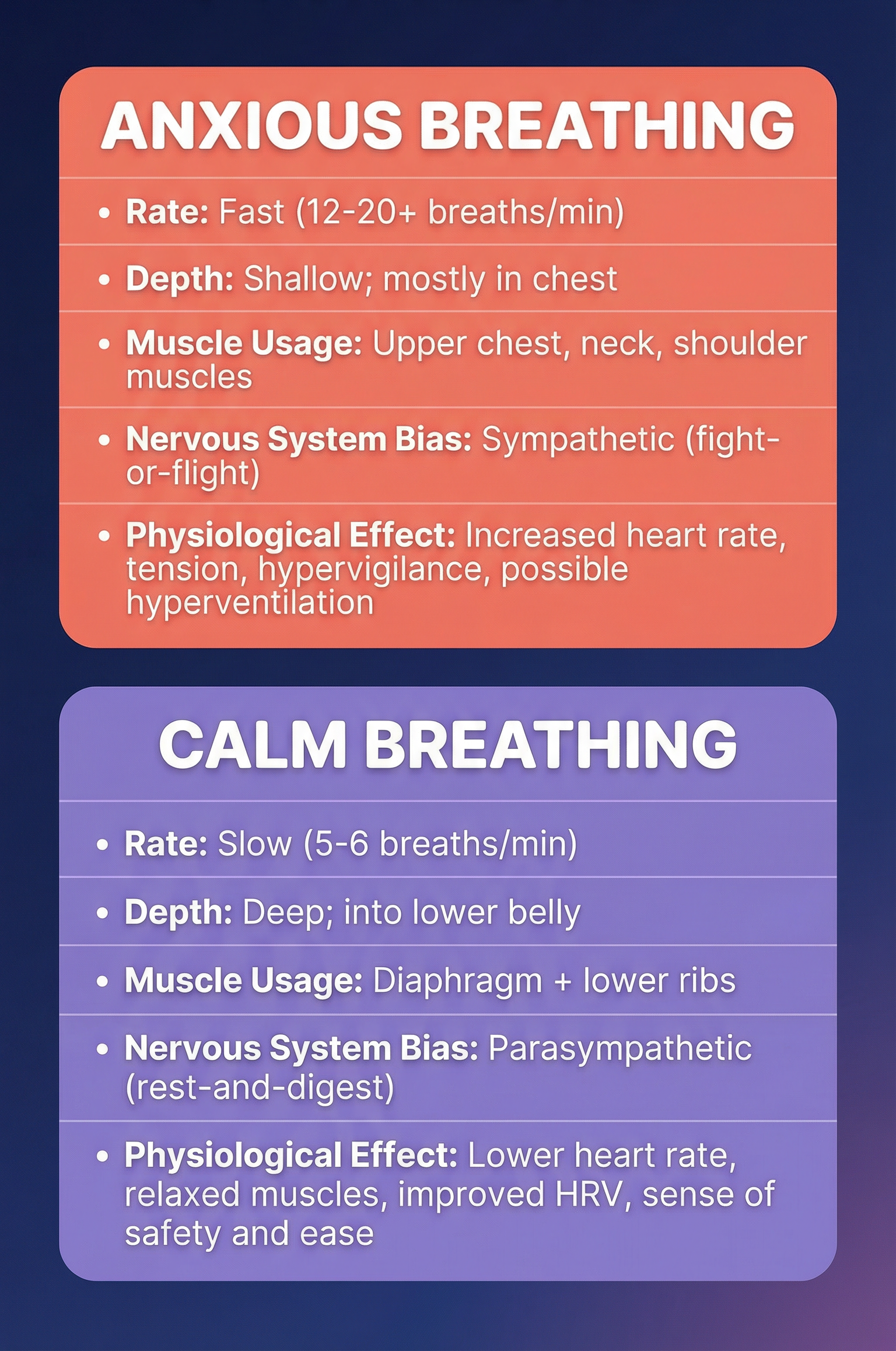
A primary goal of breathing techniques for anxiety and sleep is to shift from the top row to the bottom row of this table. Going from fast, shallow, anxious breathing to slow, deep, diaphragmatic breathing that supports relaxation and better sleep.
In the next section of this guide we’ll provide you with a series of step-by-step breathing exercises, including box breathing, 4-7-8 breathing, and coherent breathing, that you can use to calm your system during stressful days or right before bedtime. And if you don’t want to count in your head, no problem, just let the guided breathing exercises in the BetterSleep app handle the timing for you. All you need to do is close your eyes, listen, and breathe.
⭐️ 5 Foundational Breathing Techniques for Instant Calm
When anxiety strikes, your breath is often the first thing to change, but it’s also your fastest doorway back to calm. These five foundational breathing techniques for anxiety are backed by science, easy to learn, and powerful enough to use whenever you’re feeling stressed or overwhelmed. They can even help you ride out a full-blown panic attack. Each technique helps bring your nervous system back into balance by slowing down your breath, deepening your inhales, and lengthening your exhales to activate the parasympathetic “rest-and-digest” response.
Below, you’ll find step-by-step instructions, expert insights, and practical tips for using each technique both during the day and before bedtime. Some of these practices are great for everyday stress, while others are especially useful if anxiety suddenly spikes or feels overwhelming. Think of them as anxiety deep breathing techniques you can reach for whenever your system feels overloaded.
And don’t worry about tracking counts or timing in your head. The BetterSleep app includes guided audio versions of the box breathing technique, the 4-7-8 breathing technique, diaphragmatic breathing, and more, so all you need to do is press play and follow along.
🟢 Technique 1: Diaphragmatic (Belly) Breathing
Best for: Everyday anxiety, chronic stress, calming the nervous system
Diaphragmatic breathing, also known as belly breathing, is the foundation for nearly every other breathing exercise. It encourages the diaphragm to do more of the work, helping your breath deepen and slow naturally. This technique is especially useful when you feel tense, overwhelmed, or stuck in shallow chest breathing.
How to Practice
- Sit comfortably or lie on your back.
- Place one hand on your chest and the other on your belly.
- Inhale slowly through your nose, letting your belly rise more than your chest.
- Gently exhale through your nose or mouth as your belly falls.
- Continue for 1–5 minutes.
Why It Helps
- Reduces muscle tension
- Lowers your heart rate
- Improves your carbon dioxide balance
- Supports emotional regulation and calm
“Diaphragmatic breathing is one of the most accessible tools we have. With practice, it can shift your baseline from ‘slightly anxious’ to ‘generally calm.’” — Dr. Andrew Huberman, PhD
BetterSleep TipIf you’re unsure what this should feel like, open the diaphragmatic breathing animation in the BetterSleep app and let the visual guide help your breath find the right rhythm.
🟦 Technique 2: Box Breathing (Square Breathing)
Best for: Anxiety spikes, work stress, grounding, public speaking
The box breathing technique uses a simple four-part rhythm to quiet the mind and stabilize your nervous system. It’s particularly helpful when your anxiety feels chaotic or fast-paced.
The Four-Part Cycle
- Inhale for 4 seconds
- Hold for 4 seconds
- Exhale for 4 seconds
- Hold for 4 seconds
As retired Navy SEAL commander Mark Divine explains, “Box breathing is incredibly effective because it imposes order on a chaotic system. The four-second structure gives your anxious mind something to focus on, interrupting the feedback loop of panic.”
How to Practice
- Sit upright with your spine relaxed but tall.
- Inhale through your nose for 4 seconds.
- Hold your breath for 4 seconds.
- Exhale smoothly for 4 seconds.
- Hold again for 4 seconds.
- Repeat for 4–8 rounds.
BetterSleep TipIf keeping track of the timing feels distracting, just follow the Box Breathing visual guide in the BetterSleep app so all you need to do is breathe along.
🌙 Technique 3: The 4-7-8 Breathing Technique
Best for: Falling asleep faster, easing racing thoughts, calming nighttime anxiety
The 4-7-8 Breath slows the breath cycle and extends your exhalations, helping your nervous system shift into rest-and-digest mode. It’s especially effective for those nights when your mind just doesn’t want to settle at bedtime.
How to Practice
- Inhale gently through your nose for 4 seconds.
- Hold for 7 seconds.
- Exhale slowly and completely for 8 seconds.
- Repeat for 4–6 rounds.
Why It Helps
- Lengthens your exhalations
- Slows down your heart rate
- Interrupts spiraling, intrusive thoughts
- Supports the onset of sleep
“The 4-7-8 breathing technique acts like a natural tranquilizer for the nervous system. Used regularly, it can make falling asleep easier and faster.” — Dr. Andrew Weil, MD
If the 7-second hold feels too challenging, just shorten it a little. The technique still works so long as your exhalation remains the longest part of the cycle.
BetterSleep TipUse the guided 4-7-8 session in the BetterSleep app to follow along without needing to think about the count.
😮💨 Technique 4: Pursed-Lip Breathing
Best for: Panic attacks, hyperventilation, sudden anxiety surges
Pursed-lip breathing helps you to regulate fast, shallow breathing and makes your exhalations longer and steadier. This is one of the most effective techniques to help ease panic symptoms like dizziness, tingling, or a racing heart.
How to Practice
- Inhale slowly through your nose for 2–3 seconds.
- Purse your lips (like you were blowing out a candle).
- Exhale gently for 4–6 seconds.
- Repeat the cycle until your breathing becomes slower and easier.
Why It Helps
- Prevents rapid exhalation
- Stabilizes your CO₂ levels
- Eases breathlessness and chest tightness
- Helps you restore a sense of control during times of panic
“For people prone to panic, learning to slow the exhale with pursed-lip breathing can be a game-changer. It literally gives them a handle on their physiology.” — Dr. Rubin Naiman, PhD, FAASM
BetterSleep TipIf panic simply makes it too difficult to focus on your breath, open one of the calming soundscapes in the BetterSleep app and breathe along with the steady rhythm. It can sometimes make a world of difference.
🎵 Technique 5: Coherent (Resonant) Breathing
Best for: Stress relief, emotional regulation, boosting HRV
Coherent breathing keeps your breath at a steady pace of roughly 5–6 breaths per minute, which studies have shown is ideal for balancing your nervous system.
How to Practice
- Inhale through your nose for 5–6 seconds.
- Exhale through your nose for 5–6 seconds.
- Keep your breath smooth, quiet, and continuous.
- Continue this pattern for 2–5 minutes.
Why It Helps
- Enhances heart rate variability
- Reduces stress hormones
- Creates a steady, calming internal rhythm
- Supports a relaxed, but still alert, state
BetterSleep TipLet the Coherent Breathing audio in the BetterSleep app keep the timing for you so your body perfectly falls into the rhythm with ease.
🌟 Bringing It All Together
These five techniques create a powerful toolkit you can use anytime. For example:
- During a stressful workday
- When anxiety spikes unexpectedly
- Before a difficult conversation
- As part of your nightly wind-down routine
And remember, you don’t need to memorize any of this. The BetterSleep app walks you through each technique with audio and visual cues, so all you have to do is relax and follow along.
🌙 Breathing for Sleep — Techniques to Quiet a Racing Mind
When daytime anxiety follows you into the night, it most noticeably shows up as a racing mind, tight muscles, and a nervous system that simply refuses to shift into sleep mode. You feel exhausted but wired, unable to transition from wakefulness into rest. It’s on nights like this when breathing techniques for sleep become incredibly powerful.
As we’ve discussed, breathing is one of the fastest ways to shift your body out of the tense, overstimulated state that keeps you awake and into the calm, parasympathetic mode that lets sleep unfold naturally. The techniques below are especially helpful when your mind feels busy or overstimulated at bedtime.
🪖 The Military Sleep Technique
Best for: Trouble falling asleep, restless body, racing mind
This method pairs slow breathing with gentle muscle relaxation to better quiet both your body and mind. It’s the perfect antidote for those nights when you go to bed exhausted but just can’t seem to “switch off.”
How to Practice
- Lie comfortably on your back.
- Inhale slowly through your nose for 4 seconds.
- Exhale for 6 seconds, paying attention to releasing any tension in your face or jaw.
- Relax your shoulders as you breathe out again.
- Continue down your body (arms, chest, belly, legs, etc.) mentally softening each area on your exhalations.
- Once your body starts to feel heavier, return to a slow, steady breath.
Why It Helps
- Reduces muscle tension
- Lengthens your exhalations to activate your parasympathetic system
- Signals to your body that it’s safe to sleep
“We underestimate how much simple physical relaxation prepares the brain for sleep. The body must let go before the mind can follow.” — Dr. Rubin Naiman, PhD, FAASM
BetterSleep Tip
Pair this exercise with a calming BetterSleep soundscape like Deep Space Drones or Gentle Rain to deepen your sense of relaxation.
🧘♂️ The “Body Scan” Breath
Best for: Restlessness, racing thoughts before bed, difficulty staying asleep.
This technique blends mindfulness and breathwork. You’re not trying to force sleep here, rather, you’re creating the internal conditions that allow sleep to come to you naturally.
How to Practice
- Lie comfortably on your back.
- Bring attention to your breath without trying to change it.
- Inhale gently through your nose; exhale slowly.
- With each exhale, bring awareness to a different part of your body, such as your:
- Face
- Jaw
- Neck
- Shoulders
- Chest
- Belly
- Hips
- Legs
- Notice any tension in the area of focus and let it soften on your exhalation.
- Continue until you’ve traveled down your entire body, from head to toe.
Why It Helps
- Interrupts internal mental chatter by shifting your focus to physical sensations
- Engages your parasympathetic system through slow breathing
- Encourages deep relaxation that enables you to better fall into sleep naturally.
🌬️ Alternate Nostril Breathing (aka Nadi Shodhana)
Best for: Balancing your nervous system, calming overstimulation, and easing pre-sleep anxiety
This traditional yogic technique gently balances the right and left sides of your nervous system. It’s a really helpful practice for those nights when your mind feels overstimulated and you’re looking for an effective way to settle down before bed.
How to Practice
- Sit comfortably with your spine tall.
- Place your right thumb on your right nostril and your ring finger on your left nostril.
- Gently close your right nostril and inhale through your left nostril for 4 seconds.
- Close both nostrils and take a quick pause.
- Release your right nostril and exhale through it for 4–6 seconds.
- Then, inhale through your right nostril, pause briefly, then exhale through the left.
- Continue alternating sides for 1–3 minutes.
Why It Helps
- Balances brain activity
- Reduces pre-sleep anxiety
- Slows down your breathing rate
- Encourages a calm, steady transition into sleep
“Balancing the breath between both nostrils appears to gently balance activity between brain hemispheres as well, which many people experience as a deep inner calm.” — James Nestor
BetterSleep Tip
Practice this technique just before starting a BetterSleep sleep story or calming soundscape to ease any overstimulation you’re experiencing and deepen your sense of relaxation.
🐝 Humming Bee Breath (aka Bhramari Pranayama)
Best for: Emotional tension, nighttime anxiety spikes, and rumination. This soothing technique employs gentle humming during exhalations to create vibration in your throat and chest. This vibration directly stimulates your vagus nerve.
How to Practice
- Inhale deeply through your nose for 4 seconds.
- Exhale with a soft, steady humming sound (like a bee).
- Feel the vibration in your throat, face, and chest.
- Continue for 6–8 rounds.
Why It Helps
- Stimulates your vagus nerve
- Lengthened exhalations enhance relaxation
- The gentle buzzing sound helps to create a meditative state
- Reduces emotional reactivity
🌌 Creating a Pre-Sleep Breathwork Ritual
You don’t have to follow a complicated routine in order to sleep better. But what you do need is consistency. Here’s how to build a simple ritual built around a few simple breathing techniques for sleep that will signal to your nervous system when it’s time to wind down:
Try This 5-Minute Nightly Routine
- 2 minutes of slow diaphragmatic breathing
- 1 minute of coherent (resonant) breathing
- 2 minutes of a body-scan breath or humming breath
This combination:
- Slows down your breath rate
- Calms your cardiovascular system
- Softens physical tension
- Interrupts intrusive, racing thoughts
- Helps you to fall asleep faster
Expert Insight
Dr. Rubin Naiman, PhD, FAASM, reminds us:
"The goal of pre-sleep breathwork isn’t to ‘force’ yourself to sleep. It’s to create the ideal internal conditions for sleep to arise naturally. You’re inviting sleep, not hunting it."
BetterSleep Integration
You can automate this entire routine using BetterSleep’s wind-down playlist, pairing guided breathing with calming soundscapes to create a powerful, multisensory sleep environment.
🫁 Mastering the Art of the Breath — A Step-by-Step Guide
Before you explore more advanced techniques, it helps to start with the basics of healthy breathing. Many people with anxiety breathe high in the chest without realizing it; a habit that can increase tension, trigger lightheadedness, and make it harder for you to relax and fall asleep. Learning how to engage your diaphragm helps your breath deepen naturally and supports the calming “rest-and-digest” response you want before bed.
Below is a simple, step-by-step way to learn diaphragmatic breathing. You can practice it almost anywhere — sitting at your desk, lying in bed, even standing in the shower. With time, you’ll find it starts to feel natural, almost automatic.
🪑 Step 1: Set Up Your Posture
Find a comfortable position. You can sit or lie down, just as long as your spine is straight and your shoulders are relaxed. Let your jaw soften and gently rest your hands on your lap or by your sides.
✋ Step 2: Place Your Hands for Feedback
Place one hand on the center of your chest and the other on your lower belly. This helps you feel the movement of your breath and notice whether your diaphragm is working effectively.
🌬️ Step 3: The Inhale
Inhale slowly through your nose, allowing your belly to rise under your lower hand. Keep your chest as still as possible. Try not to lift your shoulders, just let them stay heavy and relaxed.
😮💨 Step 4: The Exhale
Exhale gently through your nose or softly parted lips. Let your belly fall as the air leaves your body. Aim for a smooth, easy release rather than a forceful push. As time goes on and you get used to the practice, start trying to make your exhalations slightly longer than your inhalations.
⚠️ Step 5: Common Mistakes to Avoid
It’s perfectly normal to slip into old habits at first. So, try to watch out for:
- Lifting your shoulders as you inhale
- Breathing shallowly into your chest
- Breathing too quickly
- Tensing your neck or jaw
- “Sucking in” your stomach instead of letting your belly expand
If you notice you’re doing any of these things, don’t fret. Just slow down a little, soften your muscles, and return your focus back to your belly.
“Most of us have been breathing in an inefficient way for years. The good news is that small corrections, repeated often, can dramatically change how you feel.” — James Nestor
📱 BetterSleep Tip
If you’re unsure whether you’re doing everything correctly, all you need to do is open the animated breathing guides in the BetterSleep app. The visuals expand and contract with each breath, making it easy to stay in rhythm and feel the technique in your own body.
🔥 Advanced Breathing Techniques — Wim Hof, Holotropic, and More
Once you’re comfortable with the calmer, more restorative breathing practices we’ve gone over in the earlier sections of this article, it can be helpful to understand the more advanced breathwork techniques you might have heard about online — in particular the Wim Hof Method, holotropic breathwork, and rebirthing breathwork. These approaches are more activating than relaxing, and while they can offer powerful benefits, they’re not appropriate for bedtime or during moments of anxiety.
This section will give you a clear, accessible overview of these methods so you better understand how they work. From there, you can make an informed decision on whether they’re right for you or not.
❄️ Wim Hof Breathing
Best for: Building resilience, increasing your tolerance to stress, boosting daytime energyNot recommended for: Pre-sleep use or moments of acute anxiety
The Wim Hof Method combines breathing exercises, cold exposure, and mental focus. The breathing portion involves cycles of deep, fast inhalations followed by soft, passive exhalations, ending with longer breath-holds.
How It Works
- Take 30–40 deep breaths: inhale fully, and then let the exhale fall out naturally.
- Once you’ve fully exhaled, hold your breath for as long as you comfortably can.
- When you need to breathe again, inhale again fully and hold your breath for 10–15 seconds.
- Repeat 3–4 rounds.
This type of breathwork temporarily raises adrenaline and activates your sympathetic nervous system, which is why people usually feel more alert or charged afterward.
Is It Right for Anxiety?
Wim Hof breathing does support long-term stress resilience, but because it’s stimulating, it can intensify sensations that resemble panic, like tingling, lightheadedness, or a racing pulse. For people prone to anxiety or panic attacks, it’s best to practice it only during calm periods, not in the middle of anxious ones.
As Wim Hof himself explains, “Techniques like the Wim Hof Method are like a workout for your nervous system. They build resilience over time, but you wouldn’t do an intense workout right before bed.”
BetterSleep Tip
BetterSleep focuses on calming techniques, not activating ones, but understanding the difference better helps you pick the right tool for the right moment.
🌪️ Holotropic Breathwork
Best for: Emotional exploration, processing trauma, guided therapeutic sessions
Not recommended for: Sleep, anxiety spikes, or unsupervised practice
Holotropic breathwork involves sustained periods of rapid, deep breathing accompanied by evocative music and professional guidance. The goal is to access non-ordinary states of consciousness to stimulate emotional release and psychological insight.
Because this technique intentionally lowers CO₂ levels and creates intense physical and emotional sensations, it should only be practiced with a certified facilitator. It’s definitely not suitable for anyone with a panic disorder, heart condition, or certain psychiatric diagnoses.
🔄 Rebirthing Breathwork
Best for: Emotional release, uncovering subconscious patternsNot recommended for: Nighttime use or for people prone to panic
Rebirthing breathwork, also known as conscious connected breathing, involves continuous inhales and exhales with no pauses between them. Sessions typically last an hour or more and are known to produce strong emotional and/or physical responses.
This technique can certainly be valuable for personal growth, but because it brings up intense sensations, it should only be performed under the guidance of a trained practitioner.
⚠️ Safety Considerations
“Intense breathing practices that deliberately increase ventilation can activate the body’s arousal systems. They may offer benefits in controlled settings, but they are not appropriate when someone is trying to reduce anxiety or prepare for sleep.”
— Dr. David Spiegel, MD, Associate Chair of Psychiatry & Behavioral Sciences, Stanford University
Advanced breathwork is powerful, but we can’t stress enough that it’s not appropriate for everyone. Be sure to avoid these practices if you have:
- Heart disease or hypertension
- A history of panic attacks
- Epilepsy or seizure disorders
- Respiratory conditions (unless the practice is approved by your doctor)
- Glaucoma
- Certain psychiatric conditions that could be destabilized by altered states
While this might seem obvious, never practice breath-holding techniques underwater or in unsafe environments.
📱 BetterSleep Integration
BetterSleep is designed to support calm, relaxation, and better sleep — so it doesn’t include the more intense techniques described in this section. Instead, use BetterSleep’s guided breathing exercises, sleep stories, and calming soundscapes when you want to unwind or prepare your mind for rest.
🕊️ Integrating Breathwork Into Your Daily Life
Breathwork is most powerful when it becomes part of your everyday rhythm, not something you only turn to during times of crisis or on nights when sleep isn’t coming easily to you.
These anxiety deep breathing techniques work in two ways: they help in the moment and they build benefits slowly over time. Just one slow breath can literally shift your state in seconds. But long-term transformation (less anxiety, steadier mood, better sleep, etc.) comes from small, repeated moments of practice layered throughout the day.
Here are a few tips on how to build a sustainable breathwork habit that will support you morning to night.
⏱️ Start Small (Just 5 Minutes)
You don’t need long sessions to make a meaningful difference to your anxiety levels and ability to sleep at night. Start with 5 minutes a day — or even less if that feels more manageable to you.
Because the key to all of this is consistency, not intensity.
What you might notice within the first week:
- More awareness of rapid, shallow breathing
- Slightly easier transitions from stress to calm
- Less tension in your shoulders and jaw
- A smoother wind-down before sleep
Rest assured that over several weeks your consistent breathing practice will go a long way toward helping you reshape your overall stress response.
🧩 Habit Stacking: Make Breathwork Automatic
One of the easiest ways to build a new habit is to attach it to something you already do.
Here are a few simple ways to pair breathwork with things you already do
- Before your morning coffee → 1 minute of slow belly breathing
- After brushing your teeth → 4 rounds of box breathing
- Before opening your laptop → 3 deep diaphragmatic breaths
- Right when you get into bed → 2 minutes of 4-7-8 breathing
Linking breathwork to existing routines reduces friction and reinforces calm throughout the day. Plus, it makes following a consistent breathwork practice that much easier.
“If you only remember to take one slow, conscious breath before reacting to stress, you’ve already changed the trajectory of that moment.” — Dr. Andrew Huberman, PhD
🔄 “State-Shifting” Moments
Think of your breath as a real-time tool for managing stress spikes.
Whenever you feel:
- Frustrated
- Overwhelmed
- Tense
- Sweaty or jittery
- Pulled into a fast heartbeat
Pause for 1–2 minutes and use one of the foundational techniques from Section 3.
Even a single slow breath can interrupt that surge of stress hormones and start steering your system back toward balance.
📊 Track Your Progress (Subtle Wins Count)
Don’t forget, progress with breathwork isn’t always dramatic. It’s often a series of quiet shifts. But with consistent practice you should start seeing improvements to your overall sense of well-being relatively quickly.
This is what to look for:
- Falling asleep faster
- Fewer middle-of-the-night awakenings
- A lower resting heart rate
- Feeling calmer after difficult conversations and situations
- Noticing your anxious thoughts sooner
- Recovering from stressors more quickly
You can use BetterSleep’s sleep tracker or your wearable device to observe real physiological changes over time. You should start to notice benefits like:
- A lower pre-sleep heart rate
- Improved sleep consistency
- More restorative sleep cycles
🧘♀️ Patience and Consistency
Breathwork is like strengthening a muscle; the benefits build slowly but steadily.
As James Nestor, author of Breath, says:
“The magic of breathwork isn’t in one long session. It’s in the hundreds of tiny moments throughout your day where you consciously choose to take a slow, deep breath instead of a shallow, anxious one. That’s how you rewire your nervous system.”
This is how breathing begins to reshape your relationship with anxiety: quietly, gradually, reliably.
📱 BetterSleep Integration
Set gentle reminders in the BetterSleep app to take a few slow breaths at key moments throughout your day. These small moments add up quickly, and they’re one of the easiest ways to build a lasting habit of calm.
❓ Frequently Asked Questions (FAQ)
Can breathing exercises lower blood pressure?
Yes. Multiple studies show that slow, controlled breathing reduces blood pressure. Techniques like diaphragmatic breathing, coherent breathing, and alternate nostril breathing help activate the parasympathetic nervous system, which lowers your heart rate and relaxes blood vessels.
Slow breathing (approximately 5–6 breaths per minute) has been proven to:
- Improve heart rate variability
- Decrease sympathetic activation
- Promote vasodilation
- Reduce stress hormones
With time, these changes should also lower your blood pressure.
Remember, while breathwork can definitely help support hypertensive patients, it never replaces medical care.
Is it normal to feel dizzy when doing breathing exercises?
Yes, especially for beginners.
Dizziness often happens when you’re breathing too quickly or too deeply, reducing CO₂ levels in the blood (a mild form of hyperventilation).
Common sensations include:
- Lightheadedness
- Tingling
- Floaty or warm sensations
How to prevent dizziness
- Slow down your pace
- Reduce the depth of your inhalations
- Take breaks between rounds
- Avoid long breath-holds if you’re prone to panic.
If dizziness persists, stop the exercise and consider consulting a healthcare provider.
“From a cardiology perspective, slow breathing is one of the simplest interventions we have for gently lowering blood pressure and calming the heart.” — Dr. Rubin Naiman, PhD, FAASM
What’s the difference between meditation and breathing exercises?
Breathing exercises intentionally change your physiological state through structured timing, depth, and pacing.
Meditation encourages observation of thoughts and sensations without altering them.
That said, breathwork often serves as a bridge to meditation because it:
- Quiets the mind
- Calms the body
- Reduces emotional reactivity
Can I do these techniques if I have asthma or COPD?
Yes, but with caution.
The following techniques are generally helpful for people with asthma or COPD:
- Pursed-lip breathing
- Diaphragmatic breathing
These breathing techniques improve airflow, reduce breathlessness, and release trapped air.
However, you should avoid advanced methods like:
- Fast breathing (holotropic, rebirthing)
- Long breath-holds
- Wim Hof hyperventilation cycles
As a general rule, whenever in doubt, consult your doctor or respiratory therapist.
How do I breathe if my nose is congested?
Should nasal breathing be difficult due to congestion, try the following:
- Apply saline spray
- Take a warm shower
- Nasal strips
- Using a bedroom humidifier
If you absolutely must mouth-breathe temporarily, aim to keep your breathing:
- Slow
- Gentle
- Diaphragmatic
Return to nasal breathing as soon as you’re able.
Why does my anxiety sometimes get worse when I focus on my breath?
This isn’t uncommon in people with:
- Panic disorder
- Health anxieties
- Oversensitivity to bodily sensations
- A history of prior panic attacks
Focusing on your breath should heighten awareness of:
- Your heartbeat feeling louder or stronger than usual
- Tightness or pressure in your chest
- A sensation of not getting a full breath (even though you are) — what people often describe as air-hunger
- Sudden changes in body temperature
- Slight tightness in your throat or a heightened awareness of air moving through it
What to do instead
Shift your focus to:
- A BetterSleep soundscape
- A sleep story
- Imagery-based meditation
- Body scan
- Gentle movement
Let your breath settle on its own in the background.
📱 BetterSleep IntegrationIf tuning into your breath makes your anxiety spike, you’re not alone, and you don’t have to force anything. The BetterSleep app includes calming tools that help you settle without paying close attention to your breathing. In these situations you might want to try:
- Soft, steady soundscapes to gently pull your attention outward
- Narrated sleep stories that give your mind something soothing to follow
- Guided visualizations that create a mental “escape hatch” from physical sensations
- Body-scan meditations that move at a slow, reassuring pace
- Light stretching or movement sessions to help discharge built-up tension
These alternatives allow your breath to return to its natural rhythm while you gently settle into a calmer state.
🌟Conclusion — Your Breath Is Always With You
If there’s one message to take from this guide, it’s this: your breath is the most accessible, reliable, science-backed tool you have for steadying your mind and body. Whether anxiety hits during the workday, your thoughts start spinning at night, or you’re awake at 5 a.m. staring at the ceiling, your breath is always there — a built-in anchor that can help shift your internal state in real time.
Throughout this guide, you learned:
- How your nervous system reacts to stress — and how breathing can influence it almost instantly
- Why slow, steady breathing activates the parasympathetic “rest-and-digest” response
- Five foundational breathwork techniques to help ease tension
- Specific practices to quiet your mind at bedtime
- Where advanced methods like the Wim Hof technique actually fit in
- Simple ways to weave breathwork into your daily life
- Clear answers to common questions people have when they’re just getting started
You now have a full toolkit of breathing techniques for anxiety and breathing techniques for sleep — from diaphragmatic breathing to the 4-7-8 breathing technique to coherent breathing — to help reduce anxiety, calm the body, and support deeper, more restorative sleep.
And it’s worth repeating: remember, you don’t need perfect technique to benefit. Not even close. Just one slow, deliberate breath can start shifting your physiology in a healthier direction.
🙏 A Final Encouraging Word
You’re not powerless in the face of anxiety.You’re not doomed to sleepless nights.And you’re not at the mercy of racing thoughts or a restless body.
Every slow, steady breath is a moment of self-support — a signal of safety, a quiet reset, and a small but meaningful step toward better emotional balance and more peaceful sleep.
📱 BetterSleep Call to Action
Ready to put these practices to work?
Download the BetterSleep app to access guided breathing sessions, calming soundscapes, sleep stories, and nightly wind-down routines designed to help you fall asleep easier and wake up feeling more restored.
Your path to calmer days and deeper rest starts now.