Dream Interpretation: The Complete Guide
To interpret your dreams, record them in a journal immediately upon waking, identify recurring symbols and emotions, and reflect on how they connect to your current life circumstances. Dream symbols like water, snakes, or falling aren't universal — their meaning depends on your personal experiences and cultural background.
To interpret your dreams, record them in a journal immediately upon waking, identify recurring symbols and emotions, and reflect on how they connect to your current life circumstances. Dream symbols like water, snakes, or falling aren't universal — their meaning depends on your personal experiences and cultural background.
Calling all dreamers! Have you ever wondered about the meaning behind your dreams? You’re not alone–the elusive nature of dreams has intrigued humans for millennia. Why do we dream? When and how does our brain enter the dream state? And why oh why are our dreams so bizarre?
Dream science has made incredible advancements in the last century and we now know more than ever about how certain parts of our minds activate during sleep. Through sleep and dream research, we have learned about the ideal conditions for dreaming, what happens in the brain while we dream, and how to increase awareness and recollection of dreams. But the interpretation, or how we associate meaning to our dreams, is not a fixed science.
Assessment of dream symbols may differ based on cultural associations, mental and emotional health, and the life circumstances of the person reporting or interpreting the dream. Whether you’re someone who remembers only fragments of dreams or you’re a practiced dream recorder, learning how to interpret your own dreams can give you fascinating insight into the inner workings of your mind, your emotional state and even your higher calling. Follow along as we detail the ins and outs of dream interpretation, the science behind it and how you can get started with your own dream journey.
What Is the History and Science Behind Dream Interpretation?
The dream is a little hidden door in the innermost and most secret recesses of the soul”Carl Jung
As long as humans have lived in community, dream interpretation has been a common practice. As Dr. Matthew Walker states, “We’ve always been thinking about ‘what are these things called dreams,’ and ‘how can we interpret them?’” As far back as the onset of the written word, and perhaps even dating back to 40,000-year-old cave paintings, humans have wondered about the significance of what we see when we sleep. Modern science provides us with much more detailed information about how and why we dream, but the enigmatic nature of what our dreams mean remains open to interpretation. Here, we’ll dive into the history of dream interpretation, cultural perspectives on dreaming and the modern advances in dream science.
Ancient Dream Interpretation
The analysis of dreams was first documented in writing over 5000 years ago in Mesopotamia. An ancient text, now referred to as the Assyrian Dream Book, was used as a way to record dreams, which were believed to be messages from the gods. The ancient Egyptians were also diligent dream recorders, appointing professional dream interpreters within the pharaoh’s inner circle. Dreams were written in complex manuals, illustrating how important dream meanings were during this period in history.
As the years passed, dream interpretation was often associated with religion, as the practice is described in religious texts across cultures. All major religious traditions reference dreams and dream interpretation in some way, suggesting that dreams are an important part of a person’s spiritual understanding. Across various religions and indigenous cultures, a similar thread of “divine messaging” connects the concept of dream interpretation. Dreams are seen as messages from a higher power, inviting dreamers to explore a sacred connection.
For thousands of years, dreams were most typically viewed as divine communication. Later, some religious skeptics believed them to be random mental noise, rather than sacred messages. This view was most common during the Age of Enlightenment, when scientific thought began to push faith-based beliefs aside in favor of empirical evidence. Between the 18th and 19th centuries, scientists began looking at dreams in a new light.
Freud's Revolutionary Theory
In the late 19th century, Sigmund Freud brought forth a new idea that shaped the way modern psychology looks at dreams. In his widely popularized book The Interpretation of Dreams, Freud claimed that dreams provide a peek into the subconscious desires of the mind. “The interpretation of dreams is the royal road to a knowledge of the unconscious activities of the mind,” states Freud, suggesting that our dreams are created within our own minds, illustrating our deepest unconscious wishes. He did not believe that dreams had anything to do with divine intervention, but rather with expressing thoughts and desires that most people were unable to access consciously.
Freud guided his patients to better understand their unconscious minds by describing the manifest content (the remembered account of what happened in their dreams) and working to discover the latent content (the hidden psychological meaning). By analyzing the latent content of a person’s dreams, Freud believed that he could help uncover deeply ingrained wounds and desires, most of which, he claimed, originated in childhood. Many of the subconscious ideas Freud decoded were rooted in sexual desire and socially unacceptable impulses.
Freud’s work has been criticized and praised by psychologists throughout the decades in nearly equal measure, but one concept that endures is that dreams were legitimized as meaningful psychological manifestations. He treated dreams with systematic psychological practices, rather than qualifying them as random occurrences in the mind or as direct messages from God(s).
Jung's Archetypal Symbols
Initially a follower of Freud’s work, Carl Jung diverged from Freud’s school of thought and created a completely different framework to explain the experience of dreaming. Jung believed that humans, across cultures and time, belong to a collective unconscious, a shared set of mental structures that exist within every person. Through the collective unconscious, we structure the way we view the world, tell stories, narrate life events and, yes, dream.
Jung believed in archetypical interpretations of both waking life and dreams, proven through his study of folklore, religion, dreams and human behavior. He noted specific archetypes that appear in dreams throughout history and across cultures, such as The Shadow (repressed emotions), The Wise Man/Woman (wisdom and guidance) or The Hero (overcoming obstacles). These dream symbols, Jung notes, aren’t fixed in a “library of dream symbols,” but rather change depending on a person’s experiences and interpretation at the time. Rather than relating dreams only to previous experiences, Jung believed that dreams might hint at future developments and are connected to a greater human experience.
Modern Neuroscience
Using modern technology, dream science, or oneirology, has developed significantly throughout recent decades. We now understand quite a bit about the science behind when, how, and even why we dream.
Rapid Eye Movement (REM) sleep was initially discovered in 1953, with researchers noting that this type of sleep was associated with dreaming. We now understand that dreams can happen during any phase of sleep, but they are most vivid during REM sleep. While in this “deep rest” mode, the brain puts the rest of the body into a nearly paralyzed state, with the exception of the eyelids, breathing systems and heart beat. Brain systems like the limbic system (responsible for memory and emotions) and the visual cortex remain online, allowing us to have active minds while our bodies are still.
There’s also an explanation for why dreams often feel illogical or bizarre. The prefrontal cortex, the part of the brain responsible for logic and reasoning, is offline during REM sleep. The visual and emotional centers, however, remain active, allowing seemingly fantastic or peculiar dream content to come through. While there are often aspects of our dreams that make sense and can be used to interpret dreams, we also encounter factors that defy the laws of normal human existence.
Modern researchers, such as Dr. Matthew Walker of the University of California, Berkeley, note that dreams can actually help us process emotions that we experience in our waking life, referred to as the Emotional Processing Theory. “It's during dream sleep where we start to actually take the sting out of difficult, even traumatic, emotional experiences that we've been having,” says Dr. Walker. “And sleep almost divorces that emotional, bitter rind from the memory experiences that we've had during the day.” The theory suggests that dreaming actually helps people process their dreams in a safer way, since the emotional reactions that they experienced throughout the day can be replayed and assessed during sleep when there is no real threat.
Cultural Perspectives
Depending on cultural context, dreams can mean wildly different things to different people. For example, Western cultures often focus on dreams having deeply personal meanings for the dreamer and no one else. Indigenous and tribal cultures share dreams as part of their community practices, understanding that one person’s dream might be significant for the entire tribe.
As an example, let’s take a common dream symbol of a snake and see how varied the interpretations can be. Ancient Greeks believed the snake to be a symbol of a threat, and depending on what the snake was doing, interpreted different types of danger. In Traditional Chinese Medicine, a snake symbol is associated with the liver, and can imply repressed anger, frustration or stress. However, in the Hindu tradition, snakes are seen as protective entities, often relating to fertility and spiritual wisdom. As we can see, no one symbol represents a universal meaning–dreams can be interpreted in different ways based on cultural and personal context.
In addition, the dreams we actually experience can vary greatly by location and culture. A 2003 study from the Université de Montréal surveyed over 1,300 university students, asking them to recall the most common themes of their dreams over the past month. The most commonly reported themes were being chased, sexual experiences, and falling. The students also frequently dreamed of school-related matters, arriving late, and important people in their lives. However, global research based on search history tells us that worldwide, the most common dreams vary depending on geographic location. For example, in Argentina, the most commonly searched-for dream is about spiders, but in Iceland, it’s snow. It stands to reason that people dream most often about what they know.
How Do You Interpret Your Dreams?
Interested in trying it for yourself? Here’s an easy, 5-step framework that you can start applying tonight to begin your dream interpretation journey.
Step 1: Record Your Dream Immediately
Perhaps the most important element in interpreting your dreams is actually being able to recall different aspects of a dream. Even remembering a tiny snippet is important for this process.
The best way to start remembering more details from your dreams is to keep a Dream Journal. Timing is crucial here, as dream imagery starts to fade after just a few minutes of being awake. The first 5 minutes after a dream are the golden opportunity to remember what you’ve just experienced in your dream.
Start with a pen and paper beside your bed, or use an app if you prefer a techy approach. Write any details that you remember, jotting down any element that feels even remotely significant. Words, pictures, and fragments of emotions are important here, as they’ll help you build your dream-recall muscle memory.
Don’t worry if you are unable to recall an entire dream–most people can’t! Remembering dreams is a practice that takes time and can be built from the ground up. Starting out, most people remember only fleeting feelings or tiny snippets of their dreams. After about 2-4 weeks of dream journaling, most people report improvements in their dream recall, though some folks take up to 8 weeks to start seeing progress.
Step 2: Identify Key Symbols and Emotions
Once you’ve started recording your dreams, you may notice patterns starting to emerge. Perhaps you dream of animals frequently, or maybe you’re the type to have emotionally-fuelled nighttime imaginings. There are certain symbols, emotions and imagery that seem to occur globally, such as being chased, teeth falling out, and flying. Once you notice certain patterns or recurrences in your dreams, you may want to look into the symbolism attached to those elements. Keep reading for a more detailed “dream symbol library,” but keep in mind that dream symbols aren’t universal standards; personal context plays a huge part in dream interpretation.
Step 3: Consider Personal Context
If you’re finding yourself having particularly symbolic or emotional dreams, consider your own personal position at the time of dreaming. Have you just gone through a certain stressful situation at work? Is there a specific family situation occupying your mind? Or perhaps you’ve been studying for an important exam. All of these situations could factor into your dreams–your body may be subconsciously trying to process the emotions you feel throughout the day.
The symbols that feel significant to you could also have something to do with your personal beliefs, spiritual values, and unique life experiences. For example, let’s say you have noticed snakes in your dreams lately. Sometimes, snakes represent a sense of oppression or paralysis in a person’s life. Other times, snakes are a symbol of transformation, of a certain “skin shedding” change that is under way. Depending on what you feel in the dream, and in your waking life, you may interpret a symbol differently from someone else. Your culture and personal associations change your relationship to the symbol quite significantly.
Step 4: Look for Patterns and Themes
If you’ve been Dream Journaling for some time, you’re sure to notice certain themes that present themselves while you sleep. You may find that certain images, people or emotions pop up in dreams frequently, and the more you track your dreams, the more you’ll notice. Sometimes, it’s the setting of the dream that recurs; other times, it’s the content. Whatever the case may be, recording the information can prove to be a useful tool for interpretation of repeating symbols.
Step 5: Reflect on Waking Life Connections
When thinking about how your dreams relate to your waking life, you may want to consider a few important questions:
- How does this dream relate to my current concerns?
- Have I been stressed or emotional about anything lately?
- Do I have any unresolved conflicts in my life?
By asking yourself these questions, you may uncover that some dream symbols may be pointing you toward answers. A person may have a vivid dream about missing an important exam, only to wake up, safe in their bed, realizing that they’re 40 years old and haven’t had to take an exam in almost two decades! Though the dream wasn’t literally warning them about a forgotten exam, it may be illustrative of a feeling of inadequacy in their waking life. Perhaps the person is worried about being qualified for a promotion at work, or doesn’t feel like they’re being a good enough parent to their kids. Dreams often require a level of self-awareness that can be uncomfortable, but can also help set a person free from certain emotional constraints.
How Can You Remember Your Dreams Better?
Dream recall comes easily for some, but the majority of people only remember fragments of their dreams. Luckily, there are ways to improve your dream recall, one step at a time.
Set the Intention
Before falling asleep, repeat the phrase “I will remember my dreams” to yourself a few times. This helps prime the brain for dream recall, even before your head hits the pillow. In fact, studies show that going to bed with an intention does in fact correspond to the outcome of your dreams. Setting up your physical space for dream journaling is another useful way to support your recollection of dreams, as you won’t be scrambling to find a pen or paper in the middle of the night. Decide if you’d prefer to write by hand or use an app on your phone, and arrange your bedside table mindfully for easy access to your recording materials. A dim bedside lamp or book light may also be helpful. The goal is to have the optimal environment set up for dream recall, however that may look to you.
Improve Sleep Quality
Since dreaming occurs mostly in REM (Rapid Eye Movement) stage sleep, it is essential to support your sleep hygiene in order to remember and interpret your dreams. Sleep scientists have broken sleep into 4 distinct cycles, divided into the categories of Non-REM (NREM) and REM sleep. Though dreaming is possible in all 4 stages of sleep, it is most common and vivid during REM cycles, which makes up about 20-25% of our nightly sleep cycle.
Here are some simple, effective ways to ensure you’re getting good quality sleep.
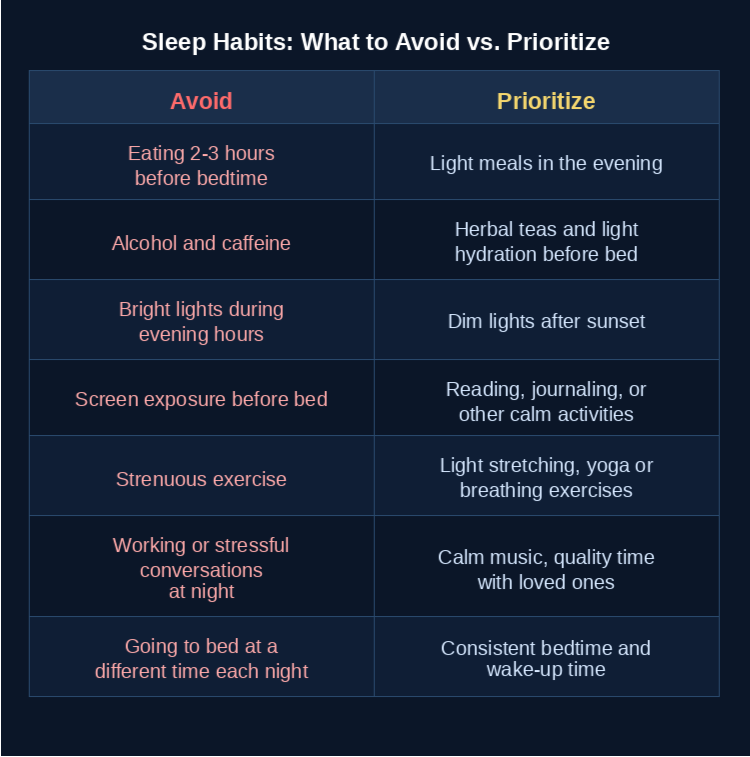
Ensuring a calm physical space helps the body relax, inviting sleep to come more naturally. Especially in our busy, modern lives, it’s easy for technology and stress to hijack our peaceful bedtime routines. But experts suggest that protecting your bedtime ritual is the best way to ensure that you’re actually getting high quality sleep.
The BetterSleep app is also full of useful tools to help you get the best sleep of your life. The Sleep Sounds library is loaded with options to lull you into a peaceful slumber, from mixable sleep sounds (like white noise and nature sounds) to guided meditations and bedtime stories. The BetterSleep app also comes equipped with a detailed Sleep Tracker, allowing you to record data about your sleep that would otherwise require a sleep lab full of equipment! By helping you track your sleep and wake-windows, your microawakenings and disruptions to your sleep, the BetterSleep app provides access to valuable information that can help you solve sleep problems using concrete data. There are countless other incredible features, like the Chronotype Quiz, BetterSleep Blog and in-depth expert advice, all backed by sleep science and designed to put you on track toward the sleep you’ve been dreaming of.
Wake Gently
In order to best remember your dreams, you need to wake gently. As you already know, the first 5 minutes upon waking are vital for dream recall, and waking with a sudden jolt can knock you out of this delicate state. The best way to remember your dreams is to allow yourself to wake calmly, without interrupting the fragile half-asleep phase that often comes after REM sleep.
But how can you do that? BetterSleep provides a Smart Alarm as part of its Sleep Tracker feature, allowing you to wake at the optimal moment for your best dream recall. If you haven’t already downloaded the BetterSleep app, give it a try and see how you can start tracking your way to Better Sleep!
Stay Still Upon Waking
While you’re working on remembering your dreams, you might have the impulse to turn on the lights and start writing right away. However, you may notice that as soon as your mind catches on one thread of a dream and you start writing about it, the remaining dream aspects have already flown out of your head. Combat this inevitability by remaining still for a few moments before reaching for your pen. As soon as you wake from a dream, stay completely still with your eyes closed. Try to replay the dream in your head, noticing people, places, symbols and feelings that come up. You may notice that you can still see the dream in your head, as if it’s playing on a video loop. Holding onto this imagery, even for a minute or two, can help you remember more details of your dream, allowing your brain the ability to process more details before you begin writing.
Practice Regularly
As with other sleep practices, consistency is key. Even in the moments when you feel like you didn’t dream of anything significant, try to incorporate dream recording as a habit. You may be surprised to find certain connections in your dreams that may not have seemed important in isolation, but add up to an interesting pattern. Many avid dream-journalers regularly go back several months or even years in their journals, noticing themes, recurring symbols or entire paradigm shifts. Consistent dream journaling also helps to build the muscle of remembering dreams, which increases your likelihood of remembering them the next night.
Interpretation of dreams begins with being able to remember details, whether they seem significant or not. Some people enjoy sharing dreams with others, finding that it helps their ability to recall future dream imagery. Friends, therapists or even dream discussion groups are common outlets for dream sharing, as long as there is trust and good will amongst participants.
What Do Common Dream Symbols Mean?
While there are no universal definitions for dream symbols, there exist many themes, symbols and patterns that tend to present themselves in dreams worldwide, across cultural demographics. Some of the most common dream themes are being chased, snakes, falling, and marriage. However, the interpretation of these symbols could mean very different things, depending on personal and cultural context.
Kelly Bulkeley, Ph.D., is a psychologist and author specializing in dream research. After writing and editing over 20 books on the subject, Dr. Bulkeley is considered an expert in the field. When speaking about dream symbols, Dr. Bulkeley is certain that dream interpretation requires significant cultural consideration. On the symbol of water, he notes, “the range of possible meanings can vary in different cultures and periods of history, so there is no one universal way of interpreting dreams of water. However, the essential importance of water in human life allows us to say with some confidence that water is a universal dream symbol of forces of nature that are both positive and negative, that we both can and cannot control, and that vitally connect us with vast energies, primal rhythms, and non-human forms of life.” He goes on to present dozens of variations of how water might be understood, depending on what form it takes, the feelings in the dream and what personal matters the dreamer is going through.
Here are 30 of the most commonly reported dream themes, what they could hint at, and what questions to ask yourself if you notice these symbols popping up in your dreams.
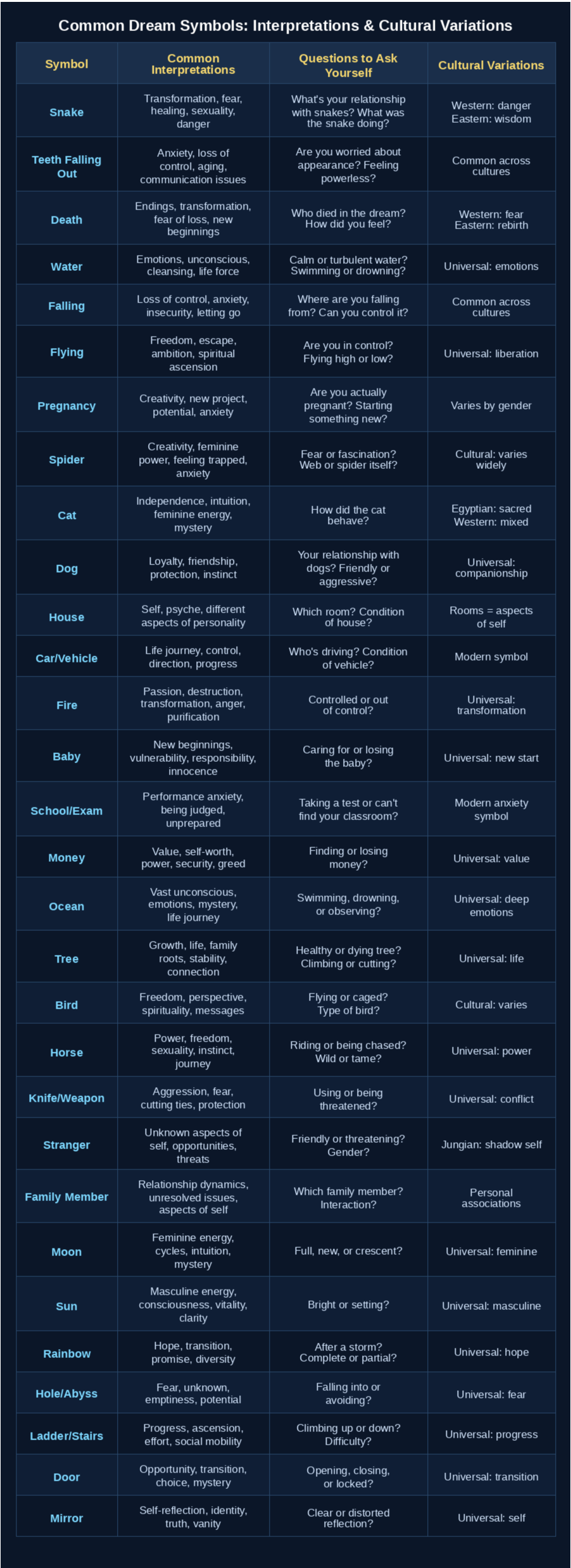
Of course, these associations can vary, and personal context is of the utmost importance when considering what your dreams mean to you. “Hopefully some of these interpretations will lead to helpful insights, but the ultimate authority is always held by you, the dreamer,” says Dr. Bulkeley. “Only the dreamer knows for sure what their dream means.”
Nightmares or Recurring Dreams
Dreams that depict negative, unwanted or overly strong emotions are known as nightmares. Nightmares are more common in children than adults, but some adults report having nightmares on a regular basis. If you have nightmares from time to time, psychologists confirm that this is nothing abnormal. However, frequent nightmares may be cause for concern. Leslie Ellis, PhD, registered clinical counsellor and author of A Clinician’s Guide to Dream Therapy, notes that recurring dreams “represent themes or issues that are unresolved in some way.” Dr. Ellis frequently treats patients with recurring dreams and suggests that dreaming can often be a way for folks to process emotions they experience in real life. “The classic version is the recurring nightmare after a trauma that has not been fully metabolized,” says Dr. Ellis. While it’s possible to have pleasant recurring dreams, researchers note that it happens about 25% of the time. More often, recurring dreams occur when we need to process something deeply, and that frequently comes after a negative experience.
Occasional nightmares aren’t much cause for alarm, as they usually work themselves out naturally. But frequent or recurring nightmares that disrupt your sleep and leave you feeling anxious, uncomfortable or overwhelmingly tired the next day may indicate that intervention is needed. If you or someone you love is experiencing recurring nightmares that affect them during the daytime, it may be time to speak with a doctor. Experts in the field can diagnose conditions like nightmare disorder and can identify potential stressors, traumas and even medications that may be causing these nightmares.
Why Is Dream Journaling Essential for Interpretation?
In order to find patterns and repeated symbols within your dreams, you’ll need to keep track of the content of your nightly imaginings. Dream journaling can be seen as a muscle that can be built up over time–the more you do it, the better you’ll be at recalling dreams.
Benefits of Dream Journaling
We’ve all been there before–you’ve just woken up from a vivid dream, trying to recall the meaningful aspects, and the memories just seem to dissolve into thin air. The more you try to tug on threads of the images you’ve just seen, the more they elude you. Expecting yourself to be able to remember an entire dream is unrealistic, but with practice, you are likely to get better at grasping onto those dream fragments. Dr. Kelly Bulkeley is an avid supporter and practitioner of dream journaling, noting that, “Dream recall tends to increase simply by means of an increased interest in and awareness of dreaming. In other words, the more dreams you want to remember, the more you probably will remember.” That is to say, once you implement the habit, you will be predisposed to recall more and more about your dreams.
Dream journaling also allows us to notice patterns in dream content over time. One isolated dream may provide some level of symbolism, but tracked over time, folks are more likely to notice interesting connections after weeks, months or years of logging their dreams. “Many people find it enjoyable, and even healing in a way, to review a long series of their dreams from the past and reflect on what has changed or evolved in their lives and what has remained stable and consistent,” explains Dr. Bulkeley. When you have more data collected, Bulkeley points out, it becomes easier to notice correlations from one dream to another, even if months or years separate the occurrences.
How to Start a Dream Journal
Though it may seem like a challenge at first, the process of starting a dream journal is really quite simple. The only thing you really need to get started is the desire to start remembering your dreams. After that, you’ll want to decide if you are more comfortable writing by hand or typing on a device (stay tuned for our best recommendations for each method).
Step 1: Set Your Space
Having a peaceful, relaxing space for sleep helps get you ready for bed in an important way: it helps your body wind down and signals to your brain that sleep is coming soon. Getting your physical space ready for bedtime and well-set for dream journaling helps prime the brain to understand that you are actively working on remembering your dreams.
Keep your pen and paper (or phone, tablet, sketchbook, etc.) on your bedside table, within arm’s reach. It’s also a good idea to have a dim light accessible so you can see what you’re doing without waking yourself too abruptly.
Step 2: Support Your Sleep
You’ve already read about how important your sleep quality is to your ability to remember dreams. Those who get 7-8 hours of good quality sleep are most likely going through several healthy sleep cycles, with deep REM sleep that allows them more time to dream. Waking gently (as opposed to being woken suddenly) means that you’ve completed a full sleep cycle naturally and wake up simply because the cycle has finished.
If you’re not sure about the quality of your sleep, check out BetterSleep’s Sleep Tracker to get some concrete data. The Sleep Tracker monitors your sleep and gives you invaluable information on how much time you spend in each phase of sleep, how much REM sleep you’re getting, and any microawakenings that occur throughout the night. You’ll know exactly how much sleep you got, understand significant changes in your routine and notice patterns night after night. The sleep tracker also includes a smart alarm which helps you wake up at the perfect time in your cycle. Where normal alarms jolt us awake without considering which sleep state we’re in, the smart alarm can process your sleep data and provide you with a gentle wake-up cue at a non-disruptive moment.
Step 3: Repeat Your Mantra
Just before you fall asleep, remind yourself that your goal is to remember your dreams. This can be something as simple as repeating “I will remember my dreams tonight” in your head a few times. Since it is a personal practice, you may want to choose your own words to diffuse the message to your brain in a way that makes the most sense to you. Those who have already begun the dream journaling process may choose to add “I will record important symbols from my dreams” or “I will notice interesting patterns in my dreams.”
Step 4: Wake Gently and Record
When you wake from a dream, don’t grab your pen right away. It’s best to stay still for a few minutes and let the dream wash over you, absorbing and replaying what you’ve just experienced. Let the action replay like a video in your mind, and then gently begin recording. Emotions, characters, settings, objects…any detail you remember should be considered important. Remember that dream symbols are extremely personal, so the aspects that you recall from a dream may seem random or disjointed, but likely have some significance in your life. Write down anything you can remember, whether it seems important or not. You may find that there are connections to previous or future dreams once you implement your dream journaling practice.
Step 5: Reflect and Read Back
When you’re awake and ready to process your dreams, try to see if you can close your eyes and visualize the dream environment again. It may feel like it’s slipping from your memory, but reading your dream journal entry could end up transporting you back to those surroundings! You might decide to re-read your journal at a particular moment of the day, or maybe do a “weekly catalogue” of your dreams. However you choose to reflect, look for patterns, symbols, and repeated characters or settings. Use the Symbol Library in the previous section (combined with your own self-knowledge and critical questioning skills) to look for symbolism within your dream collection. You can also write a daytime reflection of your dreams when you’re feeling clear-minded and inspired.
What to Record
The simple answer? Record everything! Any feeling, aspect of the setting, person, animal, environmental factor, and really anything you can remember makes for perfect dream journal material. The things that stand out to us in dreams are, by virtue of us noticing and remembering them, the important aspects to note. Therefore, dream journaling experts recommend documenting any fragments, tidbits or even half-memories from your dreams.
Digital vs. Paper Journals
There are pros and cons to both, so the decision comes down to your individual preferences.
Digital recording using an app or notes feature makes it easy to keep entries organized. It also keeps the information right at your fingertips and you can make notes or additions if you happen to remember another aspect of your dream during the day. Digital dream journaling means that if you’re a fast typist, you can record quickly and efficiently, and allows for password-protected security. However, using a device in the middle of the night is too distracting for some, and the blue light can disrupt circadian rhythm. It’s also a bit harder to draw or sketch dream details on a device, so consider your preferred method of recording when starting your dream journal.
Handwritten journals are more low-tech, making them less distracting than the digital option. There is a positive correlation between writing by hand and consolidating memories, so going old-school may help you remember more aspects of your dreams in the long-term. Analog writing provides a sense of emotional safety, potentially encouraging the dreamer to feel more open and honest while documenting dreams. It’s also easier to draw pictures or write in a non-traditional way when using your hands to write. On the flip side, writing by hand can be slower, and sometimes our dream fragments slip away while we’re in the process of writing. There’s always a chance someone else could read your dream journal, so the aspect of security is one you might want to consider.
Whichever way you decide to write, the act of focusing attention on your dreams and recording important memories can drastically increase your ability to recall more dreams over time. Give it a try tonight and dive into some fascinating insight into your subconscious mind!
What Tools Can Help You Interpret Your Dreams?
Once you have taken your first steps in the journey of dream interpretation, you may wonder how to decipher symbols from your dreams. There are many helpful tools out there to guide you in assessing your dreams’ symbolism.
Online Dream Libraries are one resource that many folks use to help gain insight into possible dream meanings. Websites like the Sleep and Dream Database, created by Dr. Kelly Bulkeley, aspires to “become the primary open, public dream database with applications in research as well as general interest.” Other dream symbol libraries, such as Dream Moods act more as directories where folks can look up their dream symbols. Several possibilities are provided for each dream image, as the creators of these databases understand that dream symbols are highly subjective and open to interpretation by the dreamer. Tone, feeling and personal experience play into dream symbols, so there is no “perfect match” for a single dream interpretation.
In the age of artificial intelligence, we have ever-more sophisticated methods of interpreting dreams. Some dreamers like typing their experiences into generative AI software and gleaning insight into their dream symbols. More detailed platforms exist, like Elsewhere, with integrated AI features designed to help people find possible dream interpretations. These apps are equipped with extensive dream libraries, common symbolism, and even the possibility to help interpret your dream while acting as a well-known expert in the field. For example, you can ask the AI to give you feedback based on what Carl Jung, or perhaps Sigmund Freud, would say about your dreams.
Finally, some people enjoy dissecting their dreams in a group as a type of dream therapy. There are online forums with this purpose, or you can find your own community of dreamers to meet with. Sharing dreams can be a vulnerable experience, since dreams tend to uncover deep, sometimes unknown areas of our insecurities. But ultimately, for those who want to dig deeper, dream groups can shed a light on some shadowed areas of our subconscious, helping us grow into more mindful versions of ourselves.
Start Understanding Your Dreams Today
Your first step on the journey to dream interpretation can start tonight! Intention and open-mindedness are all you really need to take your first steps. Now that you understand the benefits of dream journaling, why not give it a try for yourself? Grab your journal and get ready to embark on a creative adventure of self-exploration, and start getting Better Sleep while you’re at it!
Frequently Asked Questions About Dream Interpretation
Do dreams really mean anything?
The scientific consensus is that yes, dreams have significance, but not in a mystical way. Dreams help with emotional processing, memory consolidation and creativity. On the spiritual side, it’s up to each person’s individual beliefs to tell them if their dream is sacred in some way. While we can’t define dream symbols in a “one size fits all” way, each dreamer can find significance in their dream symbols individually.
Can dream dictionaries accurately interpret my dreams?
Dream dictionaries can guide you, but they can’t accurately interpret each dream concretely. Dream symbols are entirely dependent on personal context. For example, the symbol of fire can be defined in dozens of different ways, but based on the dreamer’s background and current situation, it can mean vastly different things to each individual.
Dream dictionaries are an excellent resource, however, for dreamers who want to go deeper into the symbolism presented by their subconscious mind. Through dream journaling and reflection, patterns and significance can emerge in a more visible and trackable way.
Why can't I remember my dreams?
This common issue, faced by about 50% of people, can be explained in a number of ways. There may be some factors impacting your sleep quality, such as stress, alcohol, blue-light exposure and more. See our section above for some ideas on how to support your sleep to improve dream recall, including BetterSleep’s Sleep Tracker and smart alarms.
Dream journaling can also help you remember your dreams by priming your brain with the signal that you want to recall more. Little by little, most people who start paying attention to their dreams end up remembering vastly more, simply because they’ve put their mind to it.
What do recurring dreams mean?
Recurring dreams can be an indication of unresolved tension or ongoing concerns in your waking life. People most commonly report recurring dreams of being chased, feeling unprepared or having otherwise emotionally complex dreams. Through dream journaling, you may notice a pattern emerging that can help you uncover the deeper meaning of your recurring dreams.
If you’re having recurring nightmares that impact your waking life, it might be time to seek professional advice. Dream therapists and psychologists can help diagnose when a recurring dream is indicative of a deeper issue. Anxiety disorders are medically significant and should be treated by a professional.
Are nightmares a sign of mental illness?
Nightmares here and there are considered normal, especially if you’re experiencing them during particularly stressful or emotional times. Dreams are often seen as a way for our minds to process difficult emotions, so having occasional nightmares may simply indicate that your brain is implementing its tried-and-true mechanism for unpacking complex feelings.
If you experience frequent nightmares, however, or are feeling excessively tired during the day, you may want to speak to a professional. Recurring nightmares can be indicative of PTSD, anxiety, or other medically diagnosable conditions. If you feel fear of going to sleep, traumatic experiences in your nightmares or if your sleep troubles impact your daily life, please consult with your doctor.
Do dreams predict the future?
There is no scientific evidence to support precognition of dreams, though many people feel that their dreams are indicative of future events. Coincidence and confirmation bias may explain these feelings, but there’s a layer that can be explained by science. Dreaming, and more importantly, dream journaling, can help open creative pathways that can help a person solve future challenges. Some people use mantras or creative prompts before bed to meditate on a problem or challenge, finding that when they wake up, the solution is clear. This type of dream mindfulness isn’t exactly “predicting the future,” but it can help people become more in tune with their intuition and creative problem solving.
How does sleep quality affect dreams?
When we don’t sleep well, our whole body suffers. This is true for the brain, as well, notably the areas responsible for dreaming. Conversely, getting good quality sleep with plenty of REM sleep allows our brain to rest and recharge, engaging in more vivid dream-time. Sleep disorders, such as insomnia or nighttime anxiety, can limit a person’s REM sleep, therefore cutting their ability to dream and remember dreams.