Postpartum Insomnia: When You Can't Sleep but Baby Can
Postpartum insomnia is a sleep disorder where new mothers are unable to fall or stay asleep, even when their baby is sleeping. Research links poor postpartum sleep quality to an increased risk of postpartum depression (PPD) and anxiety. Effective treatments include Cognitive Behavioral Therapy for Insomnia (CBT-I), establishing a "buffer zone" before sleep, and practicing mindfulness to downregulate the nervous system.
Postpartum insomnia is a sleep disorder where new mothers are unable to fall or stay asleep, even when their baby is sleeping. This is distinct from normal newborn sleep deprivation. It is primarily driven by a sudden drop in sleep-promoting hormones (estrogen and progesterone) after childbirth, combined with evolutionary hypervigilance, an intense biological drive to stay alert to protect the infant. Research links poor postpartum sleep quality to an increased risk of postpartum depression (PPD) and anxiety.
Effective treatments include Cognitive Behavioral Therapy for Insomnia (CBT-I), establishing a "buffer zone" before sleep, and practicing mindfulness to downregulate the nervous system. BetterSleep offers specialized guided meditations and breathing exercises designed to help new mothers transition from high-alert to deep rest.
Introduction: The Cruel Irony of Postpartum Insomnia
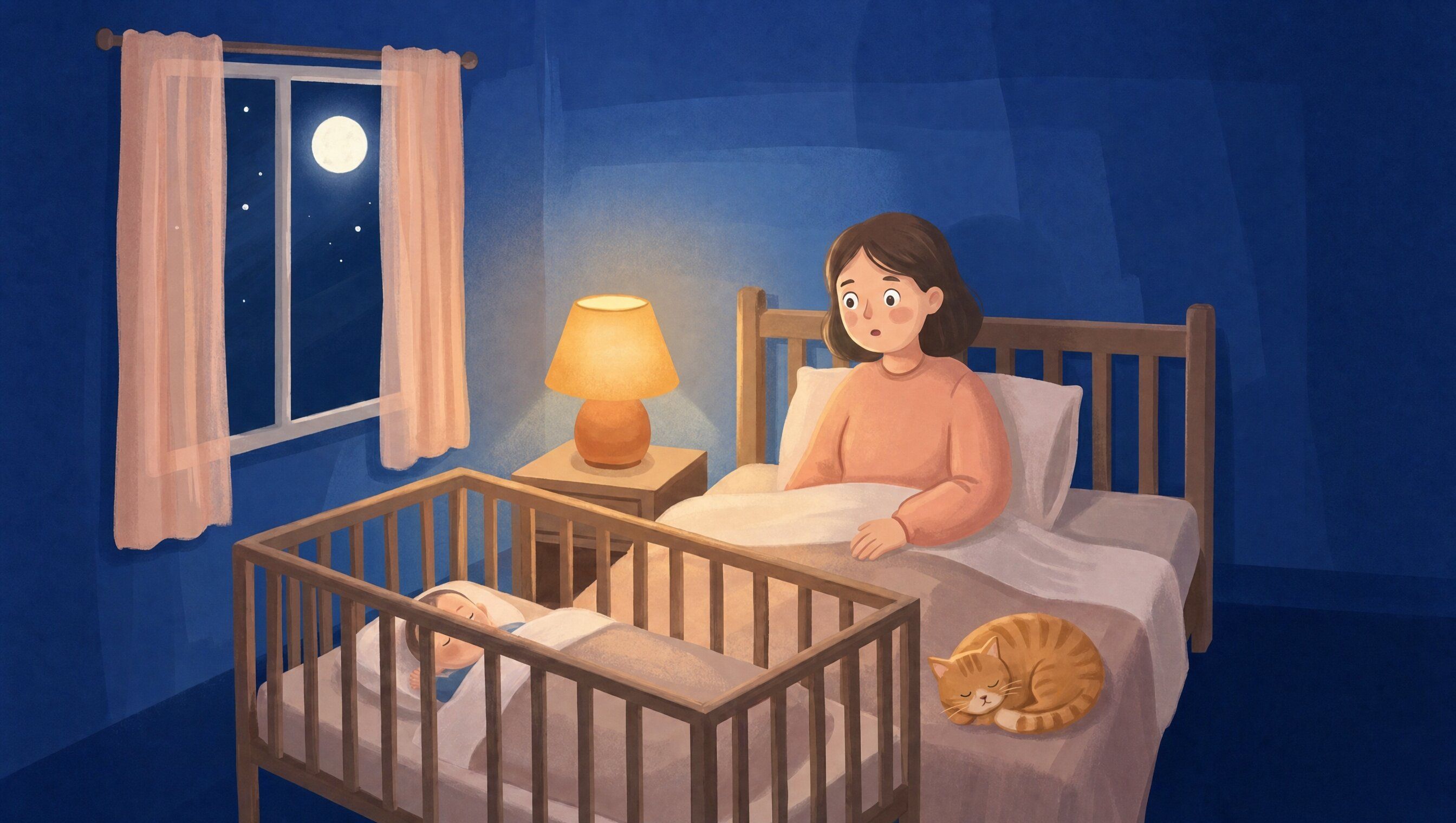
The baby is finally asleep.
The house is quiet. The lights are off. You’ve been waiting for this moment all day—aching for rest, counting down to it.
And yet, you’re wide awake.
Your body is exhausted, but your mind won’t stop. You’re listening for every sound. Watching the monitor. Replaying the day. Bracing for the next wake-up. The opportunity to sleep is right in front of you—but sleep itself feels out of reach.
This is postpartum insomnia.
Unlike typical postpartum sleep deprivation, where sleep is interrupted by a newborn’s needs, postpartum insomnia happens when your baby is finally asleep, and you’re still wide awake. It’s the inability to fall asleep or stay asleep, even when given the opportunity.
If this feels familiar, you’re definitely not alone. It’s far more common than most people realize.
Research shows that poor sleep quality in the postpartum period is strongly associated with increased symptoms of depression and anxiety. What begins as a few restless nights can quickly spiral into a cycle of exhaustion, hypervigilance, and emotional strain.
If you’re experiencing this, it doesn’t mean you’re doing anything wrong. It means your brain and body are adapting—sometimes imperfectly—to one of the most intense transitions a human can go through.
When your nervous system is stuck in “high alert,” tools that help it downshift become essential. Many new mothers find that gentle interventions—like guided meditations, breathing exercises, or calming soundscapes in the BetterSleep app—can help signal to the body that it’s finally safe to rest.
Why Can’t I Sleep? The Science of Postpartum Insomnia
Postpartum insomnia isn’t random. It’s the result of several powerful biological and neurological shifts happening at once.
The Hormonal Crash
Immediately after childbirth, levels of estrogen and progesterone drop dramatically.
"Postpartum hormonal shift is one of the most significant and rapid changes in hormone levels that a person will experience in their lifetime.”Dr. Hadine Joffe, Director of the Women’s Hormones Research Program at Harvard
Progesterone, in particular, has a calming, sleep-promoting effect. When it suddenly disappears, the brain can shift into a more alert, anxious state, making it harder to fall asleep even when exhausted.
Evolutionary Hypervigilance
At the same time, your brain is wired to protect your baby.
Dr. Michael Breus, a board-certified clinical psychologist, sleep specialist, and fellow of the American Academy of Sleep Medicine, notes that postpartum hypervigilance is “an evolutionary survival mechanism—your brain is essentially on guard, listening for any signal that your infant may need you.”
Even small sounds—a sigh, a rustle, a change in breathing—can trigger alertness. Your nervous system stays partially activated, making deep sleep difficult.
Circadian Rhythm Disruption
Newborns don’t follow a 24-hour sleep schedule—and neither do you anymore.
Frequent nighttime feedings, irregular naps, and inconsistent light exposure can disrupt your internal clock. Research shows that circadian rhythm disruption can worsen anxiety and sleep fragmentation.
Your brain can start to lose its natural sense of when it’s supposed to wind down—and when it’s supposed to wake.
Postpartum insomnia is rarely caused by just one factor—it’s the stacking of all three that makes it so powerful.
You’re navigating a neurological state where:
- Your calming hormones have dropped
- Your brain is scanning for threats
- Your body clock has lost its rhythm
Individually, each of these can disrupt sleep. Together, they create a perfect storm for disrupted sleep.
This is why many new mothers describe feeling “wired but exhausted.” The body is physically depleted, but the brain is still operating as if it needs to stay alert.
Your brain can start to associate nighttime not with rest, but with monitoring, anticipation, and vigilance.
Understanding this can be deeply relieving. It reframes postpartum insomnia not as a personal failure, but as a predictable biological response—one that can be gently retrained.
The Danger of the “Sleep When the Baby Sleeps” Myth
“Sleep when the baby sleeps” sounds like simple, helpful advice.
But for many mothers, it becomes a source of pressure.
Dr. Shelby Harris, a licensed clinical psychologist and board-certified behavioral sleep medicine specialist (CBSM), explains that this advice can backfire: “When someone feels like they should be sleeping, it can create performance anxiety around sleep—making it even harder to fall asleep.”
This is known as sleep effort.
The more you try to force sleep, especially within a limited window like a 45-minute nap, the more your brain resists. You start watching the clock, calculating how much rest you’ll get, and worrying about whether it’s working.
Instead of drifting off, your mind becomes even more alert. Your brain can start to associate bedtime with frustration rather than relaxation.
Another problem with this advice is that it ignores how adult sleep actually works.
Sleep is not an “on-demand” function. It depends on a buildup of sleep pressure and alignment with your circadian rhythm. When you try to sleep at irregular times throughout the day, your body may simply not be ready.
This creates a frustrating loop:
- You lie down because the baby is sleeping
- You can’t fall asleep
- You become more anxious about it
- The next opportunity feels even more pressured
Dr. Shelby Harris notes that this pattern can “teach the brain that bed is a place of wakefulness and frustration rather than rest.”
For mothers experiencing postpartum insomnia, a more effective approach is often to prioritize quality over quantity—focusing on one or two more reliable rest periods rather than trying to force sleep at every opportunity.
Postpartum Insomnia vs. Postpartum Depression (PPD)
Sleep and mental health are deeply connected—especially in the postpartum period.
Research shows that sleep disruption is not just a symptom of postpartum depression—it’s also a major risk factor. At the same time, anxiety and depression can worsen insomnia, creating a cycle that reinforces itself.
Dr. Kathryn Lee, Professor Emerita at UCSF School of Nursing, explains: “Normal newborn sleep deprivation is driven by external interruptions. Postpartum insomnia is when the opportunity to sleep is present—but the body cannot take it.”
Some warning signs that insomnia may be part of a larger issue include:
- Dreading nighttime because you know you won’t sleep
- Intrusive or racing thoughts that won’t quiet down
- Feeling disconnected from your baby or surroundings
- Persistent anxiety or low mood
Sleep also plays a critical role in emotional regulation.
Dr. Matthew Walker, Professor of Neuroscience at UC Berkeley, explains that fragmented sleep “disrupts REM sleep, which is essential for processing emotional experiences and maintaining mental balance.”
You can learn more about how this works in this guide to understanding how fragmented sleep affects your sleep cycles and REM sleep.
This connection isn’t just psychological—it’s neurological.
When REM sleep is disrupted, the brain has fewer opportunities to process emotional experiences from the day. This can lead to heightened reactivity, increased anxiety, and a reduced ability to cope with stress.
In the postpartum period, already a time of enormous emotional and physical change, this lack of processing can amplify feelings of overwhelm.
Research has shown that protecting sleep, even in small ways, can significantly reduce the risk of developing postpartum depression.
This is why interventions that improve sleep are often among the most effective early strategies for supporting maternal mental health.
The key takeaway: addressing sleep isn’t optional—it’s foundational to recovery.
Science-Backed Remedies for Postpartum Insomnia
The good news is that postpartum insomnia is highly treatable. There are evidence-based approaches that can help calm a hyper-alert nervous system and make sleep more accessible again. Many of them focus on changing how your brain responds to the opportunity to rest.
Cognitive Behavioral Therapy for Insomnia (CBT-I)
CBT-I is widely considered a first-line treatment for insomnia, including in the perinatal period.
It focuses on changing the thoughts and behaviors that interfere with sleep, without relying on medication.
Techniques include:
- Reducing time spent awake in bed
- Reframing anxious thoughts about sleep
- Establishing consistent wind-down routines
One of the most powerful aspects of CBT-I is that it addresses the relationship you have with sleep.
Instead of treating sleep as something you must control, CBT-I helps you rebuild trust in your body’s natural ability to rest.
For postpartum mothers, this can be especially important. The transition into motherhood often brings a heightened sense of responsibility and control—over feeding, schedules, safety, and routines.
Sleep, however, doesn’t respond well to control.
By reducing sleep-related anxiety and removing pressure, CBT-I techniques help shift the nervous system out of a performance mindset and back into a receptive one.
The “Buffer Zone”
Instead of going straight from baby care to trying to sleep, create a short transition period.
Even 15–20 minutes of low-stimulation activity—dim lighting, quiet breathing, gentle stretching—can help your nervous system shift out of high-alert mode.
Using breathing exercises to calm your nervous system during this time can be especially effective
Shift Sleeping
If you have a partner, one of the most powerful interventions is a protected sleep block.
A 3–4 hour uninterrupted stretch of sleep can significantly improve mood, cognitive function, and resilience.
Reducing Pressure Around Sleep
Sometimes the goal isn’t to fall asleep immediately, it’s to create the conditions for rest.
As Jon Kabat-Zinn, founder of Mindfulness-Based Stress Reduction (MBSR), teaches: “You can’t force sleep. But you can create the conditions in which sleep is more likely to arise.”
Practical Tips: Calming the Hypervigilant Mind
When your brain is stuck in alert mode, small shifts can make a real difference.
Use White Noise for Yourself
Even when your baby is asleep, your brain may still be tuned to every sound in the room.
Newborns often make subtle sounds during active sleep, like grunts, squeaks, and irregular breathing, that can trigger your alert system.
Using white noise or other steady background sound helps mask these small fluctuations, so your brain doesn’t react to every change and can finally settle.
If you need support with this, BetterSleep offers customizable white and brown noise designed to create steady, uninterrupted rest.
Practice “Rest Without Pressure”
If you can’t sleep, shift the goal.
Instead of thinking “I have to fall asleep right now,” try “I’m going to rest.”
This reduces performance anxiety and allows your body to relax.
Practices like Yoga Nidra can be especially effective, helping the body reach a deeply restorative state even without full sleep.
BetterSleep offers guided Yoga Nidra sessions designed to support this kind of rest.
Try a Body Scan
A simple body scan meditation can help release physical tension that keeps the nervous system activated.
You can follow this guide to use a body scan to release physical tension before bed.
BetterSleep’s guided sessions walk you through this process step by step, making it easier to disengage from racing thoughts.
Adapt Your Sleep Environment
Postpartum sleep doesn’t look like pre-baby sleep—and that’s completely normal.
Adjusting expectations and environment can help.
This might include:
- Looser sleep schedules
- Flexible routines
- Simplified bedtime rituals
Here’s how to adapt your sleep hygiene for the newborn phase without adding pressure.
Create a “Mental Off-Ramp” Before Bed
One of the biggest barriers to sleep in the postpartum period is cognitive overload.
Even when the baby is asleep, your mind may still be running through:
- Feeding schedules
- Health concerns
- To-do lists
- “What if” scenarios
Creating a simple mental off-ramp can help.
This might look like:
- Writing down your thoughts before bed
- Setting a “worry window” earlier in the evening
- Listening to a guided meditation that redirects attention
BetterSleep’s guided meditations for anxiety are specifically designed for this transition, helping shift your focus away from monitoring and toward rest.
If your mind is racing, simple cognitive techniques can help you manage postpartum anxiety at night.
Frequently Asked Questions
Is it normal to not be able to sleep after having a baby?
Yes. Hormonal changes, hypervigilance, and circadian disruption can all make sleep difficult, even when your baby is sleeping. If insomnia persists or worsens, it’s important to seek support.
How long does postpartum insomnia last?
It varies. For many, it peaks in the first few weeks postpartum. If it continues beyond a month or begins affecting your mental health, professional guidance can help.
Why am I so tired but can’t sleep postpartum?
Your body is exhausted, but your nervous system is still in “threat detection” mode. This mismatch between physical fatigue and mental alertness is a hallmark of postpartum insomnia.
Does postpartum insomnia go away?
Yes—with time, hormonal stabilization, and the right strategies, most cases improve significantly. Tools like CBT-I, mindfulness, and supportive sleep practices can accelerate recovery.
Conclusion
Postpartum insomnia can feel like a cruel contradiction. You’re exhausted beyond words, yet sleep won’t come.
This isn’t a failure. It’s your brain doing exactly what it was designed to do: protect your baby.
The challenge is helping it understand that it’s safe to rest.
With the right support, whether that’s structured approaches like CBT-I, small environmental changes, or gentle tools like guided meditations, breathing exercises, and calming soundscapes in BetterSleep, you can begin to retrain your nervous system.
You don’t have to go through sleepless nights alone.
Download BetterSleep and let its guided meditations and soothing sounds help quiet your hypervigilant mind so you can finally rest.
Medical Disclaimer:This article is for informational purposes only and does not constitute medical advice. Postpartum insomnia can be a symptom of Postpartum Depression (PPD) or Postpartum Anxiety (PPA). If you are experiencing severe sleep deprivation, intrusive thoughts, or feelings of hopelessness, please contact your healthcare provider immediately or call the National Maternal Mental Health Hotline. The BetterSleep app is not a medical device.