Headspace vs BetterSleep: Which App Should You Pick?
Headspace and BetterSleep solve different problems. Headspace is a meditation app with sleep content built on a mindfulness framework — best if you want to build a meditation practice and improve sleep along the way. BetterSleep is a sleep-first app with a customizable sound mixer, sleep stories, and bedtime routines — best if your goal is falling asleep faster. Headspace costs $69.99/year; BetterSleep costs $59.99/year with a $249 lifetime option.
Millions of people now use sleep and meditation apps to help with stress, anxiety, insomnia, and nighttime routines. But once you narrow the options down to Headspace and BetterSleep, the comparison becomes surprisingly confusing. The two apps overlap just enough to look similar at first glance, even though they’re actually built for very different kinds of users.
Headspace and BetterSleep solve different problems. Headspace is a meditation app with sleep content built on a mindfulness framework — best if you want to build a meditation practice and improve sleep as a byproduct.
BetterSleep is a sleep app built around customizable soundscapes, sleep stories, and tracking tools — best if your primary goal is falling asleep faster. Headspace costs $69.99/year; BetterSleep costs $59.99/year with a lifetime option available.
Most comparison articles treat Headspace and BetterSleep as direct competitors, but they’re actually designed around different priorities. People comparing sleep apps also tend to look at Calm before deciding which platform fits them best.
Headspace started as a meditation platform and gradually expanded into sleep content. BetterSleep took the opposite approach: it was built first as a sleep-focused app, then later added meditation and mindfulness features around that core experience.
If your biggest problem is stress, anxious thinking, or difficulty slowing down at night, Headspace has the stronger meditation framework and a more structured sleep program.
But if your priorities are more practical — falling asleep faster, managing environmental noise, building better bedtime routines, or having more control over your nighttime audio environment — BetterSleep is much more purpose-built.
Which App Makes More Sense for You?
Pick BetterSleep if your main goal is falling asleep more easily and building a better nighttime routine.
The app is designed around what people actually do at bedtime: choose a sound, start a story, follow a wind-down routine, check their sleep patterns, or adjust the room’s audio environment until it feels right. The sound mixer is the clearest example of that sleep-first approach. You can combine rain, brown noise, ocean sounds, fan noise, soft piano, binaural beats, or solfeggio frequencies into mixes that match how you fall asleep on a given night.
Some nights you might want guided narration. Some nights you just want steady background sound. Some nights you want almost no stimulation at all except a low ambient tone underneath the room noise.
That’s where BetterSleep feels different from a meditation-first app. Sleep stories, soundscapes, bedtime routines, snore detection, and sleep tracking are positioned as core features rather than secondary additions attached to a meditation platform.
BetterSleep approaches sleep tracking differently than dedicated wearable ecosystems. Its microphone-based tracking is designed more for general nightly insights and habit awareness than detailed sleep-stage analysis, and that level of feedback is enough for most people to notice patterns and improve their routines over time.
Pick Headspace if your biggest issue is mental overstimulation at night.
The meditation library is deeper, the structured courses are stronger, and the app does a better job of helping users build a long-term mindfulness practice instead of simply helping them relax at bedtime. Its guided programs feel slightly more cohesive, and its newer CBT-I-based sleep program adds real clinical credibility to the platform.
Headspace feels more guided and structured. BetterSleep gives you more control and customization.
If you want a meditation app that also improves sleep, Headspace is probably the stronger choice. If you want a sleep app that also includes meditation tools, BetterSleep makes more sense for most people.
What Each App Is Actually Built For
Both offer sleep content, guided meditations, bedtime audio, and calming wellness features. But after a few days of actually using them, the difference becomes obvious.
Headspace feels like a meditation platform that expanded outward into stress reduction, sleep support, focus tools, and mindfulness routines. Even its sleep content revolves around calming the mind first. The app assumes that better sleep starts with calming mental overstimulation and anxiety.
If your sleep problems are closely tied to racing thoughts, chronic stress, or difficulty mentally disengaging at night, Headspace’s structure can feel reassuring. The app guides you step-by-step instead of asking you to build your own experience from scratch.
BetterSleep approaches the problem from the opposite direction. The app focuses much more heavily on the physical experience of falling asleep: sound environment, bedtime routines, ambient audio, sleep stories, and nightly sleep habits. Meditation exists inside the platform, but it doesn’t dominate the experience in the same way it does with Headspace.
With Headspace, you often feel like you’re entering a guided wellness program, which doesn’t necessarily jibe with everybody. With BetterSleep, you feel like you’re building a sleep environment tailored to how your brain and body relax at night.
The BetterSleep sound mixer is a good example of this. Instead of simply pressing play on a single track, you can layer sounds together and adjust them individually: rain underneath brown noise, ocean waves plus soft piano, or wind with a low ambient hum underneath everything else.
And while Headspace does include sleepcasts and ambient audio, the experience is more curated and less flexible overall. Some people prefer that simplicity. Others eventually want more control over the sounds they fall asleep to.
Sleep Features Compared, Feature by Feature
Sleep Stories and Sleepcasts
The bedtime audio feels noticeably different once you spend time with each app’s library.
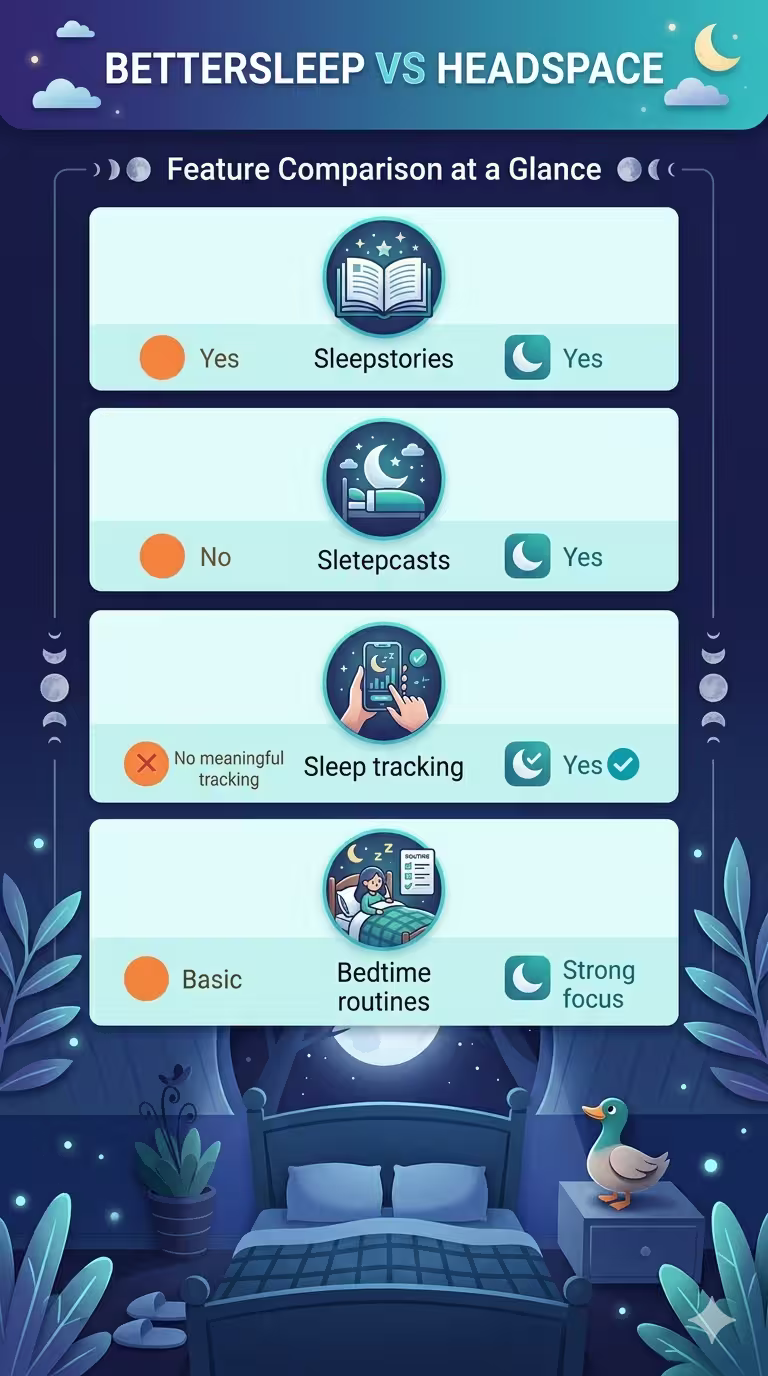
BetterSleep offers a larger overall range of sleep stories and styles. That variety matters because more people are now using bedtime storytelling as a way to mentally disengage before sleep instead of simply masking background noise.
You’ll find nature journeys, fantasy environments, mystery stories, travel scenarios, calming documentaries, children’s bedtime stories, and slower narration tracks designed for people who dislike overly theatrical voice acting.
There’s also more tonal variety. Some narrators are very restrained and almost whisper-like. Others are more animated and conversational. Some stories barely have a plot at all and are really just designed to help you drift off.
Headspace’s Sleepcasts are generally more polished. The production quality is consistently strong, and the app blends narration with ambient sound very well. Most Sleepcasts feel carefully paced, with just enough descriptive detail to occupy your attention without keeping your brain too alert.
In practice, Headspace’s sleep content might feel more polished, but BetterSleep’s library is broader and more customizable.
If you want tighter production and a more guided experience, Headspace probably wins this category. If you want variety and more freedom to find the kind of nighttime audio your brain responds to, BetterSleep has the advantage.
Soundscapes and the Sound Mixer
This is where BetterSleep really separates itself.
The BetterSleep sound mixer is one of the app’s defining tools, and for some people it becomes the main reason they keep the subscription long term. The app gives you far more control over your nighttime audio environment than most competitors, especially once you start experimenting with layered sound combinations and custom mixes.
You can layer more than 200 sounds together and control each element independently. Rain, brown noise, thunderstorms, waterfalls, fan sounds, distant trains, crackling fireplaces, low ambient drones, soft piano, birds, wind, café ambience — almost every category of sleep audio is represented somewhere inside the library.
The app also includes binaural beats and solfeggio frequencies, which some users incorporate into relaxation routines. Research on those specific audio approaches remains mixed, but many people still find them calming as part of a bedtime ritual.
Instead of encouraging users to build custom sound environments, the app leans more heavily into guided listening experiences. Ambient sound exists, but customization is much more limited overall.
For some users, that simplicity is a strength. But if personalized sound design is important to you — especially if background sound is a major part of how you fall asleep — BetterSleep offers far more flexibility.
Sleep Tracking and Snore Detection
Headspace doesn’t really function as a sleep tracking app. It tracks meditation consistency and mindfulness activity, but it doesn’t meaningfully track sleep duration, snoring, or overnight sleep behavior.
BetterSleep includes microphone-based sleep tracking and snore detection designed to give users a general sense of their nighttime patterns.
You can review estimated sleep duration, listen to recorded snoring samples, and monitor changes in nighttime habits over time. Its tracking tools are designed more around habit awareness and nightly patterns than highly detailed biometric analysis. Reviews of consumer sleep apps have found that many are more useful for tracking habits and routines than for delivering precise sleep-stage analysis.
Most people mainly want to know whether they slept poorly, woke frequently, snored heavily, or maintained a consistent routine.
CBT-I Programs and Structured Sleep Support
This is where Headspace regains some ground.
Headspace’s newer “Finding Your Best Sleep” program adds something many sleep-focused apps still lack: a more structured behavioral framework based partly around CBT-I principles.
CBT-I remains one of the most evidence-supported non-pharmaceutical approaches for chronic insomnia.
The program is still designed for mainstream app users rather than clinical treatment, but it gives Headspace more credibility in the structured sleep-improvement category than some might realize.
BetterSleep approaches sleep in a less clinical way overall.
Instead of guiding users through structured behavioral frameworks, the app focuses more heavily on relaxation, bedtime consistency, environmental control, calming audio, and nightly routines. For users whose sleep struggles are more environmental or habit-based than deeply cognitive, that can feel much more approachable.
Meditation Features Compared
Meditation is still Headspace’s clearest advantage over BetterSleep.
It’s also the foundation the app was built on, and after years of refining the platform, it still feels more complete as a long-term mindfulness app.
The guided meditation library is larger, more structured, and generally easier to navigate if meditation itself is your primary goal. (Readers interested in how mindfulness techniques may affect sleep quality can explore BetterSleep’s guide to the science of sleep meditation for a deeper breakdown of the research.)
There are courses for stress, anxiety, focus, burnout, grief, productivity, emotional regulation, and sleep, along with shorter standalone sessions for specific moods or situations.
Instead of feeling like isolated audio tracks, many Headspace programs feel intentionally progressive, with techniques and ideas layered gradually over time. For users trying to establish an actual meditation habit — not just relax before bed — that structure matters.
With that said, BetterSleep includes guided meditations too, and they’ll be more than enough for people who mainly want help winding down at night. Readers looking for additional guided sleep meditations from BetterSleep can also explore the company’s broader meditation recommendations and sleep-focused sessions.
Meditation inside BetterSleep is more integrated into a broader sleep-and-relaxation toolkit rather than functioning as the platform’s central identity. Sessions tend to be shorter, more relaxation-focused, and more directly tied to winding down at night.
Headspace, meanwhile, is better suited to people who want meditation to become part of their daytime routine as well as their nighttime routine.
If meditation depth is the deciding factor for you, Headspace is probably the stronger pick. If meditation is something you want available inside a larger sleep-focused environment, BetterSleep strikes a better balance for most users looking primarily to improve sleep.
Pricing — What You Actually Pay in 2026
Pricing matters more with sleep apps than people sometimes admit.
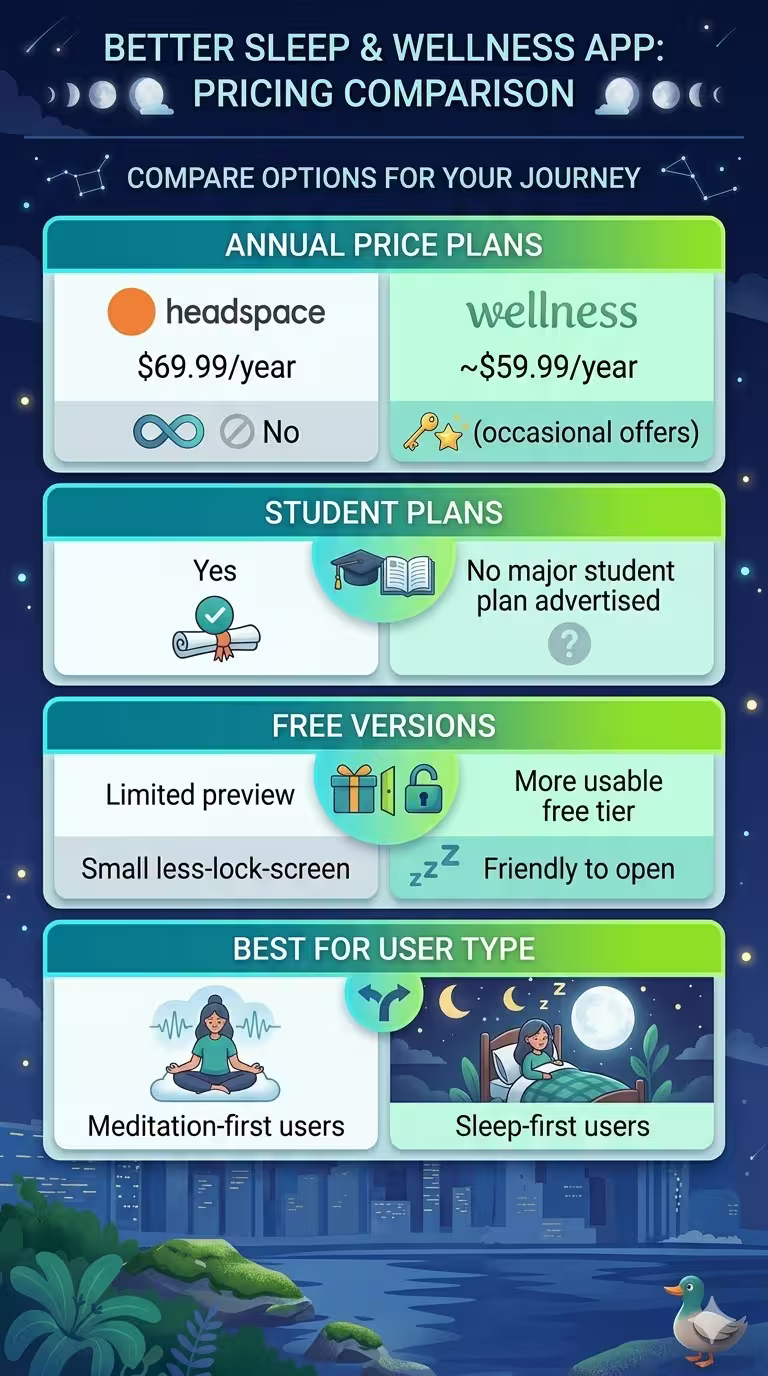
As of May 2026, Headspace costs $12.99/month or $69.99/year, with discounted student pricing available. BetterSleep costs approximately $9.99/month or $59.99/year, making it slightly cheaper annually for standard users.
BetterSleep also periodically offers a lifetime purchase around the $249 range, which changes the long-term math significantly for people who know they’ll use sleep audio every night. Headspace doesn’t currently offer an equivalent lifetime plan.
Headspace’s free tier functions more like a limited preview of the platform. BetterSleep’s free version is more usable for casual nightly listening, especially if your main interest is ambient sound or basic sleep audio.
Sleep apps are unusually personal. An app that works perfectly for one person may do almost nothing for someone else.
If you mainly want a structured meditation platform with sleep benefits included, Headspace’s pricing makes sense relative to its course library and guided content depth.
If your primary use case is nightly sleep support — soundscapes, sleep stories, bedtime routines, and environmental audio — BetterSleep generally delivers more sleep-specific functionality per dollar spent.
Quick Pricing Comparison
The Science — What Does the Research Actually Say?
There is legitimate evidence that mindfulness practices, relaxation techniques, and digital sleep programs can improve sleep quality for some people. But no mainstream sleep app should be viewed as a standalone medical treatment for serious chronic insomnia.
Headspace currently has the stronger direct clinical evidence.
A 2025 randomized controlled trial involving Headspace’s “Finding Your Best Sleep” program reported a 29% reduction in self-reported insomnia symptoms over 18 days, along with improvements in sleep quality and daytime functioning. Earlier research has also linked mindfulness-based app use with improvements in sleep duration, sleep quality, and daytime tiredness in working adults.
BetterSleep is approaching the problem from a different angle. The app focuses more on environmental audio, relaxation, nighttime routines, and personalized sound environments than structured therapeutic programs.
There is evidence that relaxing audio, sound masking, and consistent bedtime routines can help support sleep quality and make it easier for some people to fall asleep, particularly when environmental noise or nighttime overstimulation is part of the problem.
Some features inside BetterSleep — particularly binaural beats and solfeggio frequencies — are still being studied, and the evidence around them is less definitive. But the broader idea behind the app’s sleep-first approach is not especially controversial: a calmer, more consistent nighttime environment helps many people sleep better.
The best sleep app usually isn’t the one with the strongest clinical paper attached to it. It’s the one you’ll consistently use on a stressful Tuesday night when your brain refuses to slow down.
Who Should Choose Which?
Choose BetterSleep if:
- you mainly struggle with falling asleep,
- background noise or environmental sound matters to you,
- you like customizing audio,
- you want sleep stories and soundscapes first,
- or you want a sleep-focused app that also includes meditation tools.
Choose Headspace if:
- your sleep problems are closely tied to stress or anxious thinking,
- you want a structured meditation practice,
- you prefer guided programs over customization,
- or you want stronger mindfulness and CBT-I-style content inside the app.
For most users, choosing one and committing to it consistently for several weeks is more effective than constantly switching between platforms looking for a perfect solution.
Conclusion
Headspace and BetterSleep are both strong apps, but they’re designed around different priorities.
Headspace is still the stronger meditation platform overall. Its structured courses, mindfulness framework, and CBT-I-informed sleep program give it more depth for users focused on stress reduction and long-term meditation practice.
BetterSleep is more purpose-built for sleep support. Its sound mixer, customizable audio environment, sleep stories, bedtime tools, and lower annual pricing make it a better fit for many users whose primary goal is simply falling asleep faster and building more consistent nighttime routines — especially if factors like environmental noise or inconsistent sleep habits tend to interfere with sleep quality.
If you want meditation first and sleep second, choose Headspace.
If you want sleep first and meditation second, BetterSleep is probably the better fit.
FAQ
Is Headspace or BetterSleep better for sleep?
Both apps can improve sleep, but they approach the problem differently. Headspace focuses more heavily on mindfulness, meditation, and CBT-I-informed sleep support, while BetterSleep centers the experience around customizable soundscapes, bedtime audio, sleep stories, and nightly routines. If stress and racing thoughts are the main issue, Headspace may be the stronger option. If your focus is falling asleep faster or building a more personalized nighttime environment, BetterSleep generally feels more sleep-focused overall.
How much does each app cost in 2026?
As of May 2026, Headspace costs $12.99/month or $69.99/year, with discounted student pricing available. BetterSleep costs about $9.99/month or $59.99/year and periodically offers a lifetime purchase option around $249. BetterSleep is slightly cheaper annually and offers more long-term pricing flexibility for people who know they’ll be using the app long term.
Does Headspace have sleep tracking?
Not really. Headspace tracks meditation activity and mindfulness progress, but it does not function as a dedicated sleep tracking app. BetterSleep includes microphone-based sleep tracking and snore detection designed to provide general nightly insights and habit awareness. Users looking for highly detailed biometric sleep-stage analysis will still get more accurate data from wearable devices like Apple Watch, Fitbit, or Oura.
Can I use both Headspace and BetterSleep together?
Yes. Headspace works well as a daytime meditation and mindfulness platform, while BetterSleep is often used more heavily at night for soundscapes, sleep stories, and bedtime audio. The downside is cost. Maintaining both subscriptions can become expensive over time, which is why many users eventually settle on the app that best matches their primary sleep or relaxation needs.
Which app has better sleep stories?
BetterSleep offers a larger and more varied library overall, with multiple narration styles and a wider range of story types. Headspace’s Sleepcasts tend to feel more polished and tightly produced, with especially strong ambient sound design. If you value variety and customization, BetterSleep has the edge here. If you prefer a more curated and guided listening experience, Headspace may appeal more.