BetterSleep vs RISE: An Honest Sleep App Comparison (2026)
BetterSleep and RISE solve different problems. BetterSleep is a bedtime app built around a customizable sound mixer, sleep stories, and guided meditations — best if your goal is falling asleep at night. RISE is a daytime energy tracker built around sleep debt and circadian rhythm — best if your goal is understanding why you feel tired during the day. BetterSleep costs $59.99/year with a $249 lifetime option; RISE costs $69.99/year, annual only.
At a glance
Most sleep apps compete for the same role. BetterSleep and RISE don't. The two apps solve completely different problems. BetterSleep is a bedtime app built around a customizable sound mixer, sleep stories, guided meditations, and sleep tracking to help you fall asleep. RISE is a daytime energy tracker built around sleep debt, circadian rhythm, and energy-schedule prediction to help you understand why you feel tired during the day.
RISE costs $69.99/year (annual only). BetterSleep costs $59.99/year, offers a free tier, and periodically offers a lifetime option around $249.
If you've been comparing sleep apps, you may have already seen our breakdown of Calm vs BetterSleep, the meditation-app comparison or Sleep Cycle vs BetterSleep, An Honest Sleep App Comparison. This comparison is different.
Many readers assume BetterSleep and RISE compete directly. In reality, they're designed for very different purposes. BetterSleep focuses on helping you fall asleep with sounds, stories, and guided meditations. RISE focuses on understanding daytime energy through sleep debt and circadian rhythm tracking.
That's what makes this comparison unusual, and why choosing between them isn't always an either-or decision.
The Honest Verdict — At a Glance
Choose RISE if your biggest challenge is daytime energy.
RISE focuses on predicting your energy patterns, estimating sleep debt, and helping you align daily habits with your circadian rhythm. If you're constantly wondering why you feel exhausted at 2 p.m. or when your most productive hours occur, RISE was designed for these questions.
Choose BetterSleep if you struggle to fall asleep at night.
BetterSleep focuses on helping you fall asleep through sounds, sleep stories, guided meditations, and bedtime routines. If you struggle to wind down, quiet your mind, or fall asleep consistently, BetterSleep offers significantly more support in those moments.
Why you might want both
Unlike many competing sleep apps, these products barely overlap. RISE is built around understanding how sleep affects your energy and daily performance, while BetterSleep is designed to make the process of falling asleep easier and more enjoyable.
For someone focused on improving both sleep quality and daytime energy, running both apps is surprisingly logical.
Dream Interpreter
Unlock the secrets of your subconscious mind.
RISE: A Daytime Energy Tracker, Not a Bedtime App
The easiest way to understand RISE is to stop thinking of it as a traditional sleep app.
Its primary feature isn't audio content. It isn't meditation. It isn't sleep stories.
It's an energy schedule.
Sleep Debt and Circadian Rhythm
RISE is built around two concepts:
- Sleep debt
- Circadian rhythm
Sleep debt represents the difference between the sleep your body needs and the sleep you've actually been getting. RISE uses your sleep history and activity data to estimate that running balance.
The app then combines that information with circadian rhythm modeling to predict when you'll feel alert, tired, focused, or sleepy throughout the day.
This approach has helped RISE develop a loyal audience among productivity-focused users, wearable owners, and people who want more insight into their daily energy patterns.
Energy Schedule Prediction
One of RISE's most distinctive features is its energy chart.
Rather than simply showing how long you slept, it predicts:
- When sleep inertia should wear off
- Peak focus windows
- Afternoon energy dips
- Evening melatonin windows
- Ideal wind-down periods
Few consumer sleep apps focus so heavily on daytime performance.
One reason RISE has developed a dedicated following is that it reframes sleep as something that affects every hour of the day, not just the hours spent in bed. Many sleep apps focus on what happens while you're sleeping. RISE focuses on what happens afterward.
For example, instead of simply telling you that you slept 6 hours and 45 minutes, RISE attempts to estimate how that night of sleep will affect your energy, focus, and alertness throughout the day. The app highlights periods when you're likely to feel mentally sharp, times when fatigue may be more noticeable, and when your body may naturally be preparing for sleep later that evening.
The usefulness of those predictions depends largely on the user. People who enjoy planning their workday around periods of peak concentration often find value in these insights. Someone whose primary goal is simply falling asleep faster may find them less relevant.
Another important distinction is that RISE is not designed as a bedtime-focused app. You won't find a large library of narrated stories, customizable soundscapes, or meditation sessions designed to help you drift off. The app assumes that understanding your sleep habits and daily rhythms will eventually improve your sleep outcomes. BetterSleep approaches the problem from the opposite direction, helping users settle into sleep rather than analyzing what happens afterward.
The 16 Daily Habits
RISE also includes habit coaching designed to support healthier sleep and circadian alignment.
The app encourages behaviors such as:
- Morning light exposure
- Consistent wake times
- Limiting late caffeine
- Managing evening light exposure
These recommendations certainly aren't revolutionary, but they're presented within a system that continuously connects your habits to your projected energy levels.
This is what separates RISE from most traditional sleep apps.
BetterSleep: A Falling-Asleep App With the Deepest Sound Library on the Market
Where RISE focuses on understanding sleep's impact on your daytime energy, BetterSleep focuses on helping users fall asleep through audio, relaxation, and bedtime routines.
The experience begins with audio.
The Sound Mixer and 200+ Sounds
The centerpiece of BetterSleep is its customizable sound mixer.
Users can combine hundreds of sounds into personalized sleep environments, including:
- Rain
- Ocean waves
- White noise
- Brown noise
- Forest ambience
- Fan sounds
- Binaural beats
- Solfeggio frequencies
The ability to layer multiple sounds creates a level of customization that few competitors can match. If you're curious about building custom soundscapes, our guide to the BetterSleep sound mixer takes a deeper look at the feature.
The library also includes specialized audio content, including binaural beats and solfeggio frequencies, giving users more options to experiment with than they'll find in RISE. Users interested in learning more about specific frequencies can explore our guide to the 174 Hz solfeggio frequency and its place within the broader world of sound-based relaxation tools.
Why Customization Matters
The customization available inside the sound mixer is one of the reasons many users continue using BetterSleep for years. Two people can begin with the same sound and end up creating completely different sleep environments. One user might combine rainfall, distant thunder, and brown noise. Another might layer ocean waves with soft piano and binaural beats.
Not everyone falls asleep the same way. Some people sleep best with steady, predictable sounds that mask environmental noise. Others prefer immersive soundscapes that create a sense of escape from daily stress. BetterSleep accommodates both approaches without forcing users into a single listening experience.
Users can save favorite mixes, adjust individual sound volumes, and return to the same combinations each night. For many people, those familiar sounds become part of their bedtime routine, making it easier to settle in and disconnect from the day.
Sleep Stories and Guided Meditations
BetterSleep also includes a substantial library of sleep stories and guided audio designed specifically for bedtime.
The content is designed to help listeners relax and shift their attention away from the thoughts that often keep people awake. The same applies to guided sleep meditations from BetterSleep, which focus on relaxation, breathing, visualization, and sleep preparation.
RISE offers some relaxation content, but bedtime audio is not the center of its product.
For BetterSleep, it is.
Tracking Is Available, But It's Not the Main Event
BetterSleep includes sleep tracking through your phone's microphone and movement detection.
The feature can provide useful information about sleep duration and disturbances.
But unlike Sleep Cycle or RISE, tracking isn't the primary reason most people subscribe.
Most users come for the bedtime experience and continue using the app because it becomes part of their nightly routine.
Feature-by-Feature Comparison
Looking at the core features side by side highlights just how little overlap exists between these two apps.
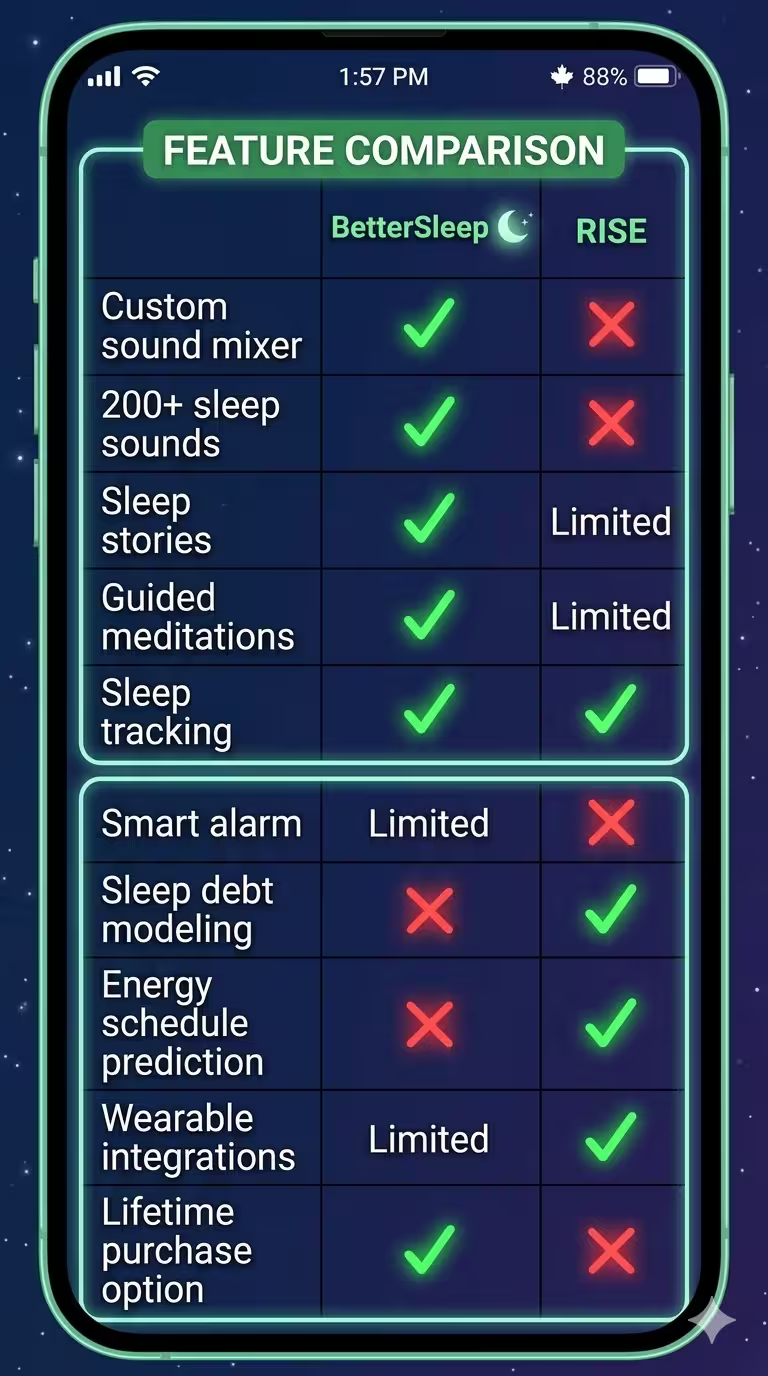
Sound Library
This category belongs to BetterSleep.
RISE offers basic audio content, but BetterSleep was built around sound. If your nightly routine depends on white noise, nature sounds, binaural beats, or custom soundscapes, the gap is significant.
Sleep Stories and Guided Meditation
Again, BetterSleep has the advantage.
The depth of its sleep-story catalog and guided meditation library makes it a more complete bedtime companion.
Sleep Tracking
Both apps track aspects of sleep, but they do so differently.
RISE uses historical data and wearable integrations to estimate sleep-related metrics and energy patterns.
BetterSleep focuses more on recording and reviewing nightly sleep information.
Energy and Circadian Features
This is where RISE pulls ahead.
BetterSleep does not predict daily energy levels.
It does not calculate sleep debt.
It does not generate a personalized energy schedule.
Those capabilities are central to the RISE experience.
Wearable integration is another area where the apps attract different audiences.
RISE is particularly appealing to people who already use devices such as Apple Watch, Oura Ring, Fitbit, or other sleep-tracking tools. The app's value increases as more sleep and activity data become available because its energy and sleep-debt estimates rely heavily on historical information.
BetterSleep takes a less data-centric approach. While tracking features are available, the core experience remains accessible even for users who don't own any wearable devices. Someone can download the app tonight, create a sound mix, start a sleep story, and immediately benefit from the experience without building months of historical data.
That's an important distinction. RISE becomes more valuable as your data history grows. BetterSleep provides most of its value from the first night.
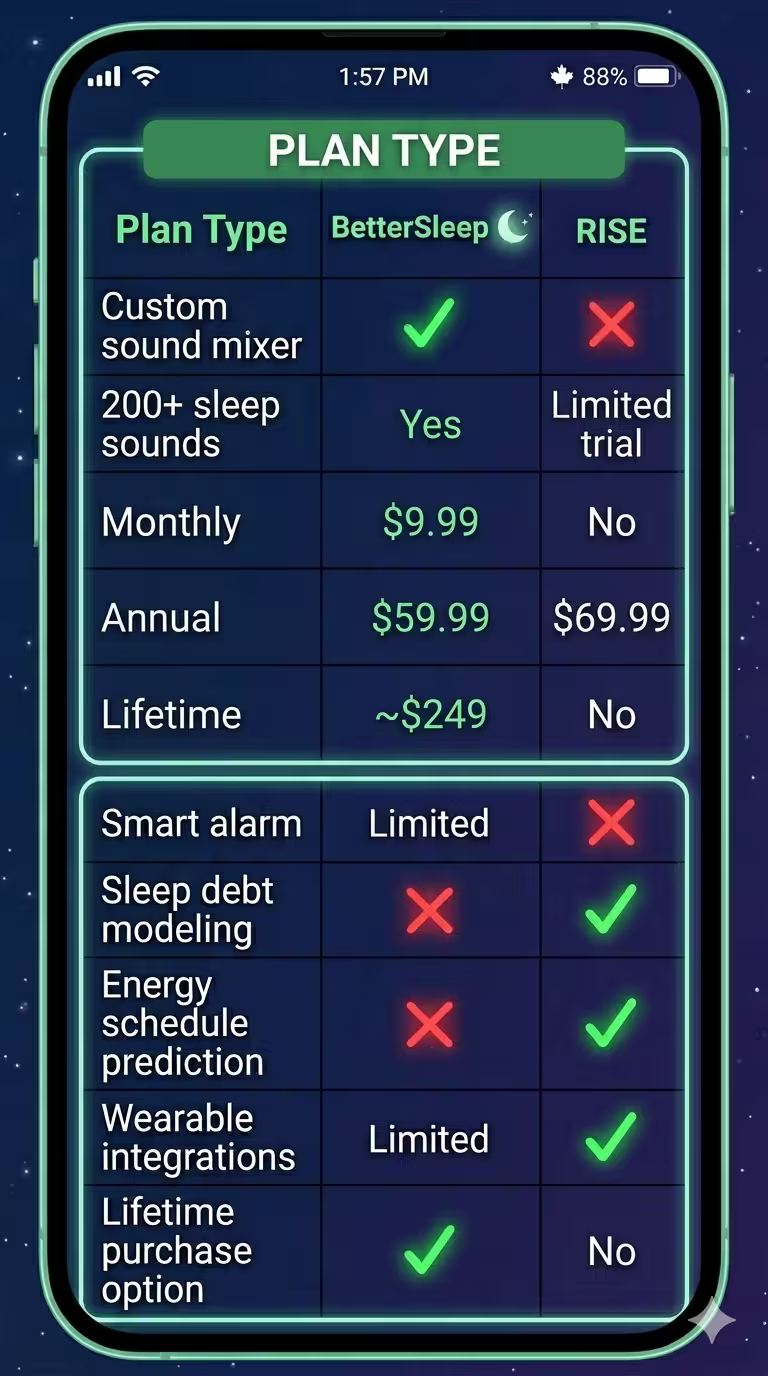
Pricing — RISE's Annual Cost Is Higher, but the Comparison Is Wider Than That
Free Tier vs Trial
BetterSleep offers a genuinely usable free version.
Users can experiment with sounds and basic functionality without making a financial commitment.
RISE operates more like a trial-first subscription product.
Monthly Options
BetterSleep allows users to subscribe monthly.
That matters for people who aren't ready to commit to a full year.
RISE doesn’t currently offer a comparable monthly plan.
Annual Plans
Annual pricing slightly favors BetterSleep.
The difference isn't huge, but BetterSleep remains less expensive.
Lifetime Value
This is where BetterSleep creates the biggest separation.
A $249 lifetime license becomes less expensive than recurring annual subscriptions after several years of use.
RISE has no equivalent purchase option.
For long-term users, that's a meaningful distinction.
The Science — What "Sleep Debt" Actually Means
Sleep debt is one of RISE's signature concepts.
It's also one of the most misunderstood.
Research supports the idea that chronic sleep restriction accumulates and can affect cognition, mood, reaction time, and overall functioning. However, the specific sleep-debt number shown inside an app is still a model rather than a direct physiological measurement.
A useful way to think about sleep debt is as a behavioral framework.
If you've consistently slept less than your body needs, you're likely carrying some degree of sleep debt.
The exact number is less important than the trend.
The concept of sleep debt is useful because it gives people a practical way to think about cumulative sleep loss. Most people understand the impact of one poor night of sleep. What's often harder to recognize is the effect of losing small amounts of sleep night after night.
Sleeping six hours instead of seven hours may not feel dramatic in the moment. But repeating that pattern for weeks can gradually affect alertness, mood, reaction time, and cognitive performance. This is one reason sleep researchers continue to emphasize consistency over focusing exclusively on occasional catch-up sleep.
At the same time, it's important not to treat sleep-debt calculations as precise measurements. Human sleep needs vary considerably. Factors such as age, health status, stress levels, activity levels, and genetics all influence how much sleep a person requires. Any app attempting to quantify sleep debt is working with estimates rather than direct biological measurements.
Circadian alignment matters as well. Research suggests that sleep timing and consistency influence alertness, mood, and daytime performance, which helps explain why RISE places so much emphasis on energy schedules and daily habits.
Relaxation techniques, meditation, and other bedtime practices may also play a role in supporting healthy sleep habits, which is one reason many people incorporate them into their nightly routines. Research into the science of sleep meditation continues to explore how these practices may support relaxation and sleep quality.
What neither app can do is diagnose a sleep disorder.
They can provide useful information and guidance, but persistent sleep problems require professional evaluation.
Who Should Choose Which — And Why Running Both Makes Sense
Choose RISE if:
- You're tired throughout the day
- You love tracking data
- You already use wearables
- You want energy predictions
Choose BetterSleep if:
- Falling asleep is your biggest challenge
- You use sleep sounds nightly
- You enjoy sleep stories
- You want guided meditation support
Choose both if:
- You're tired during the day
- You struggle at bedtime
- You're actively optimizing sleep
The two apps address different parts of the sleep equation.
RISE handles daytime awareness and habit coaching.
BetterSleep handles bedtime execution.
For readers focused on long-term improvement, combining RISE with strategies for how to get more deep sleep creates a broader approach than either app provides alone.
The "use both" recommendation may sound unusual in a comparison article, but this is one of the rare cases where it genuinely makes sense.
Most sleep-app comparisons involve products competing for the same role. Choosing between BetterSleep and a meditation app, for example, usually means deciding which bedtime experience you prefer. Choosing between BetterSleep and RISE is different because the apps are active at different times of day and focus on different outcomes.
A user might rely on RISE throughout the workday to understand energy patterns and habit timing, then switch to BetterSleep at night for sounds, stories, and relaxation exercises. The experience feels complementary rather than redundant.
For readers who are serious about improving both sleep quality and daytime performance, the combination may offer more value than either app alone.
Conclusion
In most sleep-app comparisons, the products compete for the same role.
That's not true here.
RISE helps explain why your energy changes throughout the day.
BetterSleep helps you create the conditions that make falling asleep easier.
If daytime energy is your biggest frustration, RISE is likely the better fit.
If bedtime is where your struggle begins, BetterSleep offers more practical tools, more audio content, greater pricing flexibility, and a lower annual cost.
For many people, the smartest answer isn't choosing one.
It's using each app for what it does best.
Frequently Asked Questions
What is the actual difference between RISE and BetterSleep?
RISE focuses on daytime energy prediction through sleep debt estimates and circadian rhythm modeling. BetterSleep is built around sounds, stories, and guided meditations that help make falling asleep easier. Put simply, RISE answers "Why am I tired all day?" while BetterSleep answers "Why can't I fall asleep tonight?"
How much does each app cost in 2026?
RISE costs $69.99 per year and primarily operates through an annual subscription model. BetterSleep costs $9.99 per month or $59.99 per year and also offers a lifetime option that periodically appears around $249. BetterSleep also includes a usable free tier.
Does RISE have sleep sounds or sleep stories?
RISE includes some relaxation content and basic sleep sounds. However, it doesn’t offer the extensive sound mixer, binaural beats, solfeggio frequencies, or sleep-story library that BetterSleep provides. Audio content is central to BetterSleep but secondary within RISE.
Can I use BetterSleep and RISE at the same time?
Yes. In fact, this is one of the few sleep-app combinations that makes genuine sense. RISE focuses on daytime energy, habit coaching, and sleep debt. BetterSleep focuses on bedtime sounds, stories, meditation, and sleep preparation. The two apps complement each other rather than compete directly.
Is RISE's sleep debt a real medical concept?
Sleep debt is a useful behavioral concept supported by sleep research. However, the exact number displayed inside the app is an estimate generated from collected data and modeling. It should be viewed as a directional tool rather than a clinical measurement or medical diagnosis.