Benefits of Sleeping on Your Back: Tips to Sleep Better
Medically reviewed by Patricia Weiser, PharmD and Jared Meacham, PhD, RD, CSCS
If you sleep on your side or your stomach, you may want to consider assuming a different position. Sleeping on your back can have some real benefits for your spine, joints, and even your skin — but it can have drawbacks for some sleepers. Here’s what you should know before you tuck in tonight.
Everyone’s preferred sleeping position is a little different. Some like to sprawl with all four limbs splayed out. Others like a more compact, curled-up fetal position. Some prefer their side, their back, or their stomach.
Is sleeping on your back good for you? For most people, yes. Back sleeping can be good for the joints, muscles, spine, and skin.
“For the majority of people, sleeping on your back is fine,” says Chelsie Rohrscheib, Ph.D., a neuroscientist specializing in sleep medicine and sleep science and head of sleep research at Wesper. “Most people sleep pretty well on their back, if they have no medical issues that would prevent them from sleeping on their back.”
But not everyone finds this position comfortable. If you’ve ever wondered, “Why can’t I fall asleep on my back?” you’re not alone. We’ll share how to know when back sleeping is right for you, plus tweaks and tips for falling asleep—and staying asleep—on your back in no time.
Benefits of Sleeping on Your Back
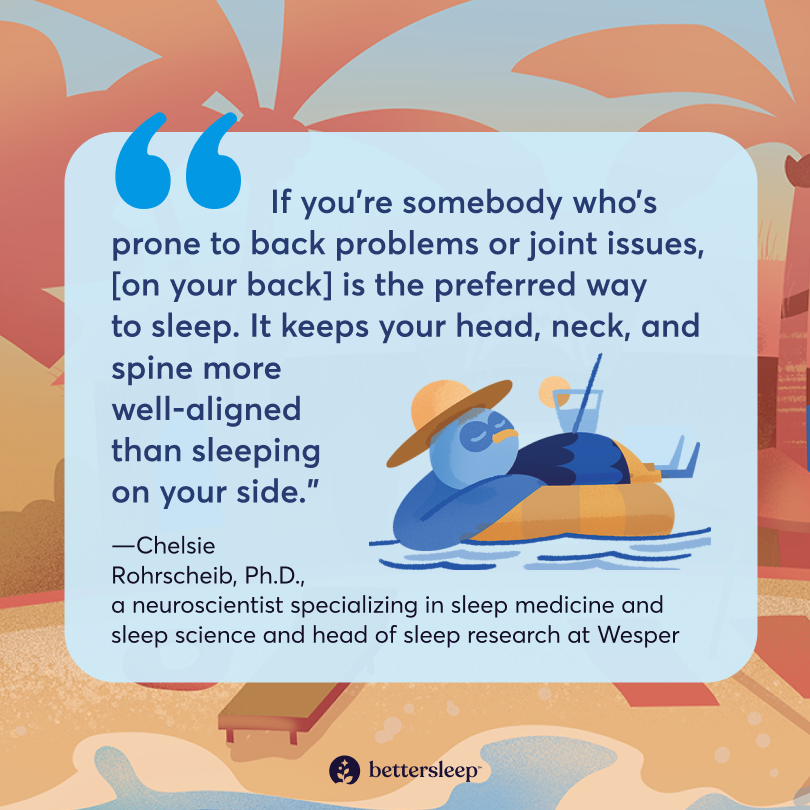
Also known as supine sleeping, back sleeping is pretty self-explanatory: You’re sleeping while lying on your back, face up, in a supine position. There are legit sleeping on the back benefits. “If you’re somebody who’s prone to back problems or joint issues, this is the preferred way to sleep,” Rohrscheib says.
Here are a few more specific benefits of back sleeping.
Reduces joint pressure
Sleeping face-up distributes body weight more evenly than stomach or curled-side positions. For people who feel pressure on their shoulders or hips, the supine posture may offer relief.
“It distributes pressure more evenly across your back, which can relieve pressure points and pain,” Rohrscheib says.
Prevents wrinkles and skin problems
Sleep wrinkles are a specific classification of facial creasing. They’re caused by compression from sleeping on your side or stomach. Back sleeping eliminates this compression by keeping you face-up in bed, thereby reducing wrinkles.
“When your face is pressed on a pillow when you’re side sleeping or sleeping on your stomach, that’s pressing on the skin, and that can definitely cause wrinkling,” Rohrscheib says. “It really depends on your genetics, and a lot of it has to do with how your body makes and maintains collagen in your skin. But because your face isn’t actually touching the pillow, it can help prevent those skin issues over time.”
Keeps the spine aligned
Compared with stomach sleeping, which forces the neck to rotate for hours, the supine posture keeps the cervical spine—the part of the spine that runs along the back of the neck—more neutral, Rohrscheib says. This may reduce morning stiffness and neck pain. “It keeps your head, neck, and spine more well-aligned than sleeping on your side,” Rohrscheib says.
That said, the real benefit is whichever sleep position helps you feel comfortable, fall asleep easily, and wake up rested. Back sleeping is one useful option—not the required one.
Is Sleeping on Your Back Good for You?
The short answer: it depends on your body’s needs. For instance, if you sleep on your side and have achy hips or sore shoulders when you wake up, back sleeping could be the ticket to pain-free mornings. But if you snore, you’re probably better off on your side.
“Back sleeping is generally best for people with certain types of back pain, for those recovering from some surgeries, or for individuals who prefer less pressure on their joints,” says Michael Howell, M.D., professor of neurology and division head of sleep medicine at the University of Minnesota and chief medical officer at GEM Sleep. “But people who snore, wake up unrefreshed, or have sleep apnea usually do far better on their side.”
But “good” is subjective. If back sleeping helps you relax and stay asleep, it may be ideal. If it worsens snoring or discomfort, another position may be better.
When Is It Bad to Sleep on Your Back?
There are certain situations in which back sleeping isn’t best. Here are some of them.
Snoring or sleep apnea
Back sleeping can worsen airway collapse in some people, especially those with obstructive sleep apnea (OSA).
“For some people, sleeping on the back can restrict breathing, especially if you’re somebody who has sleep apnea or is prone to disrupted sleeping when you’re on your back,” Rohrscheib says.
Why? “When you’re sleeping on your back, it’s allowing gravity to pull all of that soft tissue into the back of your throat, which can cause upper airway blockage,” she says. “That can prevent air from going into your lungs when you breathe.”
Instead, people who snore or who have sleep apnea are usually better off on their sides. “Side sleeping naturally improves airway mechanics and reduces the collapse we see when people lie flat,” Howell says.
But, if someone has been diagnosed with OSA and prefers sleeping on their back, using a continuous positive airway pressure (CPAP) machine and making sure it fits properly will likely be needed, Howell says.
Still, back sleeping isn’t guaranteed to make OSA better.“Not all sleep-apnea patients will find their breathing improves when they sleep on their side,” Rohrscheib says. “It’s about 50/50.”
OSA and any kind of restricted breathing during sleep may also impact the brain. Research has found an association between OSA and later development of Parkinson’s disease.
“There’s growing interest in how sleep position affects glymphatic function, which is the brain’s overnight ‘cleaning’ system,” Howell says. “Good breathing during sleep supports this system, so anything that disrupts airflow, like untreated OSA, may have downstream effects on brain health.”
Gastroesophageal reflux (GERD)
Gastroesophageal reflux (GERD) is an unpleasant and sometimes painful chronic digestive condition in which stomach acid flows back up into the esophagus. Lying flat may worsen reflux symptoms for some.
“When you’re sleeping flat on your back, those contents of your stomach are more prone to re-enter the esophagus,” Rohrscheib says. “Sleeping on your side can alleviate that, especially sleeping on your left side. That positions the stomach in a way that keeps the contents of your stomach at the bottom of your stomach.”
If you have GERD but prefer sleeping on your back, try to elevate your head higher than your feet. A 2021 systematic review found that elevating the head of the bed reduced nighttime reflux.
Late pregnancy
Some medical providers may caution against back sleeping in late pregnancy due to circulation concerns. While it’s not conclusive, some research has found an association between back sleeping after 28 weeks of pregnancy and too-small infant birth size and even stillbirth.
“When you’re lying flat on your back, it places a lot of pressure on certain arteries and veins that feed blood throughout the body, and that can restrict blood flow to the baby,” Rohrscheib says. “Usually it’s the third trimester that providers recommend you sleep on your side.”
For pregnant people who aren’t used to side sleeping—or who are just having trouble finding any comfortable sleeping position at all—a body pillow can offer additional support.
Certain types of back pain
Some individuals with low-back (lumbar) pain feel worse when lying flat, but others may feel better. A small pillow under the knees may help reduce lumbar pressure. Research has found back sleeping and supported side sleeping tend to be best for lower back pain.
A general rule of thumb: if symptoms worsen, back sleeping may not be ideal for you, or you may require some modifications rather than complete avoidance.
Why Can’t I Fall Asleep on My Back? Common Challenges
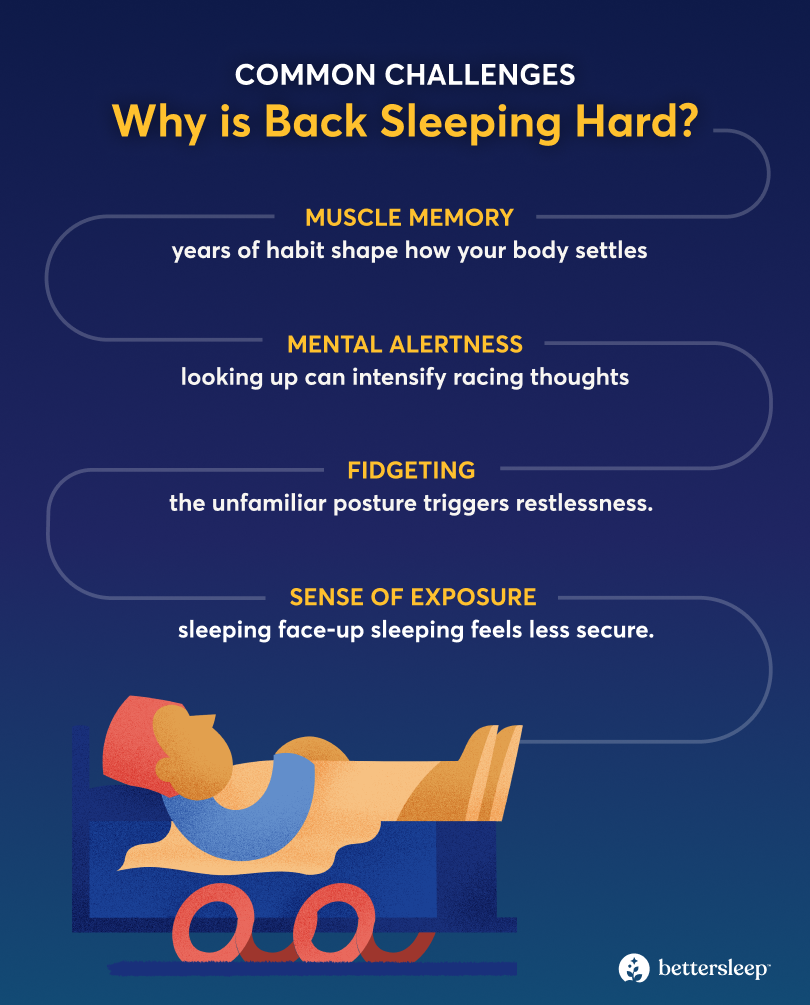
It’s not easy for everyone to sleep on their back, and it can certainly be difficult to switch sleeping positions when you’re used to something else. Here’s why back sleeping can be challenging for some people.
- Muscle memory: Your body defaults to familiar alignment, especially if you’ve slept the same way for years.
- Mental alertness: Staring at the ceiling or darting your eyes around your bedroom can sometimes make racing thoughts more noticeable.
- Fidgeting: The body may interpret the new posture as feeling strange, prompting repositioning.
- A sense of exposure: Being face-up can feel vulnerable or unfamiliar. Curled up on your side may feel a little safer.
How to Train Yourself for Comfortable Back Sleeping
You can actually train yourself to sleep in a new position, even if you’ve been a longtime stomach- or side-sleeper. But it probably won’t be a quick process.
“It takes time and persistence,” Rohrscheib says. “It’s not something that you’re going to be able to do automatically overnight.”
Start the night on your back
Begin your night on your back, then allow your body to move naturally later. This primes your nervous system to associate the posture with the winding-down phase.
“Start out a little at a time,” Rohrscheib says. “Try to sleep on your back initially, maybe a quarter of the night, and build from there. You’re essentially spending a few hours on your back. If you wake up, that’s OK. You can always switch to the side if you need.”
Try short “practice sessions”
Use naps or the first 10 to 20 minutes of rest to familiarize yourself with the posture. Consistency can lead to comfort over time.
“Try to prolong the time you spend on your back every few weeks until you get to the point where back sleeping feels pretty comfortable,” Rohrscheib says.
Get cozy with pillows
Use a pillow to close the gap between your neck and the mattress and keep your spine aligned. Look for a pillow that’s neither too soft (which will compress and make your head drop too low) nor too firm (which can also bring your head out of alignment). A pillow or folded towel between the knees (for side sleepers) or under the knees (for back sleepers) can also provide more support. Contour pillows designed for back sleeping can also keep the cervical spine aligned properly.
Use breathing cues
Breathing exercises can help encourage stillness and relaxation. Try 4-7-8 breathwork as a start. Breathe in through your nose for a count of four seconds, hold your breath for seven seconds, and then exhale forcefully through your mouth for a count of eight seconds.
Pair this with BetterSleep’s relaxing guided meditations, bedtime stories, or soundscapes to help your body settle.
Be patient
Adapting to a new sleep posture can take days to weeks. “Just like any major adjustment, you need to give yourself some grace,” Rohrscheib says. “It does take a bit of time, and you might also have to expect that your sleep quality might not be great while you’re making the adjustment. But it’s definitely something you can train yourself to do.”
Posture and Pillow Setup for Back Sleeping
There’s a reason Goldilocks was so picky about which of the three bears’ beds she slept in. The state of your bedding matters as much as the position itself. A few tweaks can dramatically improve comfort until it’s just right.
Pillow height
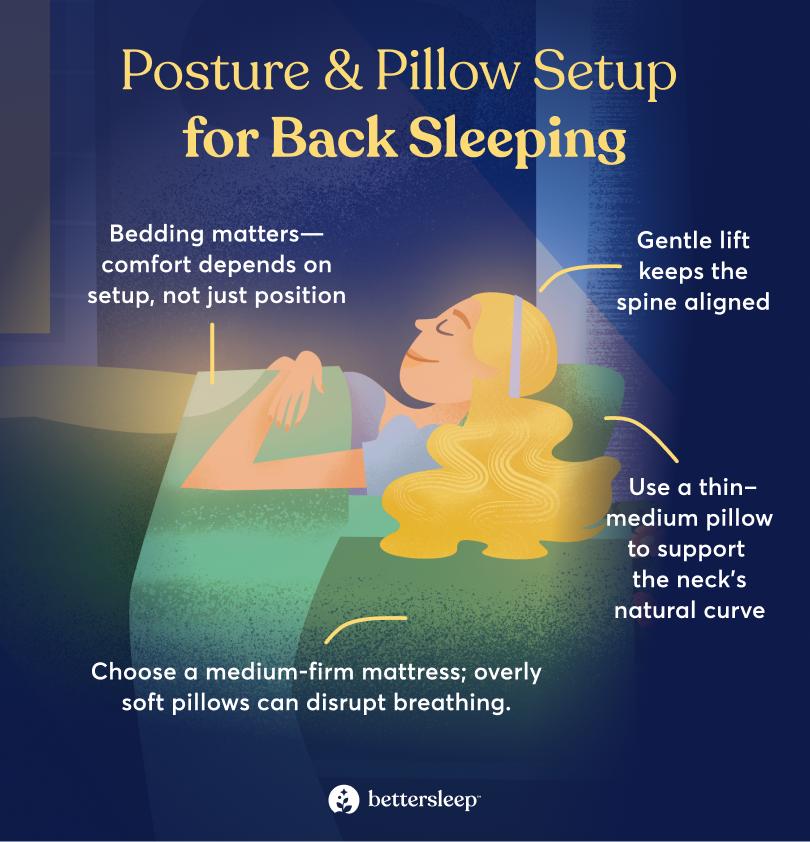
Pick a thin to medium-height pillow that supports the natural curve of the neck, Howell says. “Too-high pillows push the head forward, and too-low pillows flatten the neck.”
Research has found that when the head is too flexed forward, OSA symptoms can get worse.
“Your pillow should be only slightly elevated,” Rohrscheib says. “Too much elevation is going to cause spinal misalignment.”
As nice as it may feel to sink into a cloudlike pillow, too soft isn’t good, either. “A pillow that’s too soft is going to put your head in some weird positions, which can cause breathing disruptions and other problems,” Rohrscheib says. “Look for a pillow that’s medium to firm.”
Mattress considerations
Both experts say to steer clear of mattresses that are too soft. “Look for a medium-firm mattress that keeps the hips from sinking too deeply but still offers enough contouring for the lower back,” Howell says.
“We generally don’t recommend overly soft mattresses for pretty much anyone,” Rohrscheib says. “I know some people really like a very cushy, soft mattress. The issue with it is that it causes a lot of uneven distribution across your body that can cause your spine and your joints to be out of alignment. It can also negatively impact your respiration because your body can get into a position that isn’t conducive to good breathing.”
A memory-foam mattress topper can be a good compromise, Rohrscheib says. “It does a really good job of being both soft and supportive at the same time. What I like about memory foam is there are no springs, so there are really no pressure points against your body.”
But some sleep conditions can’t be helped by a new mattress or pillow. “Sleep position matters most when it affects how well you breathe,” Howell says. “The most luxurious topper or mattress won’t overcome poor airflow at night. If snoring, choking or persistent fatigue continue no matter what position you try, that’s a sign to look beyond bedding and consider sleep apnea.”
Back Sleeping vs. Side and Stomach Sleeping
No sleep position is universally ideal for everyone. Each one has its pros and cons.
Back sleeping
Back sleeping can:
- improve spinal neutrality
- lessen shoulder and hip pressure
- reduce facial compression and wrinkles
- compress airways and make snoring and sleep apnea symptoms worse
Side sleeping
Side sleeping can:
- be helpful for snoring and sleep apnea
- be helpful for GERD or reflux
- be more comfortable and safer in later pregnancy
- alleviate certain breathing patterns or problems
- put pressure on joints and nerves or cause neck to be misaligned
Stomach sleeping
Sleeping face-down can:
When to Talk to a Healthcare Provider About Your Sleep Position
Sleep position is generally a low-risk area of experimentation, but certain symptoms call for professional guidance. If you’re not getting restful sleep or know that you snore, you should talk to your healthcare provider to try to determine the root cause.
Also, speak to your doctor about sleep position during pregnancy or if you have other conditions that make sleeping difficult, like GERD. Providers can clarify whether back sleeping is appropriate or if a different strategy could be more effective.
Sleep Hygiene Tips to Support Better Sleep (in Any Position)
Good sleep comes from habits. These strategies support relaxation whether you’re lying on your back, side, or stomach.
Keep a consistent sleep schedule
Regular sleep and wake times strengthen circadian rhythms that make it easier to fall asleep at night.
Create a reliable wind-down routine
Wind down an hour or two before bed with dim lights, gentle stretching, a warm shower, and screen-free activities like reading can ease you into a calmer state that’s ready for sleep.
Optimize your environment
Set the thermostat in your bedroom to a cool temperature (60–67°F). If noises wake you up, try sleep sounds to mask them. Make your room as dark as possible. Choose comfortable pajamas and bedding.
Add breathwork or relaxation audio
Lying on your back is the perfect position for deep belly (diaphragmatic) breathing, which some research has found can improve sleep quality. BetterSleep offers guided breathing meditations, as well as relaxing soundscapes to help you fall into slumber in no time.
Use a sleep position log
Keep track of your comfort, pressure, and snoring patterns for a week or longer to help identify whether back sleeping truly benefits you.
The Bottom Line
The best sleep position is the one that helps you wake up rested and refreshed. Everyone’s optimal position depends on their own body’s particular needs. Back sleeping can help ease pain and pressure and reduce facial wrinkling, but it’s not the best option for snoring, sleep apnea, or pregnancy. Choosing the right mattress and pillow height can help make back sleeping more comfortable.
Key Takeaways
- Back sleeping can support neutral spinal alignment and reduce joint pressure.
- It may offer skin and cosmetic benefits by reducing facial compression.
- It’s not ideal for everyone. Snoring, GERD, pregnancy, and some other conditions can make it less suitable.
- You can train yourself to sleep on your back using gradual practice, pillows, breathing cues, and BetterSleep tools.
Frequently Asked Questions (FAQs)
Is it healthier to sleep on your back?
It can be for some people, especially for spinal alignment or reducing pressure points, but it isn’t universally best.
What’s the healthiest sleeping position?
The healthiest sleep position is the one that supports consistent, high-quality sleep without pain or breathing disruption. It depends on each person’s individual needs.
What is the unhealthiest position to sleep in?
Stomach sleeping is often considered hardest on the neck and spine, though some people still find it comfortable. It can be good for sleep apnea.
What happens if you sleep on your back every night?
It may support joint comfort, more evenly distribute body weight, and prevent wrinkles. But if it worsens snoring or reflux, side sleeping may be better.
Why do you sleep better on your back?
That’s not universally true for everyone. Some people find the neutral alignment relaxing. Others may feel less pressure and easier breathing.