Do Probiotics Improve Sleep Quality? An Evidence Synthesis
A synthesis of 20 randomized controlled trials and five meta-analyses indicates that probiotics produce modest, strain-dependent improvements in subjective sleep quality, but not in objective measures such as total sleep time. Benefits are most pronounced in people with insomnia, stress, or anxiety, and typically emerge over four to eight weeks. Effects depend on the specific strain rather than probiotics as a category, and for most people dietary fiber and plant diversity are a higher-leverage way to support the gut–sleep axis.
Probiotics for sleep have become one of the more popular claims in the wellness world. Scroll through social media or supplement websites and you'll find plenty of promises that improving your gut health can help you sleep better. At the same time, some experts remain skeptical, pointing to studies that show little or no measurable benefit.
So which is it?
The answer sits somewhere between those two positions. Some studies suggest probiotics can improve how rested people feel, particularly if they already struggle with poor sleep or insomnia. Other studies find little effect, especially when researchers look at objective measures like total sleep time.
I'm Ivan Nonveiller. To better understand the evidence, I analyzed and synthesized findings from 20 randomized controlled trials and five competing meta-analyses examining probiotics and sleep. What emerged wasn't a simple yes-or-no answer. The evidence points to a modest benefit for some people, while also revealing a bigger lesson: the most reliable way to use your gut to support sleep probably isn't a capsule at all.
The Gut–Sleep Connection Is Real (Here's the Mechanism)
The idea that your gut might influence your sleep isn't fringe science anymore. Researchers now recognize a complex communication network called the gut-brain axis that connects the digestive system and the central nervous system.
This communication happens through several pathways. Gut microbes produce compounds that influence brain function, while signals travel back and forth along the vagus nerve. The immune system also helps carry messages between the gut and the brain, and hormones involved in stress regulation can affect the conversation as well.
One discovery from sleep research decades ago still stands out. Scientists searching for substances that promote sleep isolated a compound called muramyl peptide, which is derived from bacterial cell walls. The human body can't produce it on its own. It comes from microbes. That finding helped establish that bacteria and sleep biology may be connected in ways researchers hadn't previously appreciated.
Researchers have identified several mechanisms that help explain the connection between gut health and sleep.
Certain gut bacteria help produce compounds that influence sleep regulation. Some affect neurotransmitters including GABA and serotonin, both of which play roles in mood and sleep. The microbiome may also affect cortisol regulation and the body's stress response.
Another pathway involves short-chain fatty acids (SCFAs), compounds produced when gut bacteria ferment dietary fiber. One of the most studied is butyrate. Researchers believe SCFAs may help regulate inflammation, support healthy circadian rhythms, and influence communication between the gut and the brain.
The microbiome may also affect how the body handles stress. Several researchers have proposed that certain gut bacteria help regulate the hypothalamic-pituitary-adrenal (HPA) axis, which controls cortisol production. When that system becomes dysregulated, sleep often suffers.
Human studies add another piece to the puzzle. Researchers have found that people with more diverse gut microbiomes tend to have better sleep efficiency and longer total sleep time than those with less microbial diversity. Correlation doesn't prove cause and effect, but the findings strengthen the case that sleep and gut health are closely connected.
It Goes Both Ways
The relationship isn't one-directional. Just as gut health may influence sleep, sleep habits can influence gut health. That bidirectional relationship becomes important later when we look at why improving sleep and supporting the microbiome often work best together rather than separately.
For more on the gut-brain axis and your sleep-wake cycle, see BetterSleep's guide to circadian rhythm regulation.
So Do Probiotics Actually Help You Sleep?
The short answer is yes—but with important caveats. The best available evidence suggests that probiotics can modestly improve sleep quality for some people, particularly those with insomnia or poor sleep. At the same time, the effects tend to be small, they don't appear to significantly increase total sleep time, and not every review has found a benefit.
The problem is that many articles flatten that nuance.
Several recent reviews found evidence that probiotics improve sleep quality. A 2026 meta-analysis that pooled 39 randomized controlled trials concluded that probiotics produced modest improvements in subjective sleep outcomes. Other reviews published between 2024 and 2026 reached similar conclusions.
Not all of those reviews found the same magnitude of benefit, but they did generally point in the same direction. Some reported modest improvements in overall sleep quality, while others found stronger effects in people with diagnosed sleep problems than in healthy sleepers.
That's one reason it's important to look beyond the headline conclusion of a meta-analysis. Reviews that include different populations, different strains, and different outcome measures can arrive at different estimates of benefit even when they're examining the same general question.
The field has also evolved quickly. Several of the newer reviews include randomized trials that weren't available to earlier researchers. As more studies have accumulated, the picture has become clearer: probiotics don't appear to be a major sleep intervention, but certain strains may provide modest benefits under the right circumstances.
Viewed together, those findings suggest a small but measurable effect. However, they don't tell the whole story.
A 2023 systematic review and meta-analysis reached a different conclusion, finding that gut microbiota interventions did not significantly improve sleep quality or sleep duration overall.
The apparent contradiction comes down to three things.
First, many positive findings involve subjective sleep quality rather than objective sleep outcomes. In other words, people often report feeling more rested, sleeping better, or experiencing better overall sleep quality. However, sleep trackers and laboratory measurements frequently show little change in total sleep time.
What "Improves Sleep" Really Means Here
If you wake up feeling more refreshed and less stressed, that's a meaningful improvement. But it's different from adding an extra hour of sleep every night.
Several reviews have found that baseline sleep quality appears to matter. Participants who entered studies with insomnia symptoms, elevated stress levels, or poor sleep scores generally showed greater improvement than those who were already sleeping reasonably well.
That's a common pattern in sleep research. The worse the starting point, the easier it is to detect meaningful improvement. Someone who sleeps seven and a half hours and feels rested most mornings simply has less room to benefit than someone who lies awake for hours every night.
Second, the benefits aren't evenly distributed. Some populations appear to respond better than others, which helps explain why results vary from study to study.
Third, strain selection and duration matter. Many studies showing positive results used specific strains and intervention periods lasting at least four to eight weeks. Studies using different strains or shorter timelines often reported weaker effects.
After reviewing the evidence, my conclusion is straightforward: probiotics can modestly improve how some people experience sleep, but they aren't a reliable way to increase sleep duration or replace proven sleep interventions.
That's also why sleep experts generally stop short of broadly recommending probiotics as a sleep treatment. The signal exists, but it's relatively small and highly dependent on who takes them and which strains are used.
If you're evaluating probiotics for sleep, think of them as a possible supporting player rather than the star of the show.
Who Actually Benefits (And How Long It Takes)
People who already sleep poorly tend to benefit the most.
Participants with insomnia, chronic stress, anxiety-related sleep problems, or reduced sleep quality generally show larger improvements than healthy sleepers. If you already sleep reasonably well, the evidence suggests you're unlikely to notice much change.
That finding makes intuitive sense. When someone already sleeps well, there's less room for improvement.
Another important takeaway is timing.
Most probiotic studies run for four to eight weeks or longer. Unlike a sleep aid that may produce immediate effects, probiotics appear to work gradually. Any benefit likely develops over time as the gut environment changes.
Probiotics, Sleep, and Anxiety
Some of the most promising studies involve psychobiotics, a term used for probiotics that may influence mental health and stress regulation.
Interestingly, several trials suggest sleep improvements may occur partly because participants experience reductions in anxiety, stress, or depressive symptoms.
That doesn't mean probiotics directly treat anxiety. It does suggest that improving mood and stress resilience could indirectly support better sleep.
Readers interested in how anxiety keeps you awake may find that connection particularly relevant.
The practical implication is simple: if your sleep problems are closely tied to stress, anxiety, or feeling mentally wound up at night, probiotics may have a better chance of helping than if your primary issue is simply not getting enough time in bed.
Which Strains Have Evidence?
One of the biggest mistakes in probiotic marketing is treating all probiotics as if they're interchangeable.
They're not.
Different strains behave differently, and evidence supporting one strain doesn't automatically apply to another.
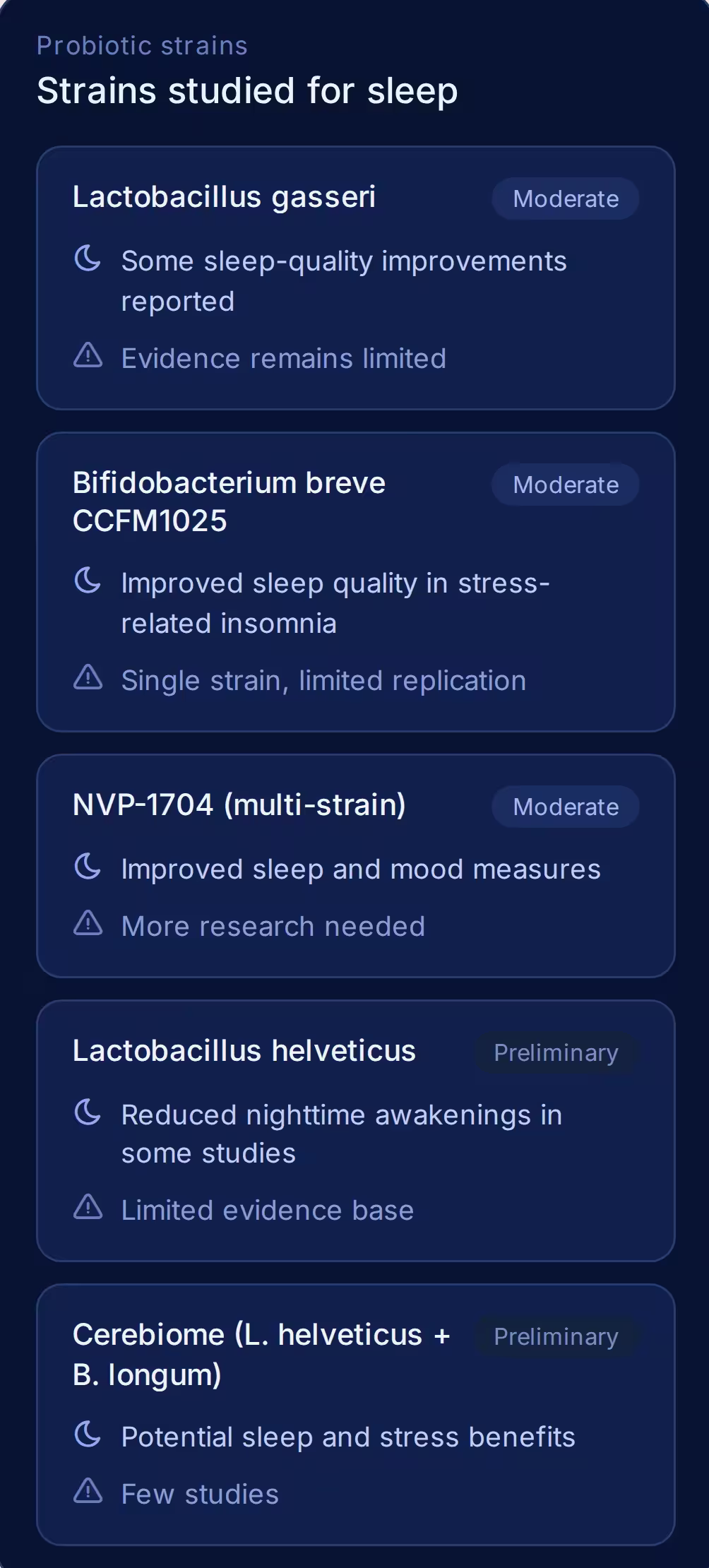
Another important takeaway is that strain names matter far more than marketing language. A product labeled "probiotic blend" tells you very little about whether it contains strains that have actually been studied for sleep.
That's also why comparing products based on colony-forming units (CFUs) alone can be misleading. A supplement containing 50 billion CFUs isn't automatically better than one containing 5 billion. The more important question is whether the specific strains have demonstrated benefits in clinical trials.
At the moment, the strongest evidence supports a handful of strains rather than probiotics as a category. That's an important distinction because evidence for one strain doesn't automatically transfer to another.
So what's the best probiotic for sleep?
At this point, there isn't a clear winner.
The evidence simply isn't strong enough to crown a single strain. What's more important is whether a product contains a strain that has actually been studied rather than relying on broad marketing claims about "gut health."
I know that's a less exciting answer than many supplement companies would like, but it's the honest one.
The Higher-Leverage Move: Feed the Microbiome You Already Have
After reviewing the research, I came away convinced that the most reliable way to influence the gut-sleep relationship isn't through a probiotic supplement. It's through diet.
The microbiome responds continuously to what you eat.
Fiber-rich foods feed beneficial bacteria. Greater plant diversity supports microbial diversity. Fermented foods introduce beneficial microbes and compounds that support a healthier gut ecosystem.
What you eat every day has a larger and more consistent effect on your microbiome than any single probiotic capsule.
One concept that has gained attention in microbiome research is plant diversity. Rather than focusing on a single "superfood," researchers increasingly emphasize eating a wide variety of plant foods throughout the week. Fruits, vegetables, legumes, nuts, seeds, herbs, and whole grains all provide different fibers and compounds that support different microbial species.
Many microbiome researchers point to a practical target of roughly 30 different plant foods per week. You don't need to count obsessively, but the idea highlights an important principle: diversity tends to support diversity. A more varied diet generally creates a richer microbial ecosystem than relying on the same foods every day.
Probiotics vs. Prebiotics vs. Fermented Foods
Probiotics get most of the attention, but they're only one way to influence the microbiome. Here's how probiotics, prebiotics, and fermented foods compare when it comes to supporting gut health and, potentially, better sleep.
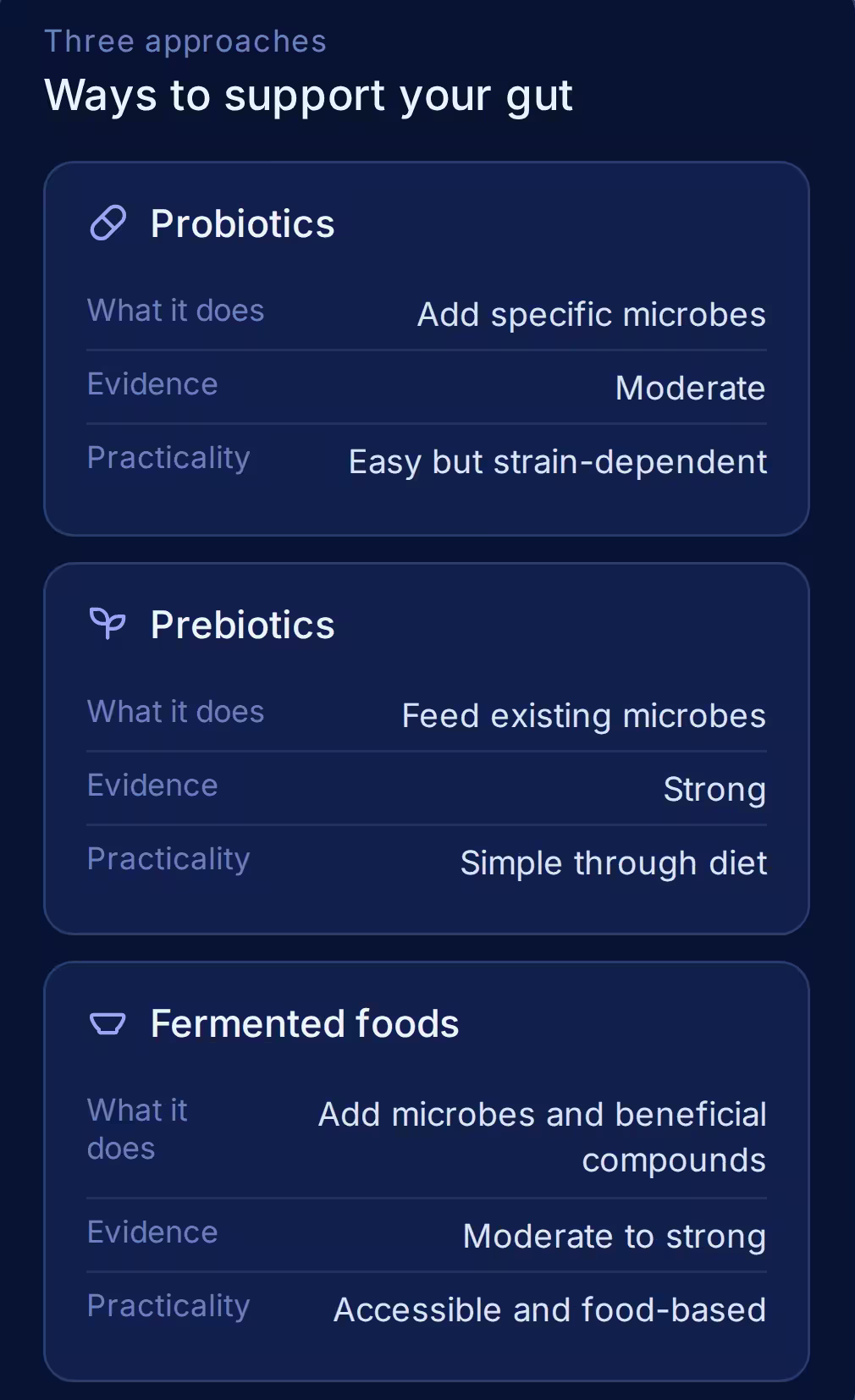
Foods such as yogurt, kefir, kimchi, sauerkraut, miso, and fermented vegetables support gut health while also influencing some of the same biological pathways that help regulate sleep.
Combined with foods that support better sleep, how late-night meals impact sleep, and the basics of sleep hygiene, these dietary habits likely provide more value than chasing the latest supplement trend.
A probiotic can complement those habits. It probably shouldn't replace them.
It Cuts Both Ways: How Poor Sleep Wrecks Your Gut
The gut-sleep relationship works in both directions.
Research shows that sleep deprivation alters the composition of the gut microbiome, reducing beneficial bacteria and increasing signs of dysbiosis.
Even relatively short periods of inadequate sleep affect microbial balance, inflammation, metabolic health, and stress regulation.
That creates a feedback loop.
Poor sleep contributes to a less favorable microbiome. In turn, changes in the microbiome can influence processes involved in sleep regulation, making quality sleep harder to maintain. The cycle can reinforce itself over time.
The relationship also works in the opposite direction.
Supporting your gut through diet while improving sleep habits can create a positive cycle in which each reinforces the other.
Several mechanisms appear to drive this process. Sleep loss increases inflammation, alters hormone regulation, and disrupts normal feeding patterns. Those changes influence which microbes thrive and which decline within the gut.
Circadian disruption appears particularly important. The microbiome follows daily rhythms just as the rest of the body does. When sleep schedules become inconsistent, those microbial rhythms become disrupted as well, affecting metabolism, immune function, and sleep regulation.
That's one reason why consistency matters more than duration when building healthy sleep habits. A predictable routine gives both your circadian system and your microbiome a more stable environment.
The biggest lesson from this research isn't that probiotics are a secret sleep hack.
It's that sleep and gut health are connected enough that improving one often helps the other.
The Bottom Line
So, do probiotics improve sleep quality?
The best reading of the evidence is yes—but only modestly, and not for everyone.
The strongest benefits appear in people who already struggle with poor sleep, insomnia symptoms, stress, or anxiety. Even then, the improvements tend to show up more in how rested people feel than in objective measures such as total sleep time.
That's still meaningful. Feeling more rested matters.
The bigger takeaway is that sleep and gut health appear to work together. Certain probiotic strains may provide modest benefits, but the strongest evidence still points toward the fundamentals: a varied, fiber-rich diet, a consistent sleep schedule, stress management, and a sustainable bedtime routine.
If you decide to try a probiotic, choose a strain that has actually been studied and give it several weeks to work. Just keep your expectations realistic. No supplement is likely to outperform the habits that support both a healthy microbiome and healthy sleep.
If you're looking for help building those habits, BetterSleep can help you create a more consistent sleep routine through guided programs, relaxation tools, and evidence-based sleep support.
Frequently Asked Questions
Do probiotics actually help you sleep?
Sometimes. Research suggests probiotics can produce small improvements in subjective sleep quality, especially among people with insomnia or poor sleep. However, effects on objective measures such as total sleep time are often weak or absent, and some reviews have found no significant overall benefit. Think of probiotics as a modest supporting tool rather than a sleep solution. Many people also explore magnesium and other sleep supports, although the evidence varies depending on the supplement.
What's the best probiotic for sleep?
There isn't a clear winner. Strains with some supporting evidence include Lactobacillus gasseri, Bifidobacterium breve CCFM1025, and multi-strain formulas such as NVP-1704. The specific strain matters far more than broad marketing claims.
How long do probiotics take to improve sleep?
Most studies run for four to eight weeks or longer. Probiotics aren't designed to work overnight. If they help, the benefit typically develops gradually over several weeks of consistent use.
Can probiotics cause sleep problems or side effects?
For most people, probiotics are well tolerated. Temporary digestive symptoms such as gas or bloating can occur while the gut adjusts. They're not generally known to worsen sleep. People who are immunocompromised or seriously ill should consult a healthcare professional before taking them.
Is it better to take a probiotic supplement or eat fermented foods?
For long-term microbiome support, diet is usually the stronger lever. Fiber-rich foods, diverse plant foods, and fermented foods help support beneficial microbes continuously. Supplements may complement those habits but shouldn't replace them.
Can fixing my sleep improve my gut health?
Yes. Research suggests poor sleep can negatively affect the microbiome, while healthy sleep habits support a healthier gut environment. That's why sleep and gut health are best viewed as part of the same system rather than separate goals.