The State of Mom Sleep in 2026: What 1,000 Tired Moms Told Us
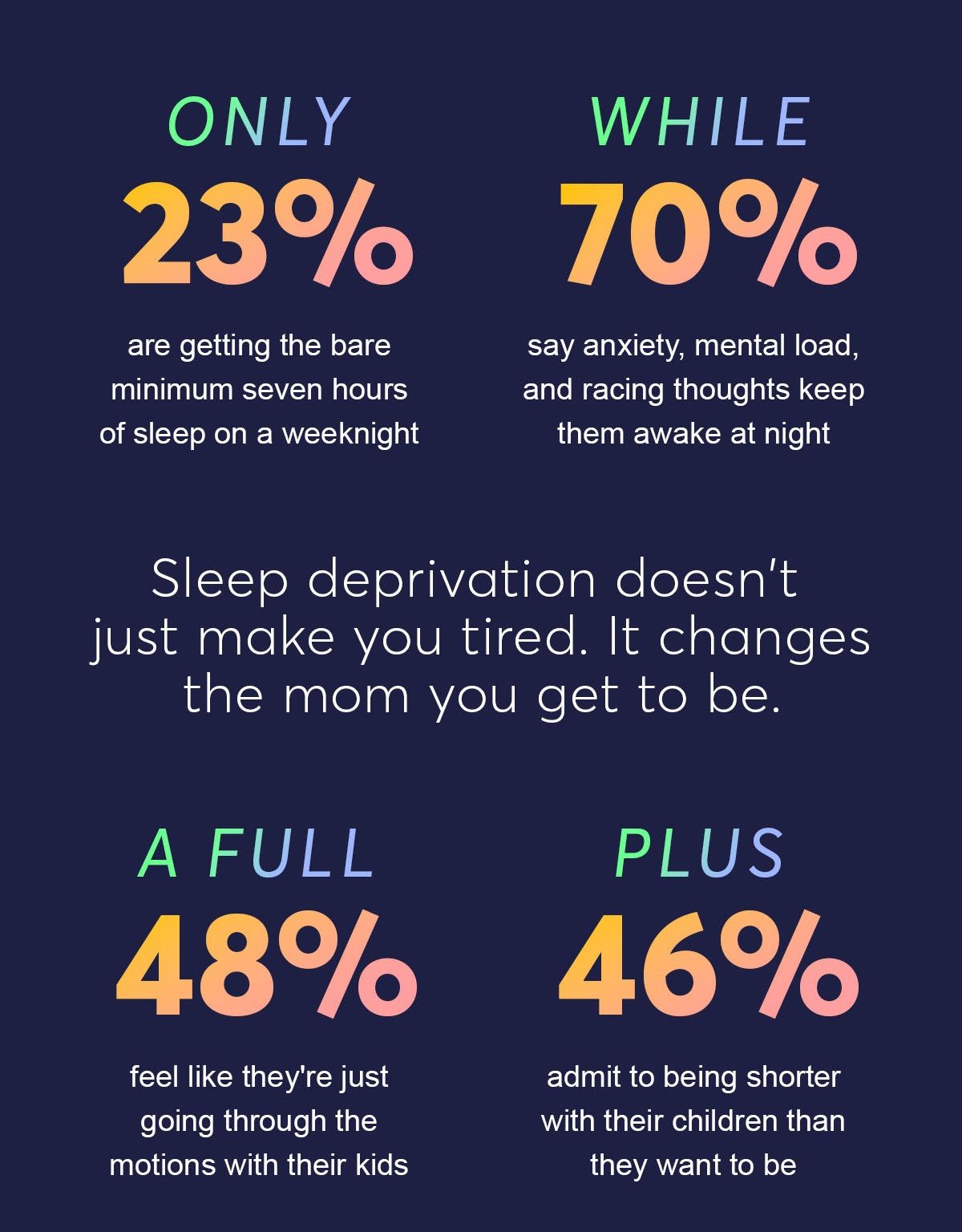
Only 23% of U.S. moms get at least seven hours of sleep on a weeknight, and 70% say anxiety and mental load keep them awake — while 73% feel their exhaustion goes unseen or deprioritized by the people closest to them.
It's 2:47 AM.
You're not sleeping. You should be sleeping. Everyone in the house is sleeping except you. And the thing keeping you awake isn't a crying baby or a barking dog or the neighbor who insists on parking his truck like that. It's a list. A long, winding, horrible little list that showed up behind your eyes the second your head hit the pillow.
Did you sign the field trip form? Is there milk? When was the last time you scheduled your own dentist appointment — and is that a thing you're supposed to do before or after the kids'? What was that weird thing your toddler said at dinner? Was that normal? Should you Google it? You should not Google it. You're going to Google it.
If you've ever had a night like that — and if you're a mother, you have — this piece is for you.
We partnered with Wakefield Research and surveyed 1,000 moms in the United States with kids under 18 at home. We asked them how much they sleep, what keeps them awake, what they've given up, and whether anyone around them even notices how tired they are. The answers are going to feel familiar. They might also feel like a relief — because the thing you thought was just happening to you? It's happening to pretty much everyone.
You are not broken. You're in very, very crowded company.
Most moms are running on nothing. And they've been doing it for a long time.
Here's the number that should not be real but is: only 23% of moms get at least seven hours of sleep on a normal weeknight. Seven hours. The bare-minimum, doctor-recommended, absolutely-not-a-luxury floor. Fewer than one in four of us is clearing it.
The rest of us live somewhere in the in-between. A little tired. Very tired. That specific kind of tired where you walk into a room and forget entirely why you're there, and also you're holding a sock.
- 14% of moms are getting 4–5 hours. 2% are getting less than 4.
- 26% are scraping by on 5–6 hours. Another 35% get 6–7 — close, but not close enough.
- 29% haven't woken up feeling rested a single morning in the past week. Not one.
- 67% have only felt rested three days or fewer out of the last seven.
Single moms are carrying it heaviest. A third (33%) of moms who aren't married or partnered are running on five hours or less on weeknights, compared to 13% of partnered moms. And here's a quiet heartbreaker: among moms who aren't currently employed, 44% haven't felt rested even once in the past week. Turns out being home all day doesn't mean anyone let you rest.
It's almost never the baby. It's the list.
We asked moms to rank the top three things keeping them from sleep. One answer crushed every other:
70% of moms said anxiety, mental load, or racing thoughts.
Higher than kids waking them up (43%). Higher than a partner's snoring or sleep habits (20%). Higher than work spilling into the evening (44%). The number one thing standing between a mom and sleep is her own brain, still open for business at 1 AM, taking inventory of everything she didn't finish today and everything that's coming tomorrow.
And then there's the second most common answer, which is honestly the one that broke us a little:
68% of moms said they stay up late on purpose. Because those quiet hours after the kids are finally down? That's the only time they have to themselves.
Researchers call this "revenge bedtime procrastination," which is a clinical way of saying: when every waking hour belongs to someone else, the only way to take anything back is to steal it from your own sleep. It's not that moms don't want to sleep. It's that staying up is the only time they get to be a person.
And the pattern shifts with the season of motherhood. Moms of teenagers (oldest kid 13–18)? 79% say mental load is their top barrier. Moms of preschoolers (oldest 3–5)? 75% admit they're staying up late on purpose, and 46% rely more on screens to get through the next day. Different stages. Same exhaustion.
"A lot of moms — some dads, but mostly moms — almost become hard-wired to listening for what I call 'sleep threats.' Even after the threat is gone, they continue to have trouble with sleep because they're so conditioned to listening."Dr. Shelby Harris, PsyD, DBSM
Sleep deprivation doesn't just make you tired. It changes the mom you get to be.
This is the part of the data that hurt the most to read. 76% of moms told us that not getting enough sleep significantly affects how they show up for their kids. Not a little. Significantly.
Here's what that actually looks like:
- 48% feel like they're just going through the motions with their kids.
- 46% are shorter with them than they want to be.
- 34% are leaning harder on screens or TV to survive the day.
- 20% feel emotionally disconnected from their own children.
- Only 24% say it doesn't really affect their parenting.
Read that again. Three in four moms feel like poor sleep is changing who they are as a mother. Nearly half feel like they're just going through the motions with the people they love most in the world. And almost half are snapping — not because they're bad moms, but because they've been running on empty for so long they can't find the patience they know is in there somewhere.
If that's you, please hear this: it's not a character flaw. It's a biology problem. When you're sleep-deprived, the part of your brain responsible for patience and perspective (the prefrontal cortex) goes offline, and the part responsible for "WHY IS THE PASTA THE WRONG SHAPE" (the amygdala) goes into overdrive. The mom you want to be is still in there. She just can't get to the surface when she hasn't slept in three days.
Newer moms are getting hit especially hard. Among moms whose kids are all 2 or younger, 73% say their kids are the thing directly interrupting their sleep. 59% feel like they're going through the motions. And 55% of them — who also work — have called in sick, left work early, or underperformed more than once in the past year.
It's not just happening at home. Work is taking a hit too.
53% of working moms — more than half — have called in sick, left early, or underperformed at work in the past year because they didn't sleep. More than a third of them (36%) have done it more than once.
The generational split is interesting, though: Gen Z moms (65%) and Millennials (55%) are way more likely to report this than Gen X (39%). Part of that is stage of life — younger kids, newer chaos. Part of it is that younger generations are simply more willing to name what's happening instead of white-knuckling through it.
And here's the kicker: even among moms who haven't called in sick, 56% told us they've wanted to. They just couldn't.
If you're a manager reading this, sit with that number for a second. A majority of working moms are missing, leaving, or underperforming at work because they're not sleeping — and another huge chunk is showing up anyway, running on fumes, and praying nobody notices. That's not a personal productivity issue. That's a structural one.
The cruelest part: sleep deprivation takes the things that would help you survive it
When you don't sleep, you can't cope. And when you can't cope, you give up the things that help you cope. Which means sleep deprivation takes, in roughly this order:
- 49% of moms have reduced exercise.
- 46% have cut back on hobbies or creative outlets — the things that made them feel like them.
- 45% are spending less time with friends.
- 37% are having less sex (that number jumps to 48% among Gen Z moms).
- 34% of partnered moms say they feel less connected to their partner.
- 22% have pulled back from therapy or mental health care. The thing they were doing to feel better. Gone.
- 19% have stepped back from career goals or promotions.
Look at that list. That's not just fatigue. That's a slow erosion of everything that makes a woman a person outside of her role as a mother. Movement. Creativity. Friendship. Intimacy. Her own mental health. Her career. All of it, chipped away, one bad night at a time.
This is the part that doesn't make it into the Instagram captions.
What moms would give up for ONE extra hour of sleep per night
We wanted to know how badly moms wanted more sleep. So we asked them what they'd trade to get one guaranteed extra hour a night. The answers are a little heartbreaking and a little funny, which is basically motherhood in a nutshell.
- 48% would give up social media. (No more scrolling. Just sleep.)
- 44% would give up TV and streaming.
- 31% would give up dining out and takeout.
- 29% would give up time with their friends.
- 26% would give up sex.
- 24% would give up exercise.
Over half would hand over the scroll-and-stream downtime most people fight to protect. A full quarter would give up physical intimacy with their partner. For an hour. Of unconsciousness.
That's not apathy. That's a woman who is so tired she would rather be asleep than do literally anything else. Including the things most people think of as fun.
The rise of the sleep divorce (and why it's not actually a divorce)
44% of moms have slept in a separate room from their partner specifically to get better sleep. 13% do it regularly. 31% do it occasionally. Another 20% are thinking about it. That's 64% of moms who've either moved out of the bed or considered it.
There's still some cultural weight pulling against it. 44% of Gen Z moms say they've never considered sleeping apart — there's a generational attachment to the idea that couples sleep together, full stop. But across the board, moms are quietly making a different choice: their sleep is worth more than the tradition.
And it's not a rejection of the relationship. It's usually the opposite. A mom who slept for seven hours is a better partner than a mom who got four and is now furious at you for breathing. Sometimes the most loving thing you can do for a relationship is sleep down the hall.
The two numbers that sum up the whole thing
If you read nothing else in this piece, read these two stats together. Because together they explain why mom sleep deprivation isn't really a sleep problem. It's something bigger.
Number one: 36% of moms think rest is something they have to earn.
They told us they only allow themselves to sleep once everything else is done. (Spoiler: it is never done.) Another 36% said rest is basically impossible because there's always someone or something that needs them. Only 28% treat rest like it matters and actually protect it. 25% said rest feels selfish. And 17% said they haven't had the space to even think about rest in years.
Years. Years!
Number two: 73% of moms don't feel their exhaustion is actually seen.
40% said the people closest to them acknowledge their need for sleep… and then routinely deprioritize it anyway. 33% said their exhaustion is flat-out invisible — the people around them don't notice at all. Only 27% of moms said the people closest to them see how tired they are and actively help them get rest.
Put those two numbers together: moms feel they have to earn sleep, and the people around them aren't seeing how badly they need it. That's the whole engine of mom sleep debt, right there. It's not a routine problem. It's a permission problem. From the outside and from the inside.
Okay. So what actually helps?
Let's not pretend we're going to solve motherhood in the final third of a blog post. We're not. But if you saw yourself in any of these numbers, here are a few things that are genuinely worth trying — not because they're magic, but because they're small, and small is what works when you have nothing left.
Dump your brain onto paper before you get into bed.
Five minutes. A notebook by your bed. Write down every task, worry, half-finished thought, and passive-aggressive email you haven't sent yet. Studies on pre-sleep cognitive arousal show that externalizing mental load reduces the time it takes to fall asleep. Your brain is not trying to torture you at 2 AM. It's trying to make sure you don't forget anything. Once it's on paper, it can let go.
Anchor your wake time, not your bedtime.
You can't always control when you fall asleep (see: 2 AM brain). But you CAN control roughly when you get up. Keeping your wake time consistent — even within 30 minutes, even on weekends — resets your circadian rhythm harder than any bedtime routine ever will.
Get outside in the first hour after you wake up.
Ten to fifteen minutes of natural morning light is one of the highest-yield things you can do for your sleep, and it costs nothing. It's not a productivity hack. It's literally how your biology knows what time it is.
Put something on your ears that isn't your own thoughts.
Guided sleep content, pink noise, a calm sleep meditation — they work because they quiet the part of your brain that generates mental-load loops. This is, not coincidentally, what BetterSleep was built for. Nearly half of our most-played content is accessed after 10 PM, by parents who need their brain to stop talking so they can finally sleep.
Say it out loud: "I'm acting like rest is something I have to earn."
Name the trap. It sounds silly until you try it. Catching yourself in the earned-rest mindset is the first step to interrupting it — because once you see it, you can't un-see it. And once you can't un-see it, you can start making different choices.
If no one has said this to you today
You are not imagining it. You're tired because you are living a life that would make anyone tired, and you are doing it in a culture that has spent a very long time pretending that shouldn't be the case.
1,000 moms just said it in unison: they are running on nothing, nobody's really seeing it, and they feel like they have to earn the one thing their body literally can't function without.
If that's you — if you recognized yourself anywhere in this piece — here is the only thing we really want you to take away from it:
You don't have to earn sleep.
You just need it. Same as air. Same as water. Same as every other mom reading this tonight, probably at 2:47 AM, probably with one ear open, probably wondering if it's just her.
It is not just you. It never was.
About the survey
The BetterSleep Survey was conducted by Wakefield Research among 1,000 nationally representative U.S. mothers with children under 18 at home, between April 6 and April 14, 2026, using an email invitation and online survey. Data has been weighted. Margin of error is ±3.1 percentage points at 95% confidence.