How to Get More Deep Sleep: An Evening Routine That Works
Medically reviewed by: Jared Meacham, PhD, RD, CSCS and Patricia Weiser, PharmD
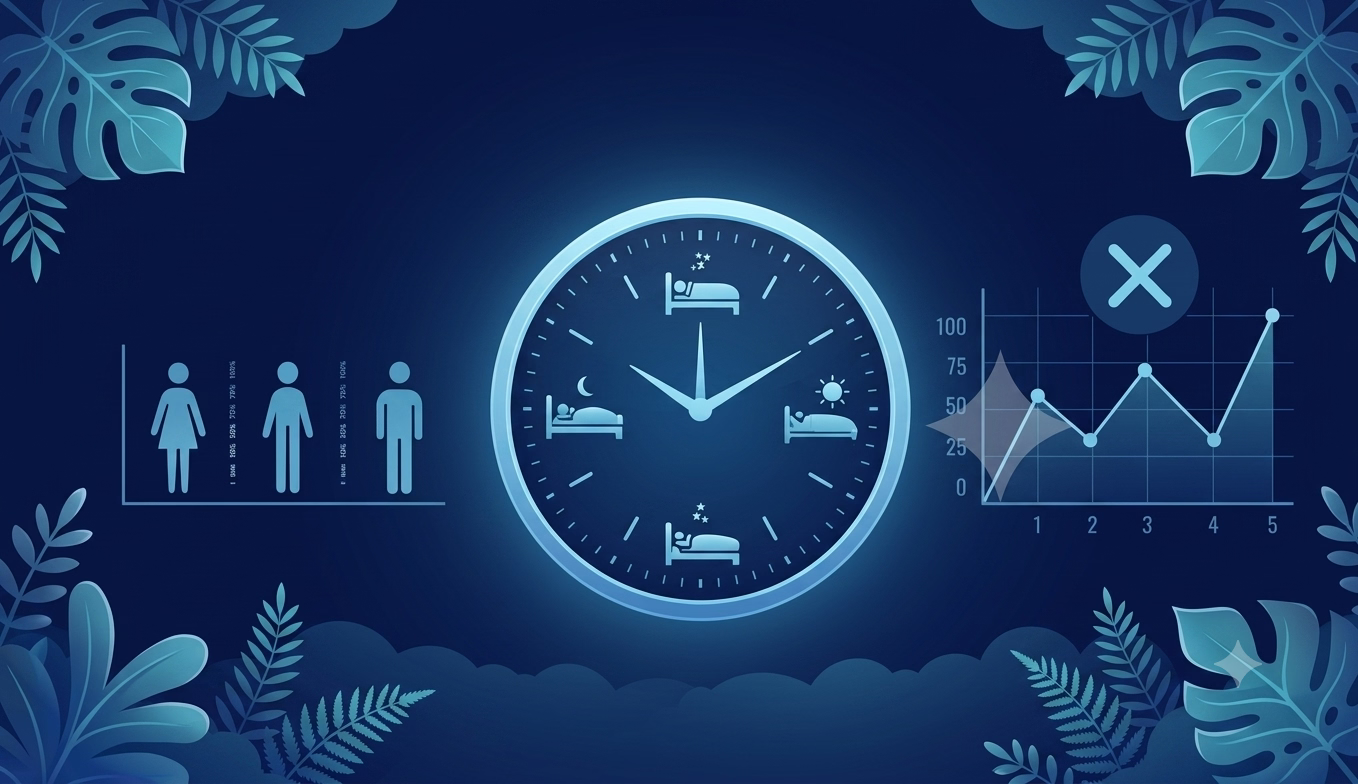
Your sleep is made up of different cycles, phases, and stages. One of the stages is your deepest level of sleep. It is important for memory, bodily repair, the immune system, detoxification, and more. You can get more deep sleep by making specific lifestyle changes and building a solid sleep routine.
If sleep were a staircase down, deep sleep is the stage where you reach the cellar or basement. It’s your deepest sleep stage. It’s the stage when you’re hardest to wake and when your body and brain are undergoing a restoration of sorts.
“While sleep is the most restorative thing you can do for your brain, deep sleep is the most restorative part of sleep altogether,” says Alex Dimitriu, MD, a physician double board-certified in psychiatry and sleep medicine and founder of Menlo Park Psychiatry & Sleep Medicine.
Sounds blissful, right? You get to shut out the rest of the world while your body rests and repairs. But you’re not in this stage during your entire sleep session. Instead, you will climb into and out of this deep stage several times per night.
“For most adults about 10% to 25% of your total sleep time should be in deep sleep, and this number diminishes as we get older,” Dr. Dimitriu says.
In this article, we explore what deep sleep is, why it matters, how to increase deep sleep, and whether you should pay attention to your deep sleep numbers on wearables and trackers. Plus, we offer you a BetterSleep routine checklist for the 90, 60, and 30 minutes before you drift off.
What Is Deep Sleep?
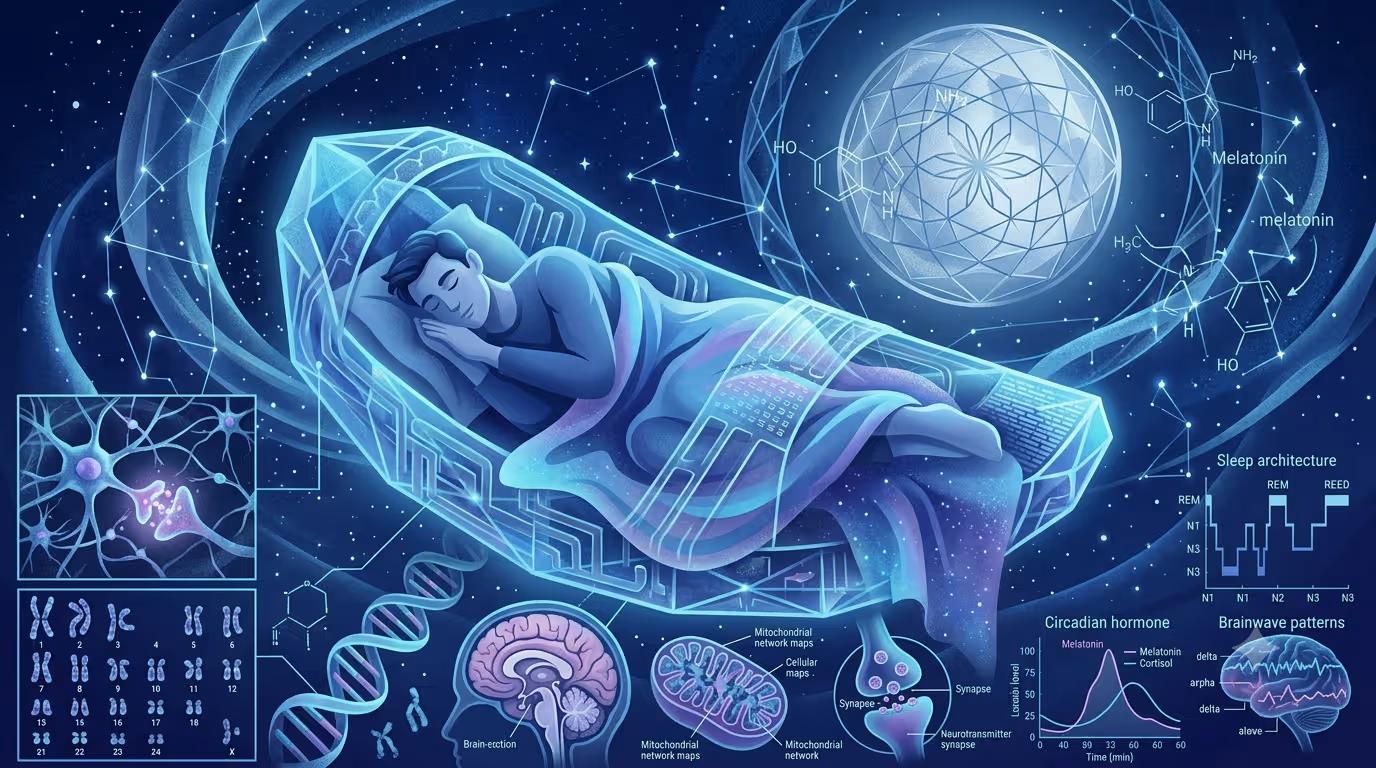
Deep sleep is when you’re in your deepest sleep stage. This is called NREM 3, which stands for your third stage of non-rapid-eye movement sleep. To understand this further, we have to explain what sleep architecture is.
Experts recommend that sleep time last seven to nine hours for adults. But all those sleep minutes are not the same. Your sleep has structure to it, called sleep architecture. It includes cycles and stages.
Sleep architecture
- Sleep cycles: We go through four to six sleep cycles per night, each with two phases.
- Sleep phases: The two sleep phases include non-rapid eye movement (NREM) and rapid eye movement (REM), with four stages across the two.
- Sleep stages: The four stages consist of three NREM and one REM, making up various percentages of your total sleep time.
- NREM 1: ~5%
- NREM 2: ~45%
- NREM 3: ~25%
- REM: ~25%
- Sleep stages: The four stages consist of three NREM and one REM, making up various percentages of your total sleep time.
- Sleep phases: The two sleep phases include non-rapid eye movement (NREM) and rapid eye movement (REM), with four stages across the two.
NREM 3 is your deepest sleep stage. Ideally, you’ll visit it four to six times per night. The exact number of times depends on how long you tend to sleep and other factors.
The importance of deep sleep
During NREM 3, your brain and body get a chance to rest and recuperate through several processes. To do this, your heart, breath rate, and brainwaves slow. And if anyone were to try to wake you, they might have a bit of trouble. When they finally succeed, you might feel groggy.
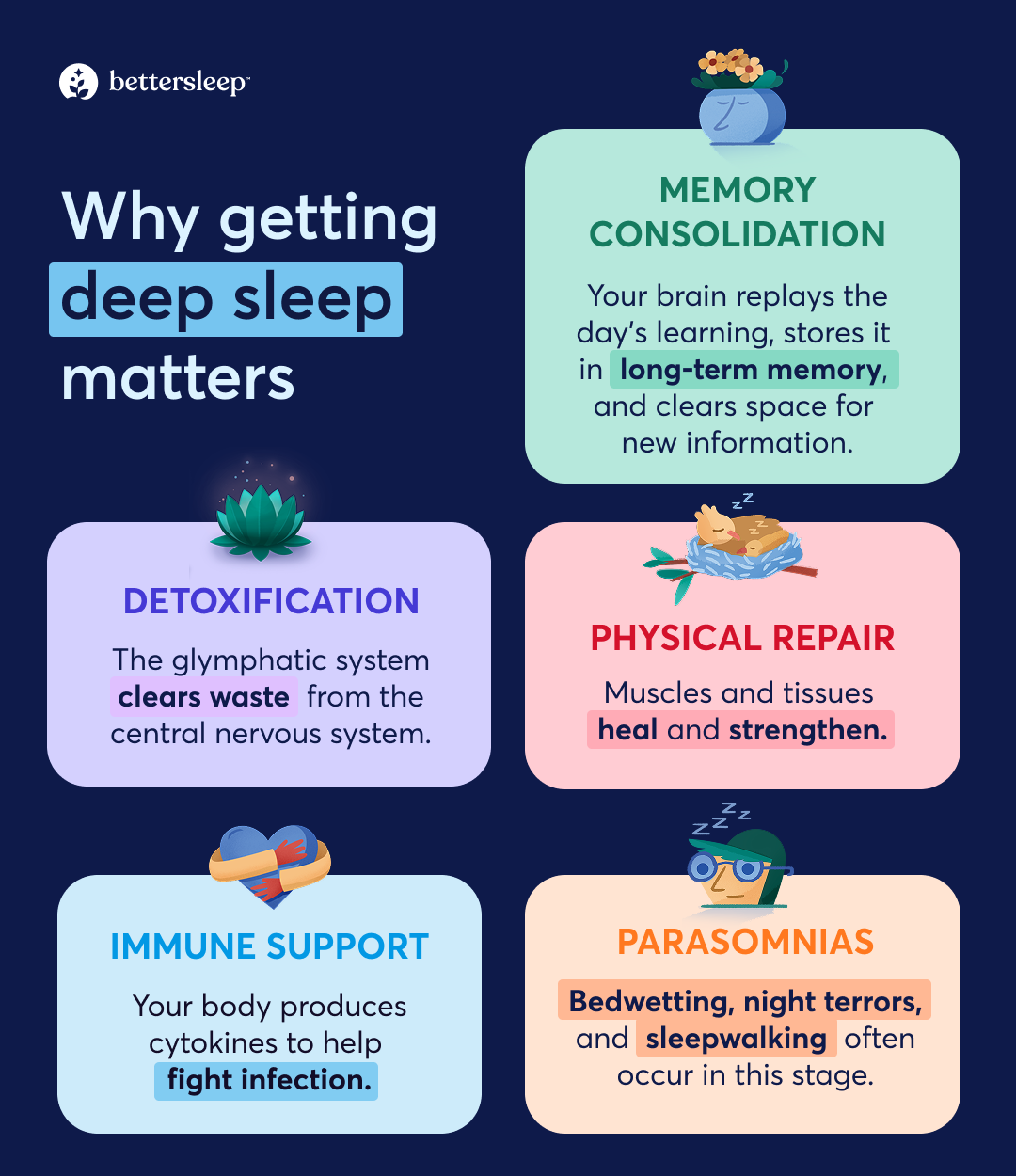
The following occur during deep sleep:
- Daily playback: Your brain replays what you learned during the day. It then places the knowledge in your long-term memory. Your brain also makes room for new info.
- Physical repair: Your body uses NREM 3 to recover and heal. Got sore muscles from raking leaves? Deep sleep repairs you and makes you stronger.
- Immune system support: Your body produces cytokines, some of which have protective effects. Not sleeping enough could reduce these immune substances, which your body needs most when you are sick or under stress.
- Detox support: During deep sleep, your glymphatic system clears waste products from your central nervous system, helping to stave off neurodegenerative diseases.
- Bedwetting, night terrors, and sleepwalking: These issues typically occur during NREM 3. Bedwetting might happen if your full bladder doesn’t wake you up. And night terrors might occur from an abrupt interruption of deep sleep.
Deep sleep vs. REM
Deep sleep is different from REM sleep. REM is your fourth sleep stage. It is typically when you dream, but it is not necessarily a restful stage. Your eyes move rapidly. But researchers aren’t sure why. They think it has to do with visual memory consolidation and aiding our understanding of visual information.
Core sleep vs. deep sleep
“Core sleep” is not a medical or scientific term regarding sleep architecture. Instead, Apple’s sleep tracking functionality uses the term to lump together the lighter stages of sleep: NREM 1 and NREM 2.
How Much Deep Sleep Do You Need?
“Genetics, age, and lifestyle factors play a role in the amount of deep sleep a person needs,” says Chelsie Rohrscheib, PhD, a neuroscientist and sleep expert and the head of sleep research at Wesper.
NREM 3 generally accounts for about 25% of your sleep. How much time you spend in deep sleep will depend on your sleep total and the quality of it. Plus, as you age, you may spend less time in deep sleep, say 15% to 20%.
You will get most of your deep sleep in your first two sleep cycles. The time you spend in this stage decreases with each additional cycle, though.
In the last two to three hours closest to when you wake up, you may no longer reach NREM 3. You will spend more time in REM and the other NREM stages of lighter sleep.
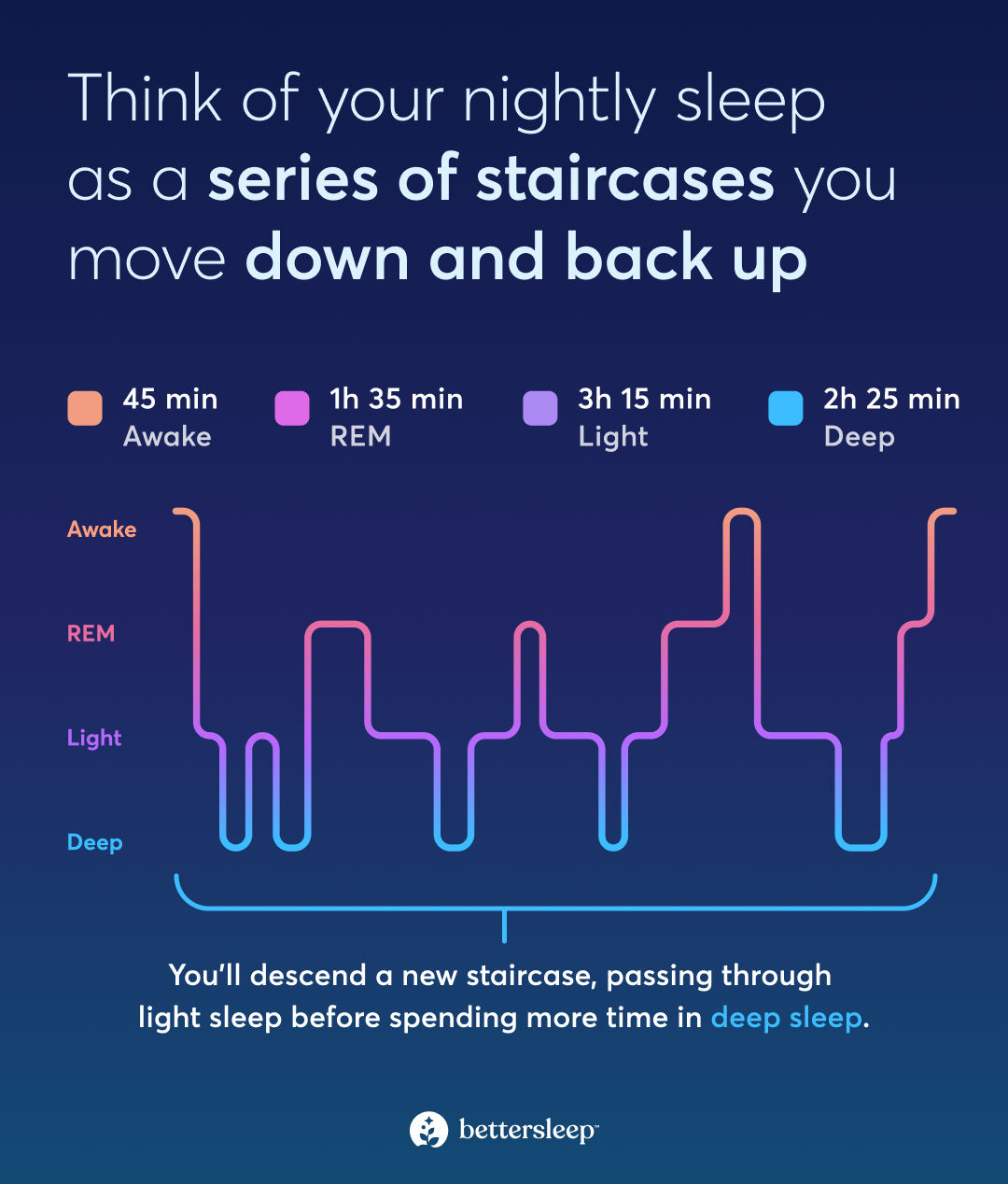
Think of your sleep over the course of a night as a series of staircases that you descend and climb:
- When you first go to sleep, you descend down the stairs through the earlier stages of sleep, and into deep sleep rather quickly.
- Then you spend time in your deep sleep basement before climbing up a new staircase that features a landing of sorts.
- Think of this landing as your REM sleep. You’ll hang out here for a short time during your first sleep cycle.
- Then you’ll descend a new staircase, pausing in the lighter sleep stages before spending some additional time in deep sleep.
Then you’ll climb to your REM landing again. This time you’ll spend more time in REM than you did previously.
- With each subsequent descent, you’ll spend less time in NREM 3. And with each subsequent climb, you’ll spend more time in REM.
- Finally, in those last sleep cycles, you’ll spend very little to no time in NREM 3. You will hang out in REM and your lighter sleep stages. These help you transition to waking.
Levers that Boost Nighttime Deep Sleep
You may be wondering how to get more deep sleep. When you nod off for the night, your sleep quality is out of your control. If you want to have influence over your sleep, you can exert your control during your awake hours. When you’re awake, you’re the captain of your ship. The levers you pull in your captain’s chair affect your overall sleep quality, not just deep sleep.
Light timing
Lever: Get natural bright light exposure in the morning as soon as possible. Then in the evening, dim your lights in preparation for sleep.
Why pull it? Cues from light and darkness help fine-tune your suprachiasmatic nucleus (SCN), your body’s master clock. Your master clock controls your circadian rhythm, aka your sleep-wake cycle.
Getting bright light in the morning helps to sync your master clock for the rest of the day. Your master clock impacts everything from your appetite to your hormones. Darkness also affects your circadian rhythm. As daylight fades to darkness, your body releases melatonin, the “sleep hormone” to help prepare you for sleep.
Exercise timing
Lever: Get at least 20 minutes of physical activity daily. But avoid vigorous activity within two hours of bedtime.
Why pull it? Exercise is beneficial for overall health. But it is particularly important for sleep. Exercise increases how much melatonin you produce. It also reduces stress. Stress can make falling or staying asleep difficult.
Physical activity also boosts mood, which can then motivate you to continue incorporating it into your days. The healthy habit then helps you improve sleep over time. Finally, exercise helps regulate body temperature. Exercise increases body temperature, then it drops after, which is important for sleep.
Research is mixed on whether vigorous exercise too close to bedtime disrupts sleep. Some research suggests avoiding high-intensity activity within two hours of slumber. Other studies say it has no effect, except for perhaps people who already have insomnia.
Meal timing
Lever: Avoid eating too close to bedtime, especially within one hour of going to sleep. But you may wish to have an even longer window of time, ranging from four to six hours.
Why pull it? Eating within one hour of bedtime increases the likelihood that you’ll wake during the night. Meals near bedtime might also cause heartburn or lead you to need to use the bathroom. These issues could disrupt any portion of your sleep, including deep sleep.
Eating close to bedtime may also lead to shorter or longer sleep times that fall outside of the recommended window of seven to nine hours. Sleeping beyond nine hours can have negative health consequences.
Caffeine timing
Lever: Avoid caffeine within six hours of sleep.
Why pull it? The average half-life of caffeine is about five hours. This means that you need this amount of time for your body to process and eliminate half of the caffeine in your system. Research shows that caffeine consumed within six hours of bedtime disrupts sleep.
Some people have a shorter or longer half-life of caffeine, depending on personal factors affecting caffeine metabolism. So you may need a longer buffer before sleep if you tend to be more sensitive to this stimulant.
Alcohol timing
Lever: Avoid alcohol altogether or limit it, and don’t drink too close to bedtime.
Why pull it? Alcohol disrupts your sleep architecture. If you drink, avoid overindulgence, and include a good window between any drinking and bedtime.
Tech timing
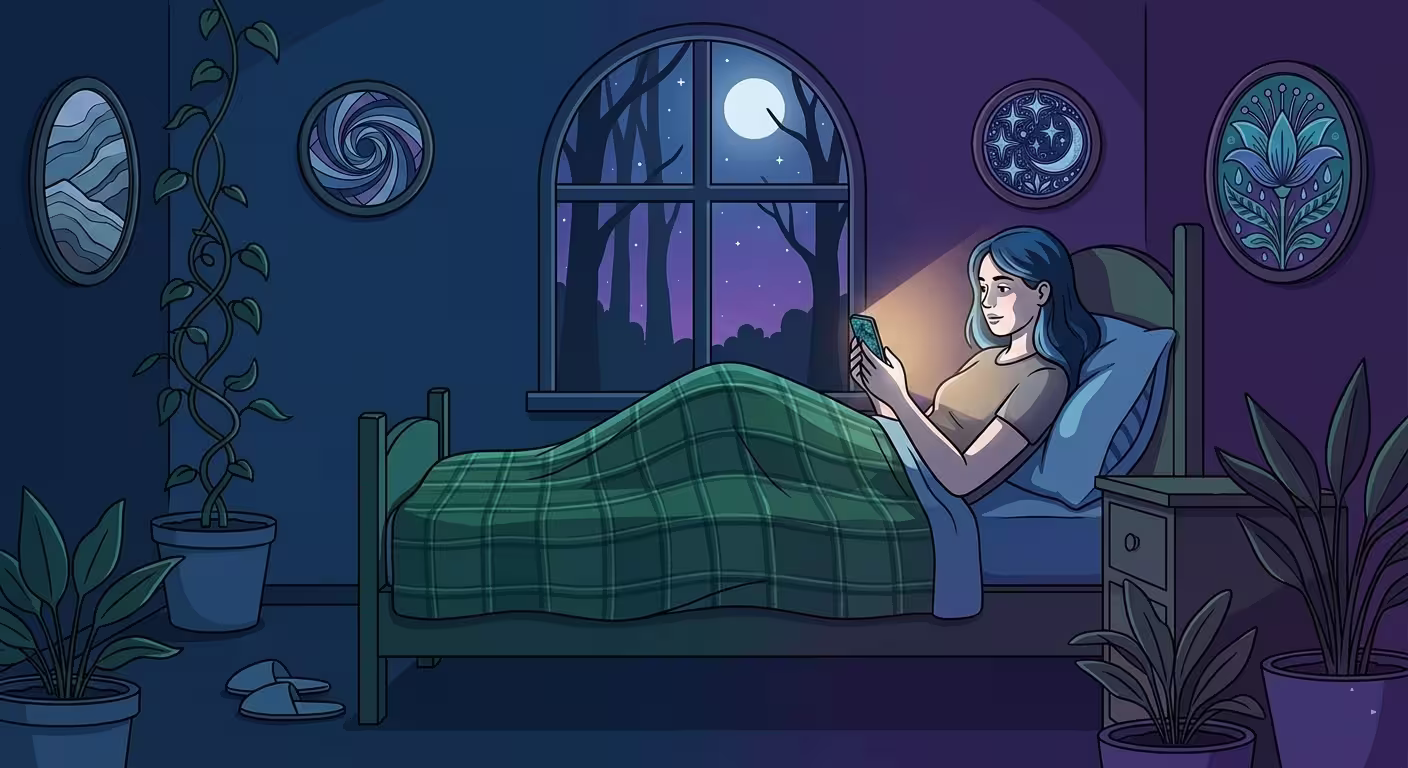
Lever: Avoid screens too close to bedtime.
Why pull it? Studies show that blue light from electronic devices, especially smartphones, tablets, and TVs, can decrease deep sleep. This is because blue light exposure at night can delay your melatonin production. “I advise all my patients to stop using electronic devices at least one hour before falling asleep,” Dr. Dimitriu says.
Stress mitigation
Lever: Find ways to reduce stress, through meditation, exercise, breathwork and more.
Why pull it? Ongoing stress is called chronic stress. This type of stress dysregulates cortisol, the “stress hormone.” Your body naturally produces cortisol before and as you are waking up to get you going for the day. Then cortisol generally decreases throughout the day and is at its lowest at night. If cortisol remains high, it can disrupt melatonin production. By mitigating stress, you help your body stick to your natural sleep-wake cycle.
An Evening Routine that Works
Your evening routine can help make all the difference in helping you fall and stay asleep. “Slowing down before sleep can have a positive effect on deep sleep,” Dr. Dimitriu says.
Here’s a checklist with links to some BetterSleep features that can help you get a good night’s rest.
About 90 minutes before sleep:
- Dim your lights.
- Set your home temperature to 66 to 70 degrees Fahrenheit.
- Avoid any intense tasks or workouts.
- Write down your to-do list or any reminders to prevent ruminating on them.
About 60 minutes before sleep:
- Take a warm shower or bath, to relax and aid with eventual cooldown for sleep.
- Put on your pajamas or whatever you sleep in.
- Put screens away to avoid blue light exposure.
- Get into bed.
- Read or journal.
About 30 minutes before sleep:
- Turn on your BetterSleep white or pink noise.
- Ensure your room is completely dark.
- Try the BetterSleep breathwork, meditation, or deep sleep delta waves features.
- Try cognitive shuffling if your mind races.

Tech and Tracking
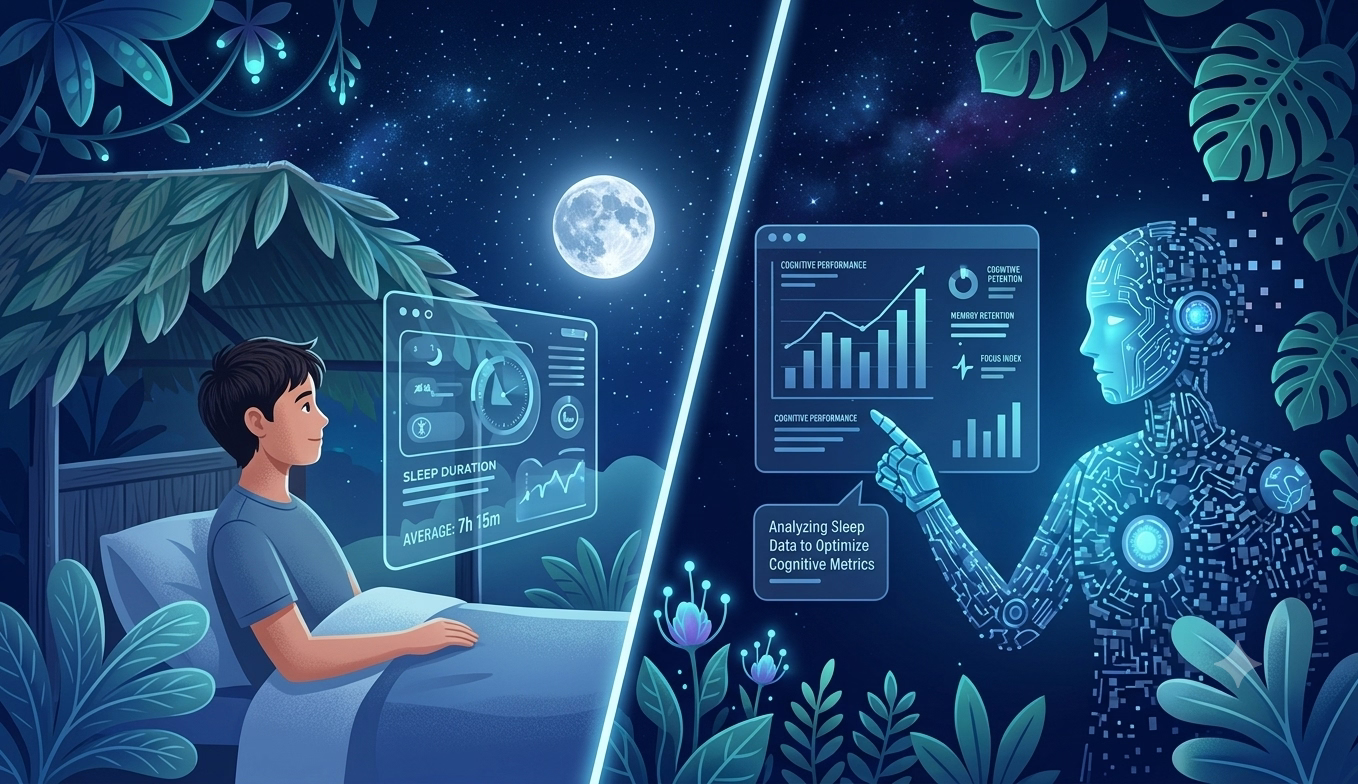
Maybe you’re monitoring your overall sleep and sleep architecture with a wearable or other tracker. You may be wondering how much stock you should put into the numbers. For example, if you’re not spending 25% of your sleep time in deep sleep, should you worry?
Trackers can be helpful for making sure you are getting enough sleep. They tend to show 95% sensitivity in detecting your sleep vs. awake time. But they are less accurate when considering your sleep architecture, with a sensitivity range from 50% to 86%.
Don’t worry too much about spending exactly 25% of your sleep time in NREM 3. Orthosomnia is a term used to describe when someone becomes overly obsessive about having perfect sleep metrics on their wearables or trackers.
“Orthosomnia is a real thing, and many people can get overly stressed out by biometric devices,” Dr. Dimitriu says. “So don't stress out, but do focus on getting enough sleep in the right environment.”
Dr. Rohrscheib agrees and recommends going by feel. “If you’re healthy and feel well rested, then no, you do not need to worry about whether or not your sleep tracker says you're getting enough deep sleep,” she says. “On the other hand, if you feel chronically unrested and your sleep tracker says you're not getting enough deep sleep, it’s probably worth evaluating your sleep hygiene and speaking to your doctor.”
When To Seek Care
If you are concerned about not getting enough sleep or enough deep sleep, you should talk to your healthcare provider. Talk to a doctor if you experience any of the following:
- You regularly wake up feeling groggy or foggy and the sensation persists.
- You experience significant daytime sleepiness or you randomly fall asleep.
- You have chronic insomnia that lasts three months or longer.
- You wake up frequently during the night.
- You or your bed partner notice that you stop breathing, or snore, gasp, or choke during sleep. These are potential signs of sleep apnea.
“If you are chronically sleep deprived due to an underlying sleep disorder like insomnia or sleep apnea, it’s crucial to see a sleep specialist for a full evaluation,” Dr. Rohrscheib says. “Additionally, other health conditions such as autoimmune diseases, nervous system disorders, chronic pain conditions, and mental health issues can also reduce deep sleep time.”
Working with your provider to treat and manage these conditions can help boost your time spent in NREM 3.
The Bottom Line
Adequate deep sleep is crucial for your body and brain to rest and recover each day. The stage of sleep that is your deepest is called NREM 3. You move in and out of NREM 3 several times per night, but deep sleep typically accounts for about a quarter of your total sleep time.
To help increase deep sleep, you can try the tips in this article. But don’t worry too much if you aren’t hitting an exact number on your sleep tracker. How you feel matters more than the numbers on your wearable.
Key Takeaways
- Deep sleep is also called NREM 3. It’s your deepest sleep stage, and you will cycle through it several times each night.
- The average person spends about 25% of their total sleep time in deep sleep, but your exact numbers may vary, and time in deep sleep tends to decrease with age.
- You can improve your overall sleep and your deep sleep with the BetterSleep tips in this article.
Frequently Asked Questions (FAQs)
Why is my deep sleep so low?
Your deep sleep might be low for several reasons. But it may not actually be low. Deep sleep accounts for only about 15% to 25% of your total sleep time, but your number may vary. If your deep sleep is truly low, some factors may be disrupting your sleep architecture, or structure. Examples include consuming caffeine, alcohol, or food too close to bedtime. Additionally, blue light from screens before bed can also disrupt your sleep.
Is there a way to increase deep sleep?
In general, you can take steps to improve the quality of your sleep, which will likely increase your deep sleep. For example, get regular exercise and get natural light exposure in the morning. Then keep your bedroom dark at night. Sticking to a sleep routine can also help improve your deep sleep.
What is the 10-3-2-1-0 rule for sleep?
The 10-3-2-1-0 rule of sleep is a method for remembering what activities to cut out too close to bedtime. Avoid caffeine 10 hours prior to bed. Avoid drinking alcohol or eating three hours before. Stop working two hours prior. Turn off screens one hour before. Finally, hit the snooze button zero times in the morning.
Is 40 minutes of deep sleep a night enough?
In general, 40 minutes of deep sleep time is likely not enough. Most adults need at least 60 to 100 minutes or more. But if you are using a sleep wearable or other type of tracker, it may not be that accurate in detecting which sleep stage you are in. So your numbers may not be correct.
How to get 100% deep sleep?
Getting 100% of deep sleep is impossible. Your body naturally cycles in and out of your deepest sleep stage several times per night. Generally, deep sleep only accounts for about 25% or less of your total sleep time.